
Learn
What Is Electroculture? A Plain-English Definition
What is electroculture? It is the attempt to grow better crops with electricity, either from powered wires and seed treatments or from passive copper antennas said to tap the air's natural charge.
On this page
Electroculture covers a wide family of methods with one shared hope: that electricity, applied to plants, seeds or soil, can make them grow faster or yield more. Some of those methods are powered and measurable. Others, including most of what home gardeners buy today, are passive devices whose effect has not been confirmed in controlled trials. Knowing which is which is the first step to judging any claim you read.
Key takeaways
- The USDA's 1926 bulletin, titled simply "Electroculture", describes the method it tested as wire networks over crops charged to roughly 30,000-60,000 volts.
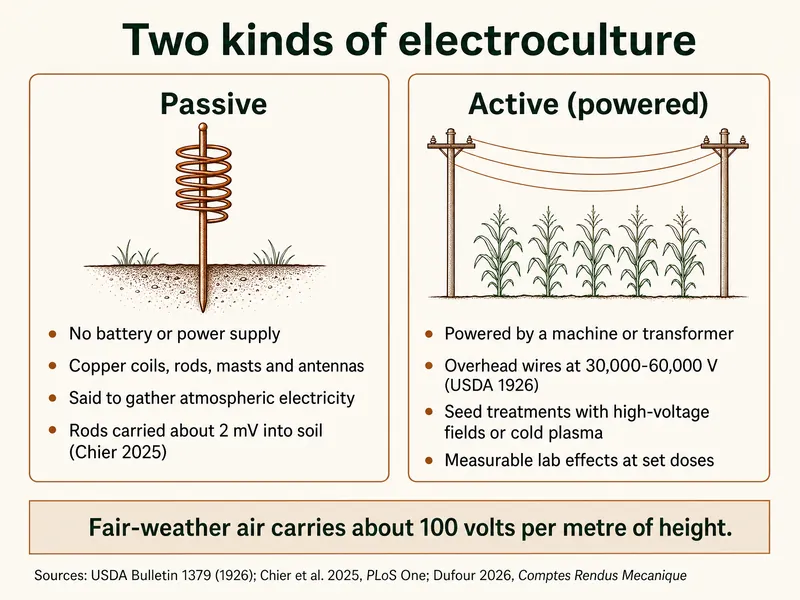
- Fair-weather air carries a natural electric field of about 100 volts per metre of height, the USDA bulletin notes on page 2; that field is the energy passive antennas are said to collect.
- In a controlled, peer-reviewed 2025 trial, passive copper rods carried only about 2 millivolts into potting soil (Chier et al., PLoS One).
- Abbé Bertholon's 1783 "electro-vegetometer", a pointed collector on an insulated mast, is the first technically described electroculture device, according to Dufour 2026.
- Powered seed treatments with high-voltage fields or cold plasma do produce dose-dependent lab effects, but Dufour writes that electroculture "did not directly evolve into or compete with plasma-based technologies".
- Earth batteries, buried pairs of copper and zinc plates, are a third type; Iowa's 1937 trials found one significant oat gain on poor soil that did not repeat.
Electroculture in four numbers
- 1783Year Bertholon described his pointed electro-vegetometerDufour 2026, Comptes Rendus Mécanique
- 30,000–60,000 VVoltage on the USDA's overhead wires, 1907–1918USDA Bulletin 1379 (1926)
- 100 V/mTypical fair-weather electric field near the groundChier et al. 2025, PLoS One
- 2 mVVoltage copper-coiled rods carried into the soilChier et al. 2025, PLoS One
What is electroculture, in one sentence?
Electroculture is the use of electricity, or of devices claimed to gather it, to stimulate plant growth. The definition is broad on purpose, because the label has covered very different things over 280 years: a frictional machine wired to a myrtle tree in 1746, high-voltage networks over Virginia wheat fields in the 1910s, and a copper coil pushed into a raised bed today.
What unites them is the method's promise rather than its physics. Some versions deliver thousands of volts at a measured current; the passive versions deliver almost nothing, as the measurements below show. That gap matters when you read that "electroculture works": the question is always which electroculture, and at what level of evidence. Our page on whether electroculture works takes that question on directly.
How is electroculture supposed to work?
Electroculture is supposed to work by bringing electric charge into contact with plants or the soil around their roots. The starting point is real: on fine days the atmosphere has a potential gradient "of the order of 100 volts per meter", in the words of USDA Bulletin 1379, and a small current of charge flows continuously from the air to the ground.
Promoters argue that a tall metal point or a copper coil concentrates that natural field and channels it into the soil, where it is said to speed nutrient uptake, warm the soil or stimulate roots. Justin Christofleau's 1920s booklet went further, claiming his mast collected atmospheric electricity, "telluric currents" and energy from sun, rain and frost; these are promotional claims, and the booklet gives no measurement of any current.
The measured numbers are modest. Chier and colleagues calculated that a 40 cm copper rod spans only about 4 volts of the natural gradient, and recorded roughly 2 millivolts reaching the soil. Thierry Dufour's 2026 model of Bertholon's mast found the field concentrated near the tips but falling back to ambient "within a few cm". Read more about the underlying physics on atmospheric electricity and plants.
What is the difference between passive and active electroculture?
Passive electroculture uses no power source, while active electroculture applies electricity from a machine, battery or transformer. The distinction decides almost everything about the evidence, so it is worth keeping clear.
| Type | How it works | Example | What was found | Evidence level |
|---|---|---|---|---|
| Passive antenna or collector | Metal point, coil or mast in the open air, no power | Bertholon's 1783 mast; Christofleau's apparatus; modern copper coils | Iowa 1930-1932: collector plots within experimental error; Chier 2025: no consistent benefit | Controlled government or station trial; controlled, peer-reviewed |
| Overhead discharge (active) | Wires over the crop charged to tens of thousands of volts | Lemström's networks; USDA Arlington trials 1911-1918 | USDA: no well-defined increase; British trials averaged +14% with soil confounds | Controlled government or station trial |
| Earth battery | Buried copper and zinc plates joined by a wire | Hull's hemp boxes (1898); Iowa earth cells (1931-1933) | Iowa 1932, poor greenhouse soil: oat grain +9.9% with earth cells, +16.2% with dry-cell-boosted cells (significant); no grain gain in 1933 | Controlled government or station trial |
| Powered seed treatment | Seeds exposed to a high-voltage field or cold plasma for seconds or minutes | Sun et al. 2024, chili seed; plasma-activated water | Germination and disease effects in the lab, dose-dependent | Controlled, peer-reviewed |
Passive methods are what most gardeners mean today. Active overhead discharge was the serious research programme of 1900-1925 and needs dangerous voltages. Powered seed treatment is a separate modern field covered on electric fields and plant growth and plasma agriculture; its results should not be borrowed to support copper stakes, because a stake produces none of the ozone, reactive chemistry or ultraviolet light that drive them.
What is electroculture gardening at home?
Electroculture gardening at home almost always means placing passive copper antennas among vegetables or flowers. Typical designs include copper wire wound around a wooden stake, a factory-made copper coil, or a decorative copper shape; some gardeners also run bare copper wire between stakes along a bed. The electroculture antennas guide compares the common types.
Many gardeners report greener, bigger plants after installing antennas. Those reports are anecdotes: they rarely include an untreated comparison plot, and the 2025 PLoS One trial that did use one found height and leaf greenness unchanged in four crops. If you want to try it, the honest version is a side-by-side trial, explained step by step in how to test electroculture.
Where does the word electroculture come from?
The word electroculture joins "electro" and "culture" in the agricultural sense of cultivation, and by the early 20th century it named the whole field. Earlier writers used other labels: George S. Hull titled his 1898 book Electro-Horticulture, and Selim Lemström's 1904 English book was called Electricity in Agriculture and Horticulture.
By 1926 the USDA used "Electroculture" as the title of Department Bulletin 1379, and the English edition of Christofleau's booklet, printed in Perth around 1927, carried the same one-word title. That booklet also mentions a "First Congress of Electroculture" held at Rheims in 1912, as printed there. For how the idea spread from 18th-century France to modern garden centres, see electroculture history.
What electroculture is not
Electroculture is not a way to replace fertiliser, irrigation or pest control, whatever some product listings imply. The USDA measured water use directly and found cowpeas under a charged screen used about 4% more water than controls, not less. Christofleau's booklet claimed fertiliser and even rain became unnecessary, yet the same booklet advised manuring in the first year.
It is also not the same thing as plasma agriculture, magnetoculture and magnetic seed treatment, or the lightning that greens a lawn after a storm. WSU Extension explains that lightning "fixes atmospheric nitrogen into a solid form (nitrate)", a chemical effect that copper antennas do not reproduce. Electroculture devices sold as health products, such as grounding mats or "energised" water, fall outside the plant evidence entirely; this library does not cover them.
How we put this page together
Our definition follows how the term is used in the original sources: the government bulletins from Washington (1926) and Ames, Iowa (1937), the books by Hull and Christofleau, the Marquette pot trial, Thierry Dufour's two papers, a 2024 chili-seed study in Scientific Reports and WSU Extension's 2024 article. All were rechecked in October 2026. Left out: definitions from product listings and blogs, and health claims attached to electroculture devices.
Common questions
Is electroculture the same as using a Tesla coil on plants?
No. A real Tesla coil is a powered high-voltage transformer, while the "Tesla coil" antennas sold for gardens are unpowered copper spirals that take the name from their shape. The garden version is passive electroculture; see the Tesla Coil antenna page for what the name means there.
Does electroculture use batteries?
Most home electroculture does not. Historical earth batteries made a tiny current from buried copper and zinc plates, and Iowa's 1932 tests boosted some with dry cells, but modern copper antennas have no battery at all.
What is a passive electroculture antenna made of?
Usually copper wire or rod, sometimes wound around wood. Christofleau's 1920s apparatus was different: a metal head on a post about 20 feet above ground, with a galvanised iron wire buried toward magnetic north.
Is electroculture a recognised science?
Plant electrophysiology and powered seed treatments are recognised research fields with peer-reviewed results. Passive electroculture antennas are not: the USDA declined to recommend electroculture in 1926, and Marquette's 2025 pot experiment saw no steady advantage from copper.
What does electroculture claim to do for plants?
Promoters claim faster growth, bigger harvests, better pest resistance and lower water and fertiliser needs. These remain claims. The controlled trials on this site mostly found no effect or effects within experimental error; the exceptions were small and did not hold up, such as Iowa's significant 1932 earth-cell oat gain that failed to repeat in 1933, and the 2025 trial's 2.5 g biomass gain in buried-copper beets and turnips, which its authors attributed to small samples.
How old is the idea of electroculture?
Hull's 1898 book dates the first plant experiment to 1746, when Dr. Maimbray of Edinburgh electrified two young myrtle trees. Bertholon's 1783 book on electricity and plants gave the first detailed device.
Keep reading


More help: see our guide to electroculture gardening.