
History
Lakhovsky Coil and the Multiple Wave Oscillator
A Lakhovsky coil is an open copper ring placed around a plant, copied from a single 1925 geranium experiment by Georges Lakhovsky; no controlled trial of the ring on garden plants has been published.
On this page
Key takeaways
- Georges Lakhovsky (died 1942) was a Paris-based inventor and writer; the Library of Congress name record gives his dates as 1870–1942.
- In 1924 he and three co-authors, A. Gosset, A. Gutmann and J. Magrou, exposed geraniums with bacterial crown-gall tumours to a 2-metre-wavelength oscillator and reported the tumours died back.
- In January 1925 he hung a 30 cm open copper spiral, its ends not joined, around one inoculated geranium; that single plant is the origin of the garden "Lakhovsky coil".
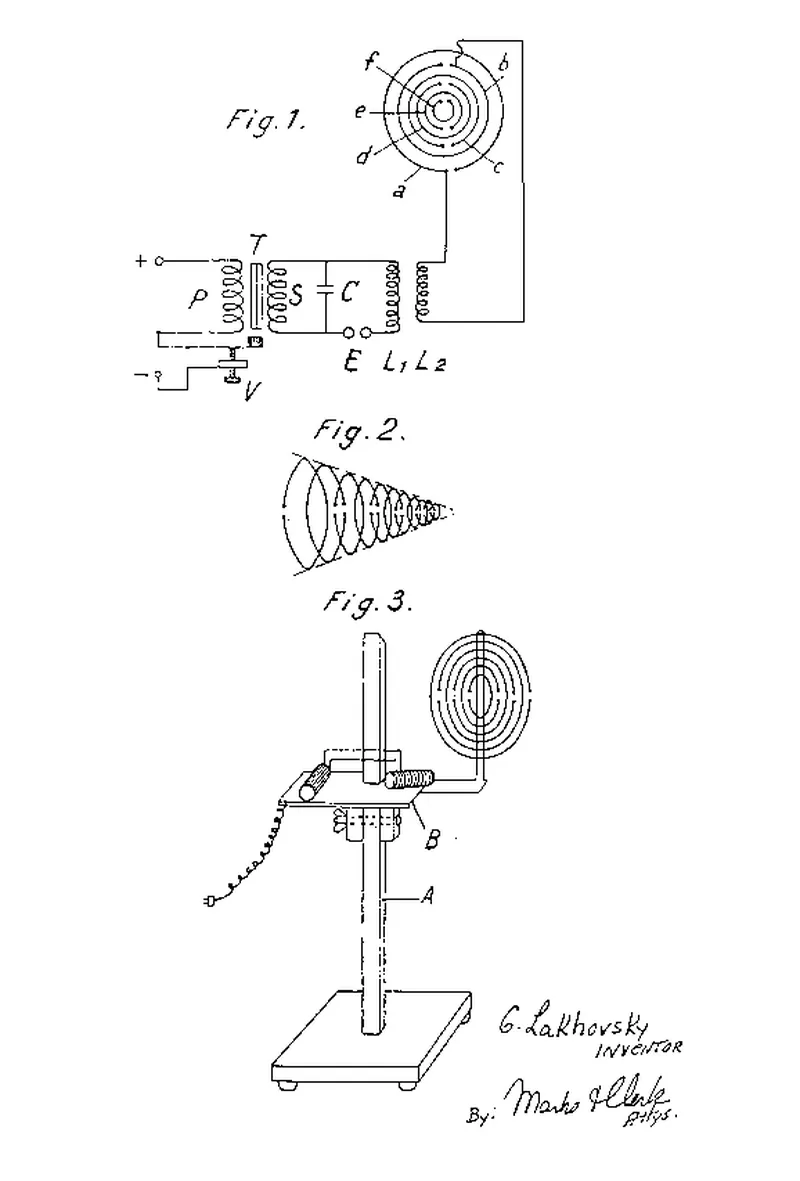
- His multiple wave oscillator, patented in the US as No. 1,962,565 in 1934, is a powered high-frequency generator feeding concentric open rings; the patent itself makes no plant or medical claims.
- Lakhovsky also claimed his rings and oscillators treated human disease, including cancer; those are his claims, with no controlled clinical evidence behind them.
- The one controlled study of passive copper in vegetable pots, Chier et al. 2025, tested coiled rods rather than rings and found no consistent benefit.
What is a Lakhovsky coil?
A Lakhovsky coil, in gardening, is a loop of bare copper wire bent into an open circle and set around a plant or tree trunk, with the two ends left apart so the circuit is not closed. Gardeners use it on Lakhovsky's own reasoning, that an open ring gathers natural radiation and passes it to the plant. The idea comes from one experiment Lakhovsky described in his book The Secret of Life, not from any field trial.
It is a different object from the coil-on-a-stake electroculture antenna, which is a helix of copper wound on a dowel and pushed into the soil. The ring has no stake and no connection to the ground; its only distinguishing feature is the gap. For how the two designs compare, see electroculture antenna designs.
Who was Georges Lakhovsky?
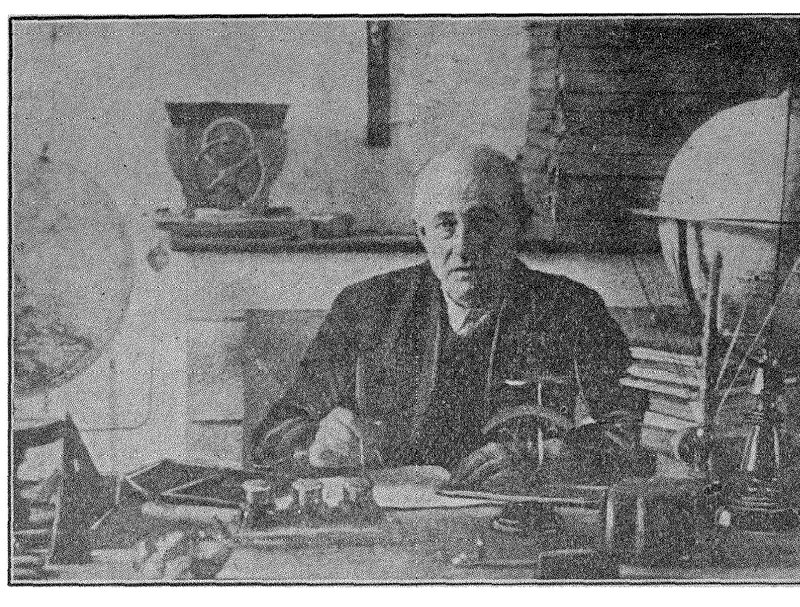
Georges Lakhovsky was an inventor and author working in Paris in the 1920s and 1930s, who developed a theory that living cells behave like tiny electrical oscillating circuits. His US patent of 1934 gives his address simply as "Georges Lakhovsky, Paris, France". He published books in French and, in 1939, an English translation by Mark Clement of The Secret of Life (London, Heinemann), and he died in 1942.
His central idea was that health depends on cells vibrating in tune, and that disease follows when that balance is disturbed. In The Secret of Life he argued that an outside oscillating circuit could restore it, and he extended the claim from plants to people, including cancer patients. This page reports those claims only as his; it gives no health advice, and no controlled clinical trial supporting them appears in any source we reviewed.
What is the multiple wave oscillator?
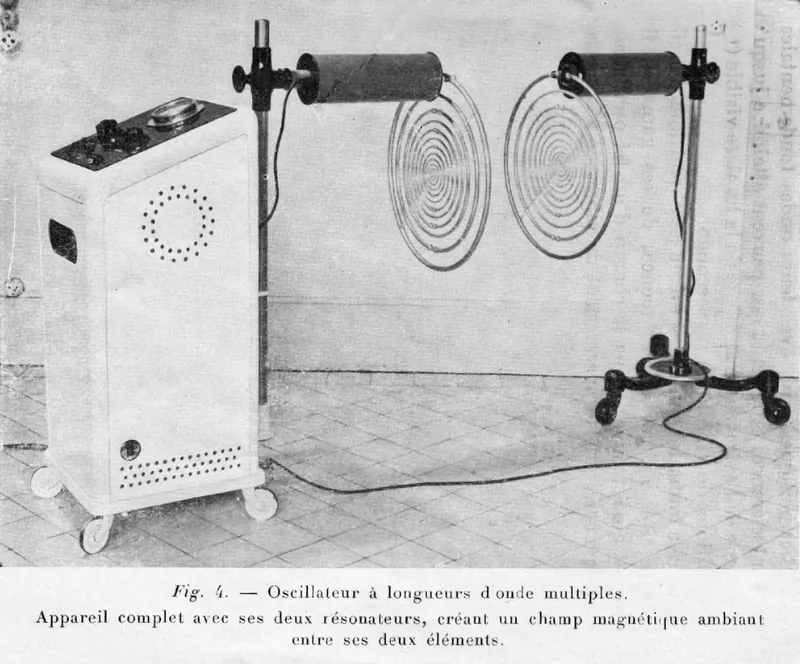
The multiple wave oscillator is a powered high-frequency device that drives a set of concentric, open metal rings of different sizes, so that it emits many wavelengths at once. US Patent 1,962,565, "Apparatus with circuits oscillating under multiple wave lengths", was filed on 13 November 1931 (French priority 2 May 1931) and granted on 12 June 1934. It describes "concentric open rings of different diameters", which "may or may not be terminated by small spheres", fed through a spark gap by a transformer and a high-frequency circuit, and mounted on a stand that slides and tilts.
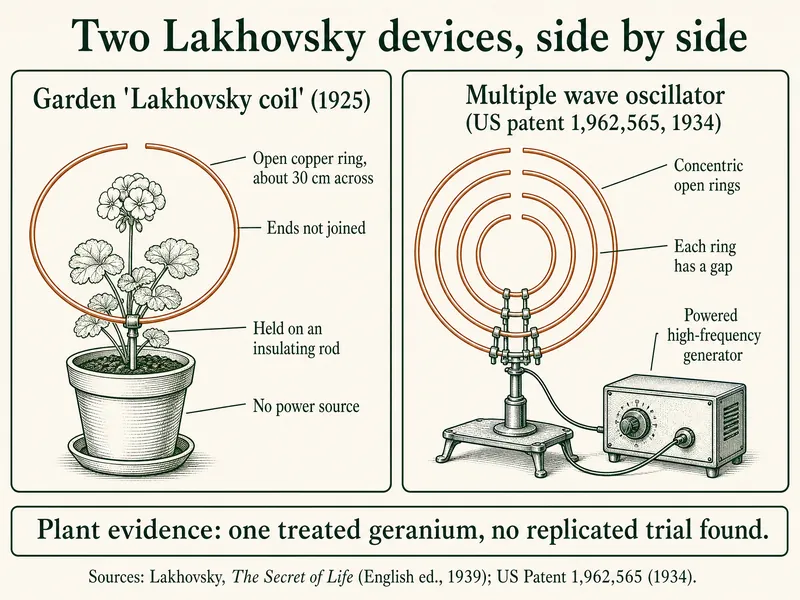
The patent's seven claims describe only the apparatus. They say nothing about plants, cells or disease. A 1937 photograph on Wikimedia Commons shows the complete set: a cabinet generator wired to two ring "resonators" on stands facing each other. A garden ring has none of this: no generator, no spark gap, no power.
How do gardeners use Lakhovsky coils?
Gardeners use Lakhovsky coils by bending copper wire into an open loop and placing it around a single plant, a pot or a tree trunk, usually supported on a small stake so it does not touch the soil. Some make spirals or several nested rings, echoing the oscillator. The practice copies Lakhovsky's January 1925 setup, which he described in The Secret of Life this way:
- The plant. A geranium (Pelargonium) inoculated on 4 December 1924 with the crown-gall bacterium, then called Bacterium tumefaciens.
- The ring. "a circular spiral consisting of copper and measuring 30 cm. in diameter, its two extremities, not joined together", fixed in an ebonite (hard rubber) support.
- The result he reported. By the end of February 1925 the tumour had dried and fallen off; on 23 March 1928 the ringed plant, then 1.40 m tall, was photographed beside two untreated plants. No measurements of the untreated plants are given.
He explained the effect as the copper spiral picking up "external radiations, atmospheric radiations" and absorbing an excess of "cosmic waves". That explanation is his theory and was never measured. Note too what the setup was meant to do: protect a diseased plant, not raise a healthy plant's yield.
What evidence exists for the Lakhovsky coil?
There is no controlled evidence that a Lakhovsky coil helps garden plants. The entire plant record behind the ring is one treated plant photographed beside two untreated plants, no measurements, reported by its inventor, with no repeat. That is an anecdote, however carefully photographed.
The earlier oscillator work had more plants but the same weaknesses. Lakhovsky's 1924 note with A. Gosset, A. Gutmann and J. Magrou, sent to the Société de Biologie and reprinted in his book, describes three treated geraniums against sixteen untreated controls, all inoculated with crown gall; the treated tumours died back after about sixteen days. No dose, blinding or replication by another group is reported, and the device was a powered 150-million-cycle oscillator, not a ring.
Nothing since has filled the gap. The 2025 PLoS One trial tested passive copper-coiled dowels on four vegetables and found no consistent benefit, with the copper carrying only about 2 millivolts into the soil; it did not test rings. Thierry Dufour's 2026 papers on Bertholon's collector and on the history of plasma agriculture do not discuss Lakhovsky at all; our plasma agriculture page covers that field. We found no regulator action against garden rings in a primary government source, and none is reported here.
Lakhovsky's devices in numbers
- 1Geraniums treated with the open copper ring in his 1925 reportLakhovsky, The Secret of Life (1939 English ed.)
- 30 cmDiameter of the copper spiral he describedLakhovsky, The Secret of Life (1939 English ed.)
- 16Untreated control geraniums in the 1924 oscillator noteGosset, Gutmann, Lakhovsky and Magrou, 1924, reprinted in The Secret of Life
- 1934Year US Patent 1,962,565 for the multiple wave oscillator was grantedUS Patent 1,962,565
- 2 mVMillivolts that passive copper rods put into potsChier et al. 2025, PLoS One
| Device | Year | Power | What was claimed | Evidence level |
|---|---|---|---|---|
| Radio-cellulo-oscillator | 1924 | Powered, about 2 m wavelength | Crown-gall tumours on 3 treated geraniums died back | Historical report |
| Open copper spiral around a geranium | 1925 | None | One treated plant photographed beside two untreated plants, no measurements | Promotional claim or anecdote |
| Multiple wave oscillator | Patent filed 1931, granted 1934 | Powered, many wavelengths | Patent claims the apparatus only | Patent record |
| Garden Lakhovsky ring today | Modern | None | Healthier, bigger plants; no study found | Promotional claim or anecdote |
| Passive copper coils on dowels | Tested 2025 | None | Better growth and yield; no consistent benefit found | Controlled, peer-reviewed |
How is a simple Lakhovsky ring made?
A simple Lakhovsky ring is made by bending bare copper wire into a circle with a small gap between the ends and holding it upright or level around a plant on a non-conducting support. To match Lakhovsky's own description, the ring would be about 30 cm across, with its open ends fixed into an insulating rod (he used ebonite; a wooden or plastic stake does the same job) pushed into the pot.
If you try one, treat it as an experiment, not a cure. Ring half of a set of identical plants, leave the other half unringed, keep everything else the same and weigh the harvest; our guide on how to test electroculture sets out a fair layout, and copper wire for electroculture covers the wire itself. For the overall verdict on these ideas, see does electroculture work.
How we put this page together
Sources for this page: Lakhovsky's The Secret of Life (English translation by Mark Clement, London, 1939), including the 1924 Société de Biologie note it reprints; US Patent 1,962,565 (1934) on Google Patents; the Library of Congress name authority record; Chier et al. (2025); and Dufour's 2026 papers, all checked in October 2026. We read the book for what Lakhovsky claimed about plants; his medical claims are named here but not described in detail, and no health guidance is given. Later "multiple wave oscillator" products, forum build guides and sellers' claims were left out.
Common questions
Is a Lakhovsky coil the same as an electroculture antenna?
No. A Lakhovsky ring is an open loop of copper around a plant with no ground connection, while a typical electroculture antenna is a copper helix on a stake pushed into soil. They come from different people and different theories, and neither has controlled evidence of a crop benefit. Decorative copper shapes such as copper butterfly garden stakes are a third design again.
Why must the ends of a Lakhovsky ring not touch?
Lakhovsky treated the ring as an "open" oscillating circuit, like a radio aerial, whose gap set its natural frequency in his theory. No experiment in his book compares an open ring with a closed one, so the importance of the gap is untested.
What size should a Lakhovsky ring be?
The only historical specification is Lakhovsky's own: about 30 cm across around a potted geranium. Larger rings for trees and nested rings are later adaptations with no published comparison behind them.
Did Lakhovsky's ring make the geranium grow taller?
He reported the ringed plant reached 1.40 m by March 1928, more than three years after treatment, and photographed it beside two untreated plants. Without measured controls of the same age and care, that height cannot be credited to the ring.
Does the multiple wave oscillator work on plants?
No controlled plant trial of the oscillator has been published that we could find. The 1924 geranium tests used an earlier single-wavelength oscillator, three treated plants and no repeat by another laboratory.
Is it safe to make a multiple wave oscillator at home?
A homemade oscillator involves high-voltage, high-frequency circuits and spark gaps, which carry real shock and interference risks. This site does not provide build instructions for powered devices.
Where can you read Lakhovsky's own words?
The Secret of Life was published in English in London in 1939 and has since been reprinted. No library-hosted public-domain scan turned up in our searches, so check a library catalogue for a copy.
Related history

More help: see our electroculture gardening.