
Learn
Does Electroculture Work? What the Evidence Shows
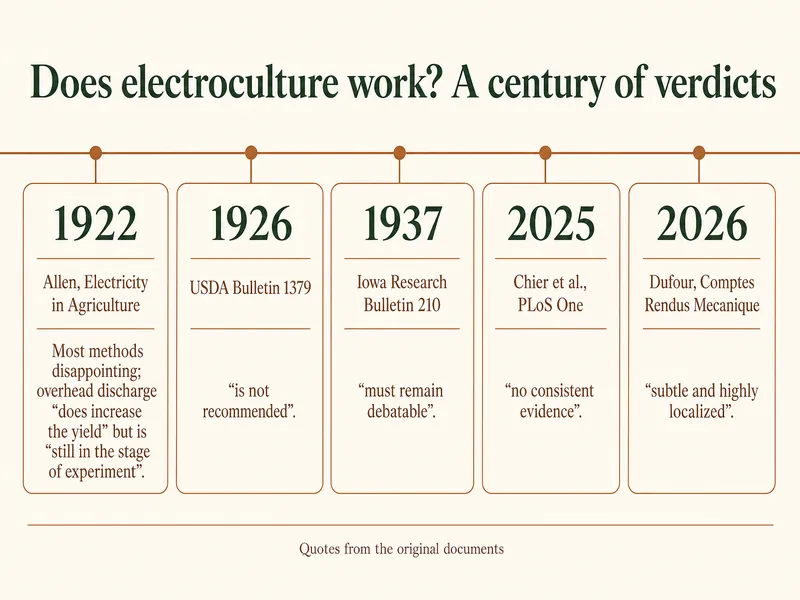
Does electroculture work? Not on current evidence: controlled trials from the USDA in 1926 to PLoS One in 2025 found no reliable yield gain from electroculture, and passive copper antennas show no consistent benefit.
On this page
The short answer disappoints many gardeners, so it deserves a careful case. Electroculture has been tested for more than a century, by government farms, agricultural colleges and, in 2025, a university lab. Positive numbers do exist in the record, some of them large. The pattern is that the better controlled a trial was, the smaller the gain became, until it disappeared into experimental error.
Key takeaways
- The USDA ran field trials from 1907 to 1918 under 30,000-60,000 volt wires and wrote in Bulletin 1379 (1926) that electrocultural methods were "not recommended".
- In 1907, 8 of 10 USDA vegetable crops under a charged network yielded less than their controls.
- Iowa's Research Bulletin 210 (1937) tested an original Christofleau apparatus among five collectors; every crop difference fell within experimental error.
- Chier et al. (2025, PLoS One) grew 4 crops with 10 plants per treatment and found passive copper rods gave no consistent benefit.
- Allen's 1922 primer reported +49% oat grain and +22% committee averages from powered overhead discharge; Allen judged most electrical methods disappointing but concluded overhead high-voltage discharge raised yields, while calling it still experimental.
- A 2026 peer-reviewed review by Thierry Dufour calls Christofleau's antenna "scientifically unfounded" and likens it to a lightning rod.
Does electroculture work, in short?
No controlled study has shown that electroculture reliably raises yields, and the passive antennas sold to gardeners have the weakest case of all. The strongest evidence comes from two kinds of work: long government field trials of powered wire networks in the 1910s and 1930s, and one modern controlled test of copper rods. Both point to effects too small to separate from ordinary plot-to-plot variation.
That is not the same as saying electricity has no effect on plants. Powered seed treatments and cold plasma change germination in the lab, as covered on electric fields and plant growth. But those use measured kilovolt doses, which a copper coil cannot supply. The rest of this page sets out each trial and its evidence level.
Results that settle the question
- 8 of 10Vegetables that fell below their controls beneath the charged 1907 networkUSDA Bulletin 1379, pp. 3-4
- +43%Gain of a formerly treated rye plot in 1916 with no electricity at allUSDA Bulletin 1379, p. 13
- 94-102%Oat yields under 7,000-20,000 V, as a share of controlsIowa Research Bulletin 210, 1937
- 2 mVVoltage that passive copper rods passed into pot soilChier and colleagues, PLoS One (2025)
What did the 2025 controlled trial find?
The 2025 trial found no consistent benefit from passive copper rods. Chier and colleagues (Lemoine lab, Marquette University) grew mustard greens, kale, turnips and beets in 1-gallon pots under LED grow lights for eight weeks, with 10 plants per treatment per species. Each plant got a copper-coiled dowel 40 cm long with 10 cm pushed into the soil, a 10 cm coiled dowel buried completely, or nothing.
Plant height and leaf greenness (SPAD) showed no treatment effects. Buried copper raised beet and turnip aboveground biomass by about 2.5 grams (p < 0.01); exposed antennas did not, which is the opposite of what the atmospheric-collection theory predicts. The rods passed roughly 2 millivolts into the soil, peaking near 20 millivolts only close to a fluorescent light. The authors found "no consistent evidence" that passive electroculture helps crop growth or yield in container gardens.
This is a controlled, peer-reviewed study, but a small one. It ran indoors, in containers, with modest samples, so it cannot rule out an effect in open field soil. It is still the only modern controlled test of the copper antennas gardeners actually use, and its authors drew a blunt practical conclusion: "We therefore suggest that both the production and purchase of such products would waste both financial and natural resources."
What did the historical experiments report?
The historical experiments reported gains ranging from nothing to over 50%, and the gains shrank as controls improved. USDA Bulletin 1379, by Briggs, Campbell, Heald and Flint, is the key document: in the USDA's main winter-wheat series at Arlington Experiment Farm, 1914-18, treated grain came to 0.89-1.03 of control (-11% to +3%). Other plots wandered further, such as a rye plot at 1.40 in 1915, which the authors put down to soil. The authors found no "well-defined increase in yield" from the treatment.
The USDA also reviewed V. H. Blackman's British programme, which it called "perhaps the best evidence" for electroculture. Blackman's 33 field trials averaged +14%, with 21 up and 12 down, but the biggest gains came beside unusually weak control strips; his 47 pot trials averaged only +1%, "well within the experimental error". Arthur Allen's 1922 primer Electricity in Agriculture reported the British headline figures, including +49% oat grain on Miss Dudgeon's farm in 1916 and potato gains of 17.2% and 12.6% at Llantwit Vadre, and concluding that "the high-pressure discharge does increase the yield" while calling the process "still in the stage of experiment".
Iowa's Charles Dorchester tested collectors including Christofleau's from 1930 to 1932. Six crops varied from -3.95% to +11.05%, all within error. His one statistically significant result came from copper-zinc earth cells on poor greenhouse soil in 1932: oat grain +9.9% with the earth cell alone and +16.2% in flats boosted with a dry cell. It failed on richer soil and in the 1933 repeat, where root weights fell 7.7% and 10.8%. His verdict: the matter "must remain debatable". The electroculture studies page tabulates every trial.
| Source | Year | Method | Finding | Evidence level |
|---|---|---|---|---|
| Marquette University pot trial (PLoS One) | 2025 | Copper dowels, exposed or buried, 4 vegetables | Nothing consistent; small buried-rod gain in 2 crops | Controlled, peer-reviewed |
| Dufour, Comptes Rendus Mécanique | 2026 | Physics model of a passive collector | Field gain confined to millimetres or centimetres of the tips | Peer-reviewed review/model (no plants) |
| USDA Bulletin 1379 | 1926 | Charged overhead networks, 1907-1918 | Winter wheat, 1914-18: treated grain from 11% below to 3% above its control; advised against | Controlled government or station trial |
| Dorchester, Iowa Bulletin 210 | 1937 | Collectors, earth cells, high voltage | Within error, one unrepeated gain | Controlled government or station trial |
| Blackman, via USDA | 1915-1920 | Discharge wires over field plots and pots | Fields +14%, weak control strips; pots +1% | Controlled government or station trial |
| Lemström at Niemis, as told by Hull | 1885 | Holtz machine feeding wires above barley | One third more barley | Historical report |
| Christofleau booklet | c.1927 | Post-mounted head, iron wire run north | Advertised 100-200% increases | Promotional claim or anecdote |
Is electroculture real or a myth?
Electroculture is real as a history and as a research question, but its main garden claims are unsupported. People really did run these experiments, governments really did fund them, and electricity really can affect plant tissue at high enough doses. What is not supported is the idea that a passive copper stake harvests enough atmospheric energy to change a harvest.
Thierry Dufour's 2026 physics model of Bertholon's 1783 collector concluded that any fair-weather effect "was subtle and highly localized". His companion review describes Christofleau's antenna as "behaving more like a lightning rod than a genuine energy transfer system". WSU Extension, summarising horticulturist Linda Chalker-Scott, says the promises are not "backed with any reliable scientific evidence". "Debunked" is too strong for a field with so few modern trials; "unconfirmed" is accurate.
Why do gardeners report results?
Gardeners report results because many things change in a garden at once, and without a matched control the antenna gets the credit. The USDA showed how big that background noise is: a rye plot that had been electrified out-yielded its control by 43% in 1916, a year when neither plot received any electricity. Iowa found chard and beet yields varied by more than 50% between neighbouring plots.
Four effects explain most success stories. Soil differs from bed to bed. Weather differs from year to year, so "bigger than last season" says little. Small samples swing widely, as Chier's team noted for their own biomass result. And attention changes care: a gardener who has just installed antennas tends to water, weed and watch more closely. Many gardeners report greener plants; controlled trials have not confirmed that the copper caused it.
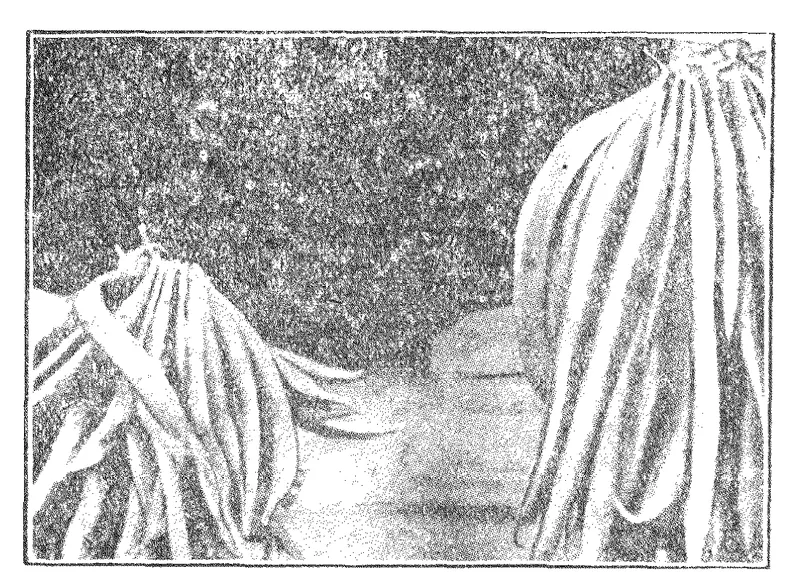
Christofleau's own comparison photograph, above, shows the problem. Dufour notes that soil, season, rainfall and fertilisation all varied between the two bunches, so the picture cannot show what the apparatus did.
Electroculture pros and cons
The case for trying electroculture is cost and curiosity; the case against is that no controlled trial supports the yield claims. Weigh both before you spend money.
Pros: copper antennas are cheap, durable and safe when unpowered. A home trial is a good excuse to run a proper side-by-side comparison, which teaches a lot about your own soil. Cons: claims of bigger harvests, less watering or fewer pests have no controlled support, and the USDA measured cowpeas under charge using about 4% more water, not less. Powered rigs copied from old high-voltage designs are dangerous. If you do try it, follow the fair-test method and weigh the harvests, or start with the realistic setup in electroculture gardening for beginners.
How we put this page together
Every verdict here comes from reading the trial reports themselves: the two government bulletins, Allen's and Hull's books, Christofleau's sales booklet, the 2025 Marquette paper, both 2026 Dufour papers and the WSU Extension article, last checked in October 2026. We quote Blackman's British numbers through the USDA's 1926 summary rather than from his journal papers. Left out: social-media yield claims, a 2025 okra preprint we could not verify, and health claims.
Common questions
Is electroculture debunked?
Not formally, because very few modern controlled trials exist. The trials that were run, from the USDA's to the 2025 PLoS One study, found no reliable yield gain, so the claims are best described as unconfirmed rather than disproved.
Did the USDA ever endorse electroculture?
No. Bulletin 1379 reported that its own Arlington trials showed no well-defined increase and that electrocultural methods "in their present state of development" were not recommended. It did say some of Blackman's British differences deserved further research.
Why did older electroculture experiments report big gains?
Most lacked repeated, randomised control plots. The USDA showed that untreated plots on the same farm could differ by over 40%, enough to create an apparent gain from soil alone. Blackman's largest gains sat beside weak control strips.
Did the 2025 study find any positive effect?
One: buried copper dowels added about 2.5 grams of aboveground biomass to beets and turnips. Exposed antennas, the design that is supposed to collect atmospheric charge, had no effect, and the authors judged the buried result "likely ... simply a result of small sample sizes".
Does a Christofleau-style antenna perform better than a copper coil?
Iowa tested an original Christofleau apparatus from 1930 to 1932 and found small crop differences, all within experimental error. Dufour's 2026 review calls the design scientifically unfounded.
Could electroculture work in field soil even if it failed in pots?
It is possible, since the 2025 trial was indoors and small. But the USDA trials and Iowa's collector trials ran outdoors in field soil, over several seasons, and still found no reliable gain.
What would convince scientists that electroculture works?
Replicated, randomised field trials with untreated controls, weighed harvests and measured soil currents, repeated across seasons and sites. Dufour argues that coupled electrical and biological measurements are needed.
Related guides
More help: see our honest guide to electroculture.