
Science
Magnetoculture: What Is Claimed and What Is Measured
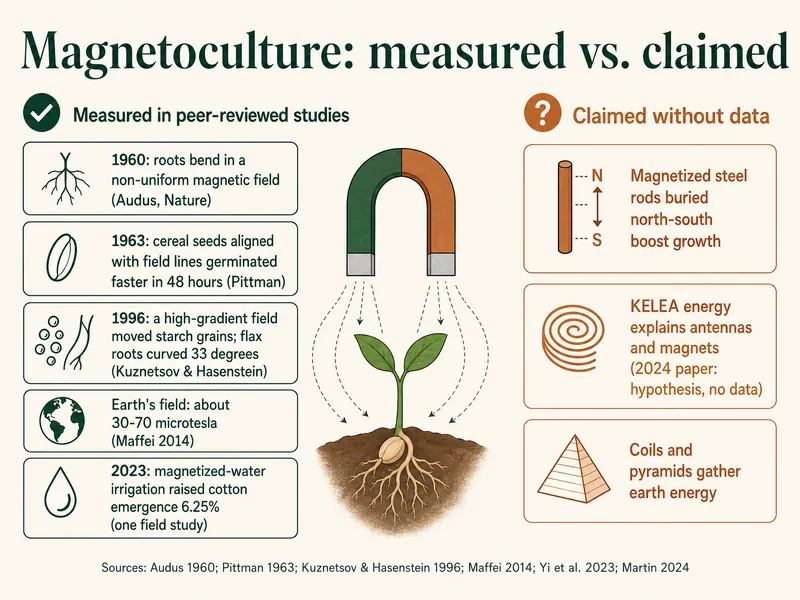
Magnetoculture, using magnets or magnetized water to grow plants, rests on real but inconsistent lab findings: strong fields can change germination and root bending, while claims about buried magnetized rods have no controlled data.
On this page
Magnetoculture usually comes up as a companion to electroculture: the same sellers and forums that promote copper antennas also credit magnets with bigger harvests, and some describe coils as magnetic. Magnets appear in garden lore alongside copper antennas: buried rods, magnetic water conditioners, seeds rolled over a magnet before sowing. Some of that traces back to genuine research published in Nature and the Canadian Journal of Plant Science from 1960 onward. Much of it does not. This page separates the two and gives an evidence level for each.
Key takeaways
- L. J. Audus of Bedford College, London, named "magnetotropism" in a 1960 Nature paper on plant organs growing in a magnetic field (Audus 1960).
- U. J. Pittman found in 1963 that cereal seeds lined up with magnetic field lines germinated faster and grew more within 48 hours (Can. J. Plant Sci.).
- Earth's own field ranges from under 30 to almost 70 microtesla, and a 2014 review found the weak-field literature full of "contradictory reports" (Maffei 2014).
- A 2023 field study found magnetized irrigation water raised cotton emergence by 6.25% over plain fresh water (Yi et al. 2023).
- The 2024 KELEA paper that links electroculture and magnetoculture contains no data, and 15 of its 24 references are to the author's own work (Martin 2024).
- No controlled study of magnetized rods buried in garden soil was found for this page.
What is magnetoculture?
Magnetoculture is the idea that exposing seeds, plants, soil or irrigation water to a magnetic field can improve growth. In research it usually means "magnetopriming": placing seeds in a measured field for minutes to hours before sowing. A 2020 review in Plants groups the fields used into weak static fields of 0 to 100 microtesla, which includes Earth's own field, strong fields from millitesla to tesla, and low-frequency alternating fields (Sarraf et al. 2020).
In gardening circles the word covers a looser set of practices: magnets or magnetized steel rods in beds, magnetic devices on hoses, and coils said to work with "earth energy". The research and the folk practice share a name but rarely a method. The lab work uses a known field strength, a known exposure time and a control group; the garden practice usually has none of the three.
What do magnetoculture advocates claim?
Advocates claim that magnets or magnetized water make seeds sprout faster, plants grow stronger and crops resist pests, and some claim that buried magnetized rods aligned north to south boost a whole bed. The 2024 KELEA paper describes "magnetized galvanized steel rods, which are buried in the soil in a north-south orientation" as a practice among enthusiasts, and lists reported benefits such as earlier germination, sturdier stems and fewer pests, all as reports rather than measurements (Martin 2024).
These are anecdotes, not trial results. Web compilations also attribute specific yield figures to Pittman's later papers, such as gains for potatoes or for wheat rows sown in a particular direction; those figures could not be checked in the originals and are left out here. Claims about magnet poles, moon phases or a "left-handed" seed have no controlled support in any source reviewed for this page.
What have magnetoculture studies measured?
Peer-reviewed studies have measured real plant responses to magnetic fields, mostly in seeds and roots and mostly with fields far stronger than Earth's, but the results are inconsistent across labs. Audus reported in 1960 that plant organs responded to a strong magnetic field and named the effect magnetotropism (Audus 1960). Later work explained at least part of it: in 1996, Kuznetsov and Hasenstein used a very steep field gradient to push the starch grains that roots use to sense gravity, and flax roots curved 33 ± 5 degrees in response (Kuznetsov and Hasenstein 1996). A starchless Arabidopsis mutant did not respond, which points to a physical push on starch grains rather than a growth boost.
Pittman's Canadian series began in 1963. Seeds of wheat, barley, oats, rye and flax germinated faster and grew more in 48 hours when lined up parallel to magnetic field lines, whether the field was Earth's or an added magnet's (Pittman 1963). In 1964 he reported that most wheat roots grew in a plane roughly parallel to the horizontal geomagnetic field, while rye roots grew in every direction, and suggested a "critical level of magnetic intensity" may be needed (Pittman 1964).
Strong-field seed priming has produced large numbers in individual studies. Massimo Maffei's 2014 review in Frontiers in Plant Science reports pea seeds exposed to 60 to 180 millitesla for 5 to 15 minutes with emergence index up 86% and vigour index up 205% (Maffei 2014). That is roughly 1,000 to 3,000 times Earth's field. The same review warns that the weak-field literature "contains a plethora of contradictory reports" with few successful replications.
- 30-70 µTRange of Earth's magnetic field at the surfaceMaffei 2014, Frontiers in Plant Science
- 48 hWindow in which field-aligned cereal seeds germinated fasterPittman 1963, Can. J. Plant Sci.
- 33°Flax root curvature in a high-gradient magnetic fieldKuznetsov and Hasenstein 1996, Planta
- 6.25%Rise in cotton emergence with magnetized fresh irrigation waterYi et al. 2023, BMC Plant Biology
- 15 of 24References in the KELEA paper that cite its own authorMartin 2024, Horticulture Int. J.
Magnetized water has its own small literature. In a 2023 field study in southern Xinjiang, China, spring irrigation with magnetized fresh water raised cotton emergence by 6.25% and plant height by 15.60% compared with plain fresh water, and magnetized brackish water raised emergence by 27.78% over plain brackish water (Yi et al. 2023). That is a controlled, peer-reviewed result from one site and one crop, with water passed through a magnetizing treatment before irrigation rather than a magnet in the soil.
Reviewers who look across the whole field are cautious. Galland and Pazur's 2005 survey of 80 years of plant magnetoreception work in the Journal of Plant Research found that most studies "remain largely on a phenomenological level", lacking mechanistic insight (Galland and Pazur 2005). A 2022 systematic-map protocol in Environmental Evidence cites "inconsistent reported treatment protocols and contradictory study outcomes" as the reason objective conclusions are hard to draw (Pawełek et al. 2022).
What does the 2024 KELEA paper claim?
The 2024 KELEA paper claims that electroculture and magnetoculture work by raising a proposed energy called KELEA in groundwater, but it offers no experiment, measurement or data to support that. Its author, W. John Martin of the Institute of Progressive Medicine in South Pasadena, defines KELEA as "Kinetic Energy Limiting Electrostatic Attraction", a force not recognised in mainstream physics, and suggests antennas let it pass down into the ground (Martin 2024). The paper was received on 2 February 2024 and published 10 days later in Horticulture International Journal.
The paper's own wording concedes the weakness. It notes "inconsistencies in reported results", says scalar-energy explanations have been offered "without proof", and closes with "Additional studies are clearly warranted." It also promotes products and concepts tied to the author, and it includes human-health claims that this site does not repeat. Its evidence level is a hypothesis with no data, and it should not be read as support for any garden device.
| Claim or finding | Source | Field or method | Evidence level |
|---|---|---|---|
| Plant organs bend in a strong magnetic field | Audus 1960, Nature | Strong laboratory magnet | Peer-reviewed lab study |
| Field-aligned cereal seeds germinate faster | Pittman 1963, Can. J. Plant Sci. | Earth's field or an added magnet | Peer-reviewed lab study |
| High-gradient field moves root starch grains | Kuznetsov and Hasenstein 1996, Planta | Ferromagnetic wedge between magnets | Controlled, peer-reviewed |
| Pea emergence index +86% after priming | Reported in Maffei 2014 | 60-180 mT for 5-15 min | Peer-reviewed review/model |
| Magnetized irrigation raises cotton emergence | Yi et al. 2023, BMC Plant Biology | Magnetized irrigation water | Controlled, peer-reviewed |
| Buried magnetized rods aligned north-south boost growth | Enthusiasts, as described by Martin 2024 | No measured field | Promotional claim or anecdote |
| KELEA energy explains antennas and magnets | Martin 2024 | None; no data | Promotional claim or anecdote |
How is magnetoculture different from electroculture?
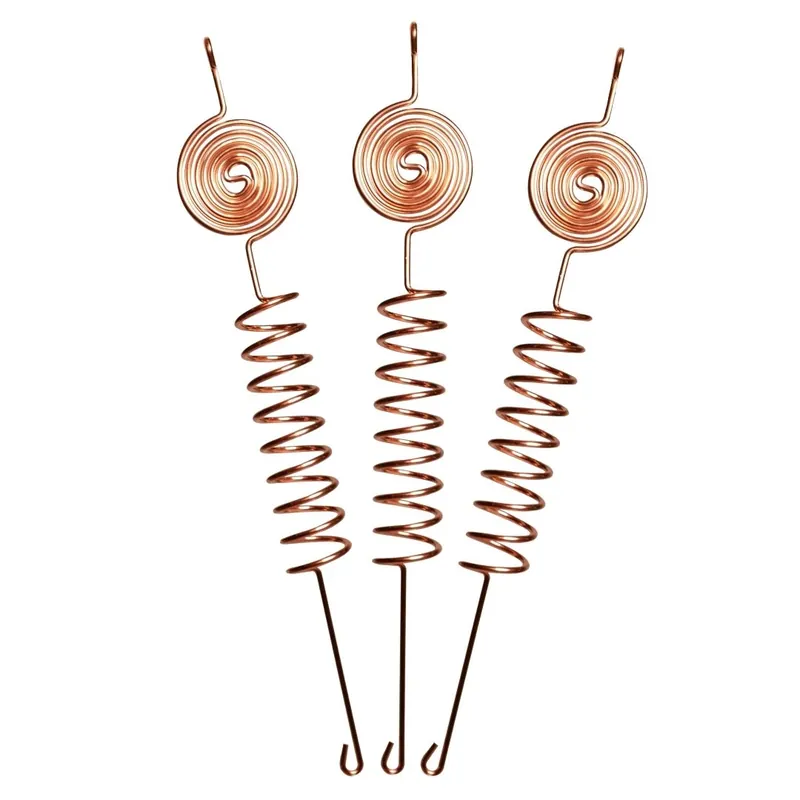
Magnetoculture uses a static or slowly changing magnetic field and needs no current, while electroculture uses electric fields, charges or currents; the two are separate physical effects. A copper coil is not magnetic and does not become a magnet by being wound, and with no current flowing through it, it makes no magnetic field of its own. The passive copper rods tested in the 2025 PLoS One trial carried about 2 mV into the soil and gave no consistent benefit (Chier et al. 2025).
Some early electroculture devices mixed the two ideas. Christofleau's 1920s apparatus had a pointer aimed at magnetic south to capture "telluric currents", and his booklet insisted the alignment was essential, though it reported no measurement of any current; see our Justin Christofleau page. For the electric side of the science, read atmospheric electricity and plants and electric fields and plant growth.
How could you test magnetoculture at home?
You can test a magnet or magnetized-water claim at home with the same side-by-side method used for antennas: matched plants, random assignment, several replicates and a measurement taken without knowing which group is which. Sow two batches from the same seed packet, treat one batch by the method you want to test and leave the other untouched, then count germination by day and weigh or measure the seedlings at a fixed date.
Keep everything else identical: soil, pots, light, watering and position. Swap the positions of treated and untreated trays every few days so light differences average out, and repeat the test at least once. A gain that shows up in only one round, or only in one tray, is more likely chance than magnetism. Our guide on how to test electroculture sets out the full method, and does electroculture work? summarises where the antenna evidence stands.
How we put this page together
This page is based on the original peer-reviewed sources where they could be read (Pittman 1963 and 1964 abstracts; Kuznetsov and Hasenstein 1996, Galland and Pazur 2005, Pawełek et al. 2022 and Yi et al. 2023 abstracts; the full Maffei 2014 and Sarraf et al. 2020 reviews) and on the full text of the 2024 KELEA paper, checked in October 2026. Audus 1960 was confirmed by its Nature record; its full text is paywalled. Left out: yield figures attributed to Pittman by web compilations that could not be checked, unsourced pole and moon-phase rules, and all human-health claims.
Common questions
Do fridge magnets in a plant pot do anything?
No study reviewed for this page tested that. Lab magnetopriming uses measured fields, often tens to hundreds of millitesla, for a fixed time on dry seed, and a magnet's field falls off steeply within a few centimetres. Without a control pot, any difference would be impossible to attribute.
Is magnetized water different from ordinary water?
Some peer-reviewed field studies, such as Yi et al. 2023 on cotton, report better emergence and growth with water passed through a magnetizing device. The mechanism is debated and results vary between studies, so treat it as an open research question rather than settled practice.
Which magnet pole should face the seeds?
There is no controlled evidence that one pole helps above-ground crops and the other helps root crops. That rule circulates in web compilations without a traceable study behind it.
Does Earth's magnetic field affect how roots grow?
Pittman's 1964 paper reported that most wheat roots in his pots grew in a plane roughly parallel to the horizontal geomagnetic field, while rye roots did not. It is a measured effect on root direction, not evidence of higher yields.
Is the KELEA paper peer-reviewed research?
It appeared in a journal and is labelled a research article, but it has no methods, no data and no experiments, and most of its references are to the author's own work. It is best read as a hypothesis.
Can magnets replace fertilizer?
No study reviewed here showed that. The positive magnetic results are changes in germination, emergence or seedling growth under controlled conditions, some of them large in single studies (such as the +205% pea vigour index), and all measured alongside normal nutrition rather than in place of it.
Is there a link between magnetoculture and copper coil antennas?
Sellers sometimes describe coils as magnetic, but a copper coil without current makes no magnetic field. Our page on electroculture antennas covers what the coils are and what has been tested.
Related guides
More help: see our electroculture gardening home page.