
History
The 1926 USDA Electroculture Report, Explained
The USDA electroculture report of 1926, Department Bulletin No. 1379, tested charged overhead wires on field crops for over a decade and concluded that electroculture "is not recommended".
On this page
Key takeaways
- USDA Department Bulletin No. 1379, Electroculture, was issued in January 1926 by four Bureau of Plant Industry scientists: Lyman J. Briggs, A. B. Campbell, R. H. Heald, L. H. Flint.
- The team ran field trials at Arlington Experiment Farm, Virginia, in 1907–08 and 1911–18, under networks of wire carrying about 30,000–60,000 volts.
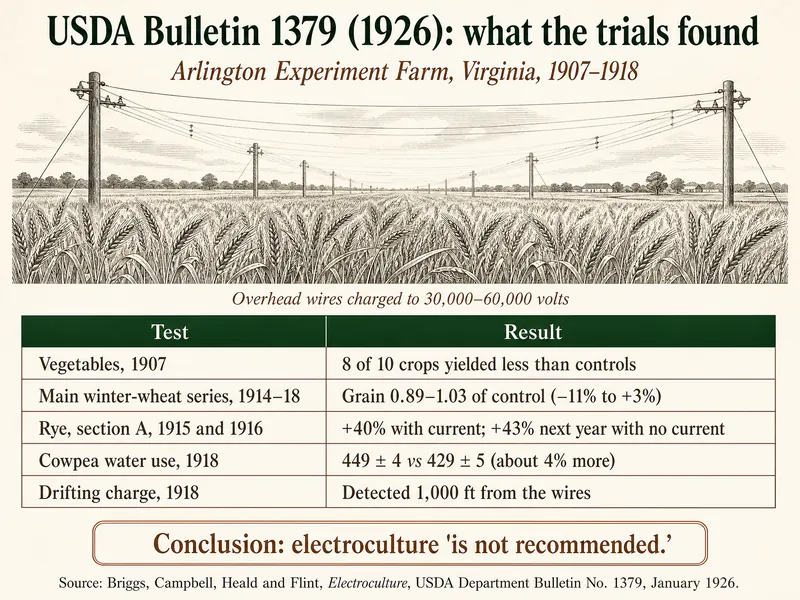
- USDA's main winter-wheat series, 1914–18: 0.89–1.03 of control (−11% to +3%), across four treated seasons and one untreated check year.
- A 40 per cent rye "gain" in 1915 was matched by a 43 per cent gap on the same plots in 1916 with no electricity, which pinned it on the soil.
- Reviewing Britain's best trials, the authors found 47 pot experiments averaged a 1 per cent gain, "well within the experimental error".
- Their verdict: the trials did "not show any well-defined increase", and the method "is not recommended".
What was the 1926 USDA electroculture report?
The 1926 USDA electroculture report is Department Bulletin No. 1379, titled simply Electroculture: a 34-page government research bulletin that combined the department's own field and greenhouse experiments with a review of the major electroculture trials since the 1700s. It defines electroculture as "practices designed to increase the growth and yield of crops through electrical treatment" and leaves out electric lighting.
It is still the most thorough primary document on the subject. It contains 32 tables and 48 references, and its findings were the basis for the USDA's formal advice against the method. For where it fits in the longer story, see electroculture history.
Who ran the USDA electroculture trials?
The trials were run by the Office of Biophysical Investigations in the Bureau of Plant Industry, and the bulletin lists Briggs first among its four authors. Briggs, a physicist, had moved to the Bureau of Standards in 1920, as a footnote notes. The 1907 vegetable trials were carried out "largely by E. W. Hudson and W. Seifriz".
The team was not hostile to the idea. It modelled its methods on English trials that had reported higher yields, called V. H. Blackman's British work "perhaps the best evidence of plant response to electrical discharge" (p. 27), and ended by saying some differences in his data were "the immediate concern of further research".
How were the experiments set up?
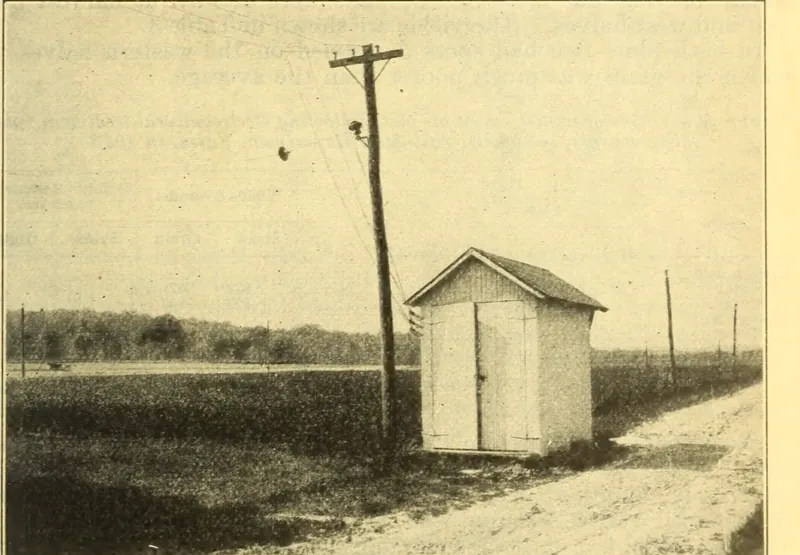
The experiments used networks of bare wire strung on insulators over the crop and charged to high voltage, usually positive, with matched untreated plots as controls. The main site was Arlington Experiment Farm at Rosslyn, Virginia. Power came from a Wagner static machine (1907), a Snook-Roentgen transformer set (1912), a Lodge-Newman induction coil with five Lodge valve rectifiers (1912–15), and in 1914–15 a direct connection to a 6,600-volt alternating-current power line.
Three features made the design stronger than most earlier work:
- Separated plots. In section E, which the authors call "the most reliable", two half-acre plots stood 350 ft apart, one north of the other, with a 16 ft network over the southern one.
- Uniformity checks. In some years they left both plots untreated to measure natural differences, "a precaution which has not been generally observed by other investigators" (p. 16).
- Greenhouse tests. Geraniums were weighed for water loss and cowpeas grown in sealed cans of about 125 kg of soil to measure water use.
What did the USDA report find?
The USDA report found no clear yield gain from electrical treatment that the authors could separate from soil differences or experimental error. The 1907 vegetable trial set the tone: 8 of 10 crops yielded less under the charged network than the average of two controls, from cowpea vines at 0.74 to cabbage at 1.14, and the authors warned that "no great dependence can be placed in these results" because the controls varied so much. A 1908 close-wire test, "similar to that employed by Lemström", showed no gain either.
| Test and years | Treatment | Result | Bulletin page |
|---|---|---|---|
| 10 vegetables, 1907 | +50,000 V network overnight, 656 h | 8 of 10 below control (0.74 to 1.14) | pp. 3–4, Table 1 |
| Wheat, section E, 1914–1918 | +30–60 kV (−45 kV in 1916) | Grain 0.97, 1.03, 0.89, 0.95 (no current), 1.02 | pp. 5–7, Tables 2–6 |
| Corn, section B, 1914 | 6,600 V AC power line | Grain 1.28, but treated plot had better soil moisture | pp. 10–11, Table 11 |
| Rye, section A, 1915 then 1916 | 6,600 V AC, then no current | Grain 1.40, then 1.43 with no treatment | pp. 12–13, Tables 15–16 |
| Geranium transpiration, 1913 | Charged screen | 1.00 during treatment | pp. 13–14, Tables 17–18 |
| Cowpea water use, 1918 | Pots charged above 50 kV | 449 ± 4 vs 429 ± 5, about 4% more water | p. 15 |
Four findings stand out on a close read:
- The soil confound. The section A rye result looked like a 40 per cent gain until the next year, when the same plot beat its control by 43 per cent with no electricity. The authors concluded the 1915 difference "was probably owing to soil conditions rather than to the electrical treatment".
- Charge drift. After the 1918 harvest they tracked charge on the wind with a flame collector and electroscope and found it still at full-scale deflection 1,000 ft from the network: a grounded screen "afforded little protection from the drifting charge" to the control plot.
- Water use. Charged cowpeas used slightly more water, not less, and a set grown under a charged screen collected soot, "did not thrive" and was discarded.
- The British trials. Across Blackman's 33 field trials the average gain was 14 per cent, yet the biggest gains at Lincluden came against control strips that managed only 28.9 and 33.0 bushels to the acre, against 43–46 elsewhere. His 47 pot trials, 26 up and 21 down, averaged 1 per cent.
The conclusions are short. The experiments, the authors wrote, "do not show any well-defined increase" — no yield gain they could separate from plot-to-plot variation (p. 16). A slight wheat increase under positive charge was "well within the experimental error of field trials". And the practical advice: electrocultural methods were "not recommended" at their "present state of development" (p. 17).
USDA Bulletin 1379 in numbers
- 8 of 10Vegetable crops below their controls under the 1907 networkUSDA Bulletin 1379, p. 4
- 0.89–1.03Grain ratio in USDA's main winter-wheat series, 1914–18 (−11% to +3%)USDA Bulletin 1379, Tables 2–6
- 43%Gap between the section A rye plots in 1916, when neither was chargedUSDA Bulletin 1379, p. 13
- 1,000 ftDistance at which drifting charge was still detectedUSDA Bulletin 1379, p. 8
- +1%Average result of Blackman's 47 pot trialsUSDA Bulletin 1379, p. 29
Why does the 1926 report still matter?
The 1926 report still matters because it is the clearest early example of what happens when electroculture is tested with proper controls, and its lessons apply to any garden trial today. Its biggest "effect", 40 per cent on rye, turned out to be the plot, not the treatment, which is exactly the trap a gardener falls into when one bed with an antenna beats one bed without.
Later work agrees with it. Iowa State College tested five atmospheric collectors, including an original Christofleau apparatus, over three seasons from 1930, and Dorchester judged every yield difference to be within error (Research Bulletin 210), and the 2025 Chier et al. trial found no consistent benefit from passive copper rods. Note the difference in scale: USDA tested powered networks at tens of thousands of volts, far stronger than a passive copper stake, and still saw nothing reliable. The wider picture is on does electroculture work and electroculture studies; to avoid the soil trap yourself, follow how to test electroculture.
Where can you read the full USDA report?
You can read the full USDA report free online, because it is a US government publication in the public domain. Two library scans are available on archive.org:
- National Agricultural Library copy: Electroculture, Department Bulletin No. 1379, digitised by the USDA National Agricultural Library.
- Library of Congress copy: the LoC scan as a PDF, also on archive.org as item electroculture00brig.
A tip for reading it: the scanned text layer is garbled in many tables. Check figures against the page images. One example: in Table 23, on the English trials at Evesham, the 1908 crop with a 30 per cent gain by weight per plant is tomatoes, though some text versions read it as potatoes. Our electroculture books page lists the other public-domain classics.
How we put this page together
This page is based on a full reading of USDA Department Bulletin No. 1379 (January 1926), with every table cited here checked against the page images of the scan, plus Iowa Research Bulletin 210 (1937) and the 2025 Chier paper; all were checked in October 2026. Ratios are treated yield divided by control yield, as the bulletin prints them; percentages are computed from those ratios. Where the bulletin's summary Table 19 disagrees with its detailed tables, the detailed tables are used.
Common questions
Is USDA Bulletin 1379 the same as "the USDA electroculture study" people cite?
Usually, yes. It is the USDA's main published report on electroculture, dated January 1926. Some websites cite a 1964 USDA tree experiment instead, but no original report for that has been found.
Did the USDA test copper antennas?
Not by the USDA. It tested powered overhead wire networks charged to tens of thousands of volts, plus charged screens in a greenhouse. Passive collectors were tested at Iowa State in 1930–32, and copper-coiled rods in Chier et al. 2025.
Why did the USDA use positive charge?
It followed Lemström and the English experimenters, whose results Allen's 1922 primer summarised, who believed positive discharge from overhead points worked best. It also tried negative charge in 1916 (wheat grain 0.89 of control) and alternating current from a power line, with no better result.
Did the USDA say electroculture could never work?
No. It said the methods, as developed by 1926, were not recommended, and it called parts of Blackman's British data worth "further research". The bulletin is a verdict on the evidence then available, not a ban.
How much did the charged plots differ from the controls?
In the USDA's main winter-wheat series, 1914–18, grain ranged from 11 per cent below to 3 per cent above the control. The untreated check years showed natural differences of a similar size, which is why the authors called the results within experimental error.
Was the 1926 USDA report peer-reviewed?
It was a government research bulletin, the standard way federal scientists published field results then, rather than a journal paper. Its data tables and methods are printed in full, so its figures can be checked line by line.
More history

More help: see our electroculture gardening home page.