
Antennas
Electroculture Antenna Designs, With Diagrams
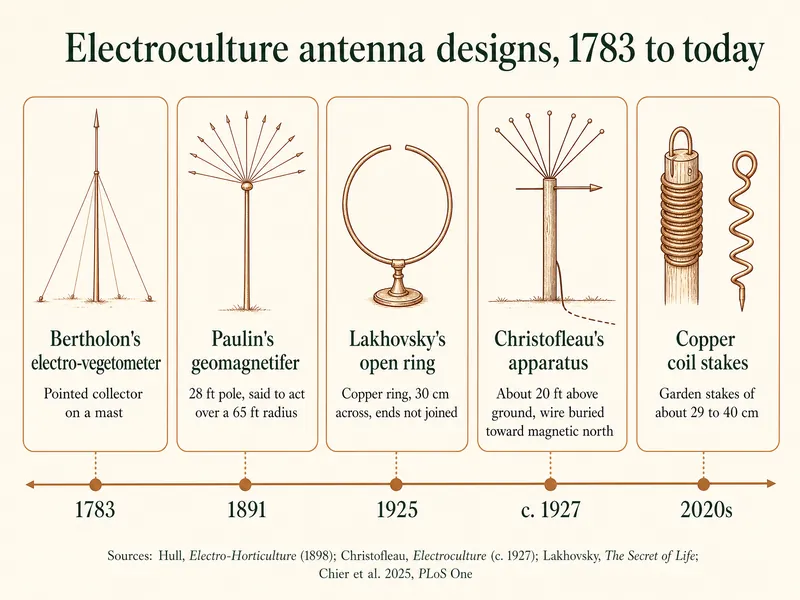
Electroculture antenna designs run from Bertholon's 1783 pointed mast to today's 29 cm copper coil stakes; none has beaten an untreated control in a published controlled trial.
Disclosure: Thrive Garden, which sells the electroculture antennas and copper stakes we link to, is a store owned by the same team as this site. Our history pages follow the original documents and our science pages follow peer-reviewed studies, checked October 2026. Store descriptions are reported as the store's own claims. Ownership disclosure
View at Thrive Garden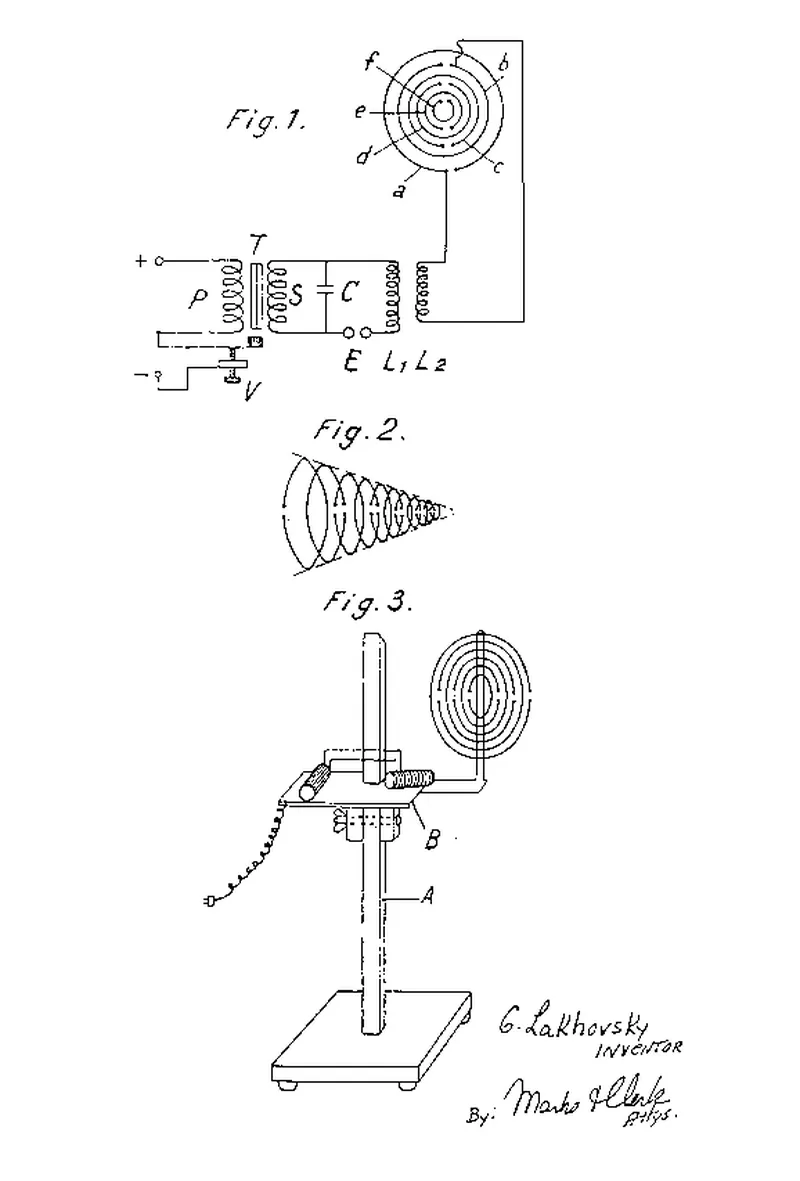
On this page
Key takeaways
- Five designs have documented origins: Bertholon's electro-vegetometer (1783), Paulin's geomagnetifer (from 1891), Lakhovsky's open ring (1925), Christofleau's apparatus (c. 1927) and the modern copper coil stake.
- The tall historical designs stood 20 to 28 ft high; modern garden coils are 29 to 40 cm, so a fair-weather field of about 100 V/m gives them roughly 3 to 4 V top to ground (Chier et al. 2025).
- A 2026 physics model of Bertholon's mast found its points concentrate the field 175–700 times, but only within millimetres to centimetres of each tip (Dufour 2026).
- Christofleau's booklet gives the most detailed diagrams of any design, and an original apparatus gave only small, non-significant differences at Iowa State College in 1930–32.
- Coil direction rules (clockwise, counterclockwise, by hemisphere) appear in sellers' and hobby guides only; no controlled study has compared them.
What electroculture antenna designs exist?
Five electroculture antenna designs have a documented source: a pointed mast, a branched pole wired into the soil, Christofleau's multi-part mast head, Lakhovsky's open copper ring, and the copper coil on a stake. Everything sold today, from butterfly stakes to spiral "Tesla" coils, is a variation on the last of these.
The older designs were big. They stood on posts 20 ft or more high and fed long buried wires, because their inventors believed height gathered more atmospheric electricity. The modern coil shrank the idea to a garden stake under 40 cm, with no buried network at all. For the products built on these designs, see electroculture antennas.
| Design | Origin | Claimed mechanism | Evidence level |
|---|---|---|---|
| Electro-vegetometer | Abbé Bertholon, France, 1783 | Pointed mast collects atmospheric charge and showers it on crops through a crown of points | Historical report; peer-reviewed review/model finds effects confined to mm–cm |
| Geomagnetifer | Paulin, Montbrison, France, from 1891 | 28 ft pole with five pointed branches feeds buried wires over a 65 ft radius | Historical report (committee figures relayed by Hull, 1898) |
| Christofleau apparatus | Justin Christofleau, France, booklet c. 1927 | Aerial wires, pointer and copper–zinc "piles" collect air and earth currents into a 14 ft strip | Controlled government or station trial: yields within error, Iowa 1930–32 |
| Lakhovsky open ring | Georges Lakhovsky, Paris, 1925 | Open copper spiral picks up "radiations" around a plant | Historical report: one treated plant photographed beside two untreated plants, no measurements |
| Copper coil on a stake | Online guides and sellers, 2020s | Copper coil gathers atmospheric energy and passes it to roots | Controlled, peer-reviewed (2025): no reliable gain |
Where did each design come from?
Each electroculture antenna design came out of a particular moment in the history of electricity. Bertholon's mast followed Franklin's lightning rod by about thirty years; Paulin's and Christofleau's poles came from the late-19th-century enthusiasm for atmospheric electricity; Lakhovsky's ring came from early radio, where a coil and a gap make a tuned circuit.
- Bertholon, 1783. His book De l'électricité des végétaux introduced the electro-vegetometer, a tall insulated mast with a metal point that led collected charge to a crown of points held over plants. Dufour (2026) notes it "recorded neither electric field, nor electrical charge, nor current".
- Paulin, from 1891. Hull's Electro-Horticulture (1898), pp. 9–10, describes "a tall, resinous pole" carrying a galvanised iron rod on porcelain knobs that ended "in five pointed branches", wired to a network under the soil. A local committee reported potato yields 50–75% higher inside the wired circle, a historical report without modern controls.
- Christofleau, 1920s. A French inventor at La Queue-les-Yvelines, he sold his apparatus through agents for £6; see Justin Christofleau.
- Lakhovsky, 1925. His open ring dates from 1925; his later US patent 1,962,565, granted in 1934, covers an "apparatus with circuits oscillating under multiple wave lengths". The garden version is a single open ring; see the Lakhovsky coil.
- The copper coil. No historical document in our library describes copper wire wound on a wooden stake. It appears in hobby literature and online guides, and is the design tested in 2025.
What did Christofleau's design look like?
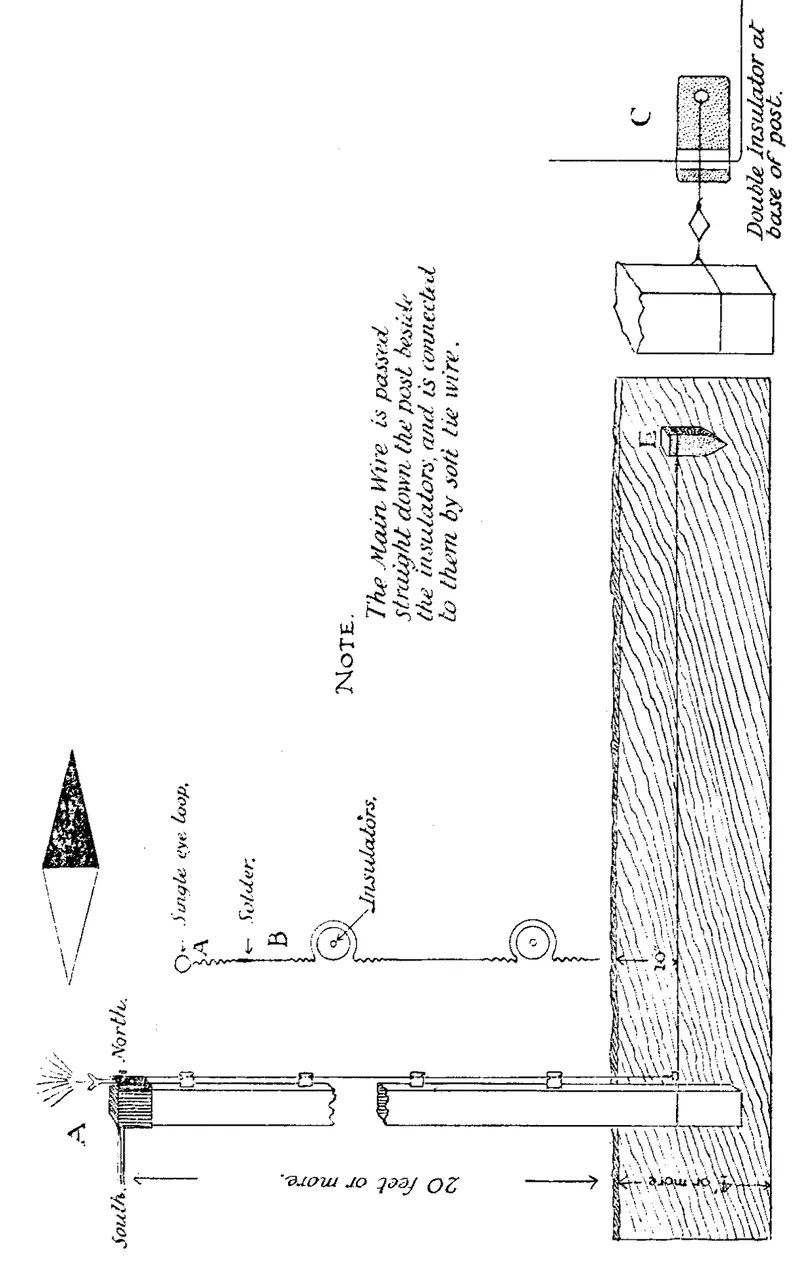
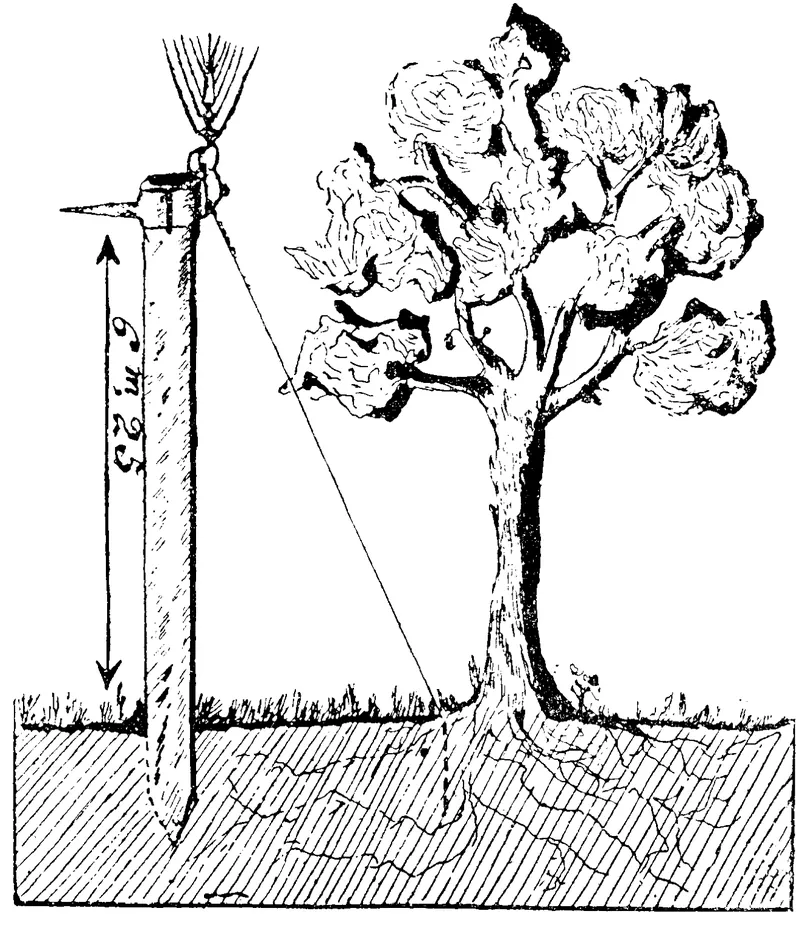
Christofleau's design was a small metal head on a 25 ft wooden post, buried 5 ft so that about 20 ft stood above ground. His booklet Electroculture (c. 1927) labels each part of the engraving on printed page 7, and describes the installation on pages 10–11.
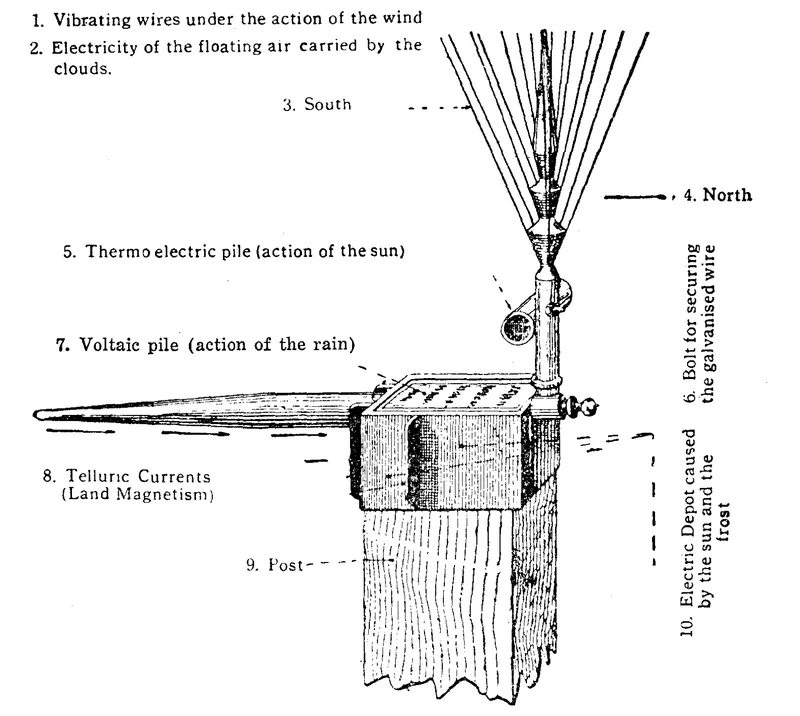
From the top: a fan of about 12 thin upward "aerial" wires, which he labelled as "vibrating wires under the action of the wind"; a vertical point; a long horizontal pointer aimed at magnetic south and labelled "Telluric Currents"; a casing he called an "Electric Depot"; a copper–zinc tube he called a "thermo electric pile"; and a zinc saucer with a riveted copper plate, his "voltaic pile", meant to catch rain. A No. 12 galvanised iron wire ran from a bolt on the head down the post on four porcelain insulators, then turned underground and ran 10 in deep toward magnetic north. He claimed it treated a strip 14 ft wide along the wire.
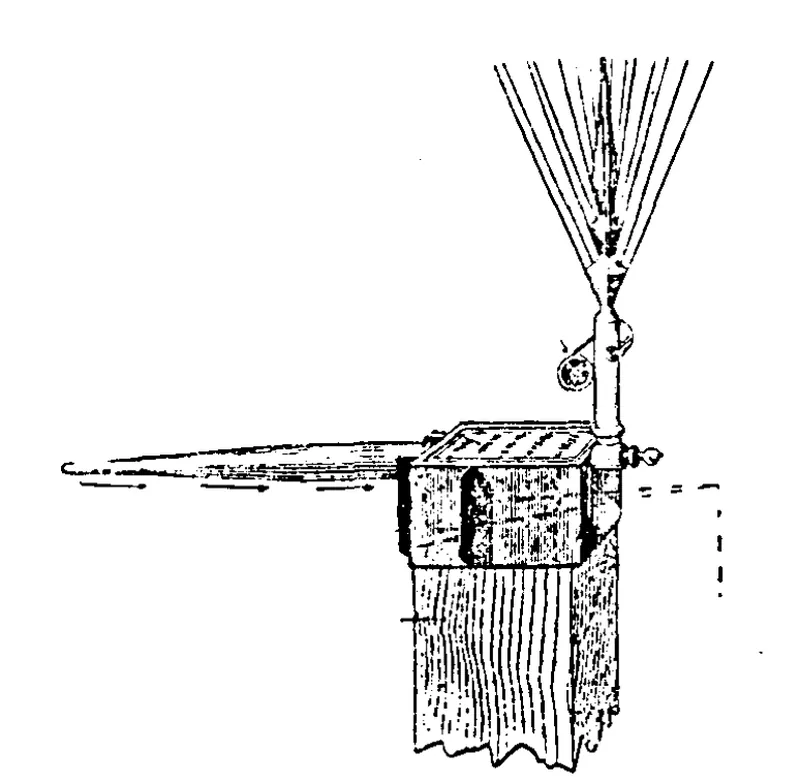
Three things the booklet does not contain matter for anyone copying it. It gives no voltage or current reading. It names no metal for the casing or aerial wires. And there is no copper coil anywhere: the buried conductor is galvanised iron. The peer-reviewed review by Dufour (2026) concludes the device behaved "more like a lightning rod than a genuine energy transfer system".
Is there a best electroculture antenna design?
No electroculture antenna design has shown a crop benefit in a controlled trial, so there is no best design on the evidence. The two designs that were tested against untreated plots both came out within normal plot-to-plot variation.
Design numbers from the sources
- 28 ftHeight of Paulin's geomagnetifer pole (historical report)Hull, Electro-Horticulture, 1898, pp. 9–10
- 20 ftHeight of Christofleau's apparatus above groundChristofleau, Electroculture, c. 1927, p. 10
- 175–700×Field concentration at the tips of a Bertholon-type mast, confined to mm–cmDufour 2026, Comptes Rendus Mécanique
- 40 cmLength of the copper-coiled dowels in the 2025 trialChier et al. 2025, PLoS One
At Iowa State College from 1930 to 1932, Charles Dorchester ran five atmospheric collectors, including one original Christofleau apparatus, into buried copper cables. Six crops gave yields from about 4% below to 11% above control, all within experimental error. In 2025, Chier and colleagues tested copper coiled on dowels, exposed or buried, beside four vegetables for 8 weeks. Only buried copper nudged beet and turnip leaf mass up by about 2.5 g, and the authors judged the overall result inconsistent. If you pick a design, pick it for cost, looks and ease of comparison; does electroculture work sets out the full record.
How do coil direction and height differ between designs?
Height varies by a factor of about 20 between the historical masts and modern stakes, while coil direction is a modern rule with no documented test behind it. Christofleau's only direction rule was a compass one: pointer to magnetic south, buried wire to magnetic north, which his booklet called "absolutely essential".
Height matters physically because the fair-weather field is roughly 100 V per metre. A 40 cm stake therefore spans about 4 V (a 29 cm stake about 3 V), which Chier's team calculated before measuring only about 2 mV actually reaching the soil. Christofleau's 20 ft head sat in a gradient several hundred volts higher than its base, yet Iowa still found only small differences within experimental error. Dufour's model adds that tip shape and angle barely changed the result once a mast was present.
Winding direction is different. Thrive Garden's Tesla Coil antenna (a store we own) is listed as wound clockwise; some hobby guides say counterclockwise in the northern hemisphere, without citing any trial. No controlled study has compared the two. For placement choices, see antenna placement, and for the physics, atmospheric electricity and plants.
Where can you find antenna design diagrams?
The original electroculture antenna diagrams are in public-domain books and patents, most of them free to read online. These five are the primary sources worth opening before copying any design:
- Christofleau, Electroculture (c. 1927). The labelled engraving, installation plans for fields, vines and single trees, and the buried-wire layout. Our electroculture books page describes the edition.
- Hull, Electro-Horticulture (1898). No drawings, but word descriptions of Paulin's geomagnetifer and Spechnew's pointed poles, readable at archive.org.
- USDA Department Bulletin 1379 (1926). Photographs of the Arlington overhead wire networks, the high-voltage design the USDA tested, at the Library of Congress.
- Lakhovsky's US patent 1,962,565 (1934). Circuit drawings and the spiral ring, on Google Patents.
- Dufour (2026). A modern reconstruction of Bertholon's mast with modelled field lines, open access.
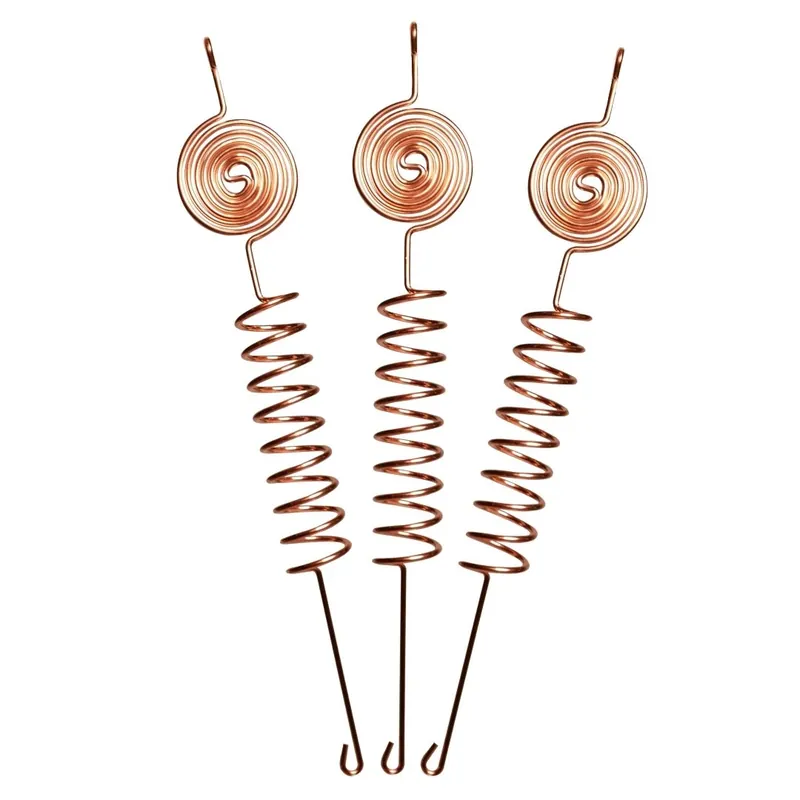
For a garden-scale build from these ideas, see how to make an electroculture antenna. If you would rather start with ready-made stakes, Thrive Garden's Copper Butterfly stakes (a store we own) are listed as 10-gauge copper and cost $39.95 for 3 (store price, October 2026). Either way, plan the comparison first with how to test electroculture.
How we put this page together
This page draws on Christofleau's booklet Electroculture (c. 1927, pp. 7–11), Hull's Electro-Horticulture (1898, pp. 9–10), the 1926 USDA electroculture bulletin (No. 1379), Dorchester's 1937 Iowa bulletin (No. 210), Lakhovsky's US patent 1,962,565 and The Secret of Life, both 2026 Dufour articles (Comptes Rendus Mécanique, crmeca.331 and crmeca.346) and the 2025 PLoS One copper rod paper, all checked in October 2026. Store details are from Thrive Garden's product pages on 23 October 2026. Left out: pyramid, Fibonacci and "vortex" designs that appear only in sellers' listings, Lakhovsky's health claims, and any patent number for Christofleau, since his booklet prints none.
Common questions
Is there a downloadable electroculture antenna design PDF?
The best design documents are public-domain scans: the USDA's 1926 bulletin at the Library of Congress, Hull's 1898 book at archive.org and Lakhovsky's patent at Google Patents. Christofleau's booklet circulates as scans too; check that a copy shows the Perth edition's labelled engraving before relying on it.
Did Christofleau use copper wire?
His booklet specifies No. 12 soft galvanised iron wire for the down lead and the buried run. Copper appears only in the small "piles" on the head, paired with zinc.
What is a geomagnetifer?
It was Paulin's 1890s collector: a resin-coated pole with a galvanised iron rod ending in five points, wired to a buried network. Hull reports a 28 ft example near Montbrison said to act over a 65 ft radius.
Why do some designs point north and south?
Christofleau insisted the pointer face magnetic south and the buried wire run north, believing it caught "telluric currents". No controlled trial has tested compass alignment for any design.
Is a spiral top better than a straight coil?
No study has compared tops. The 2026 Dufour model found that the shape and angle of the collector tips made little difference to the field, which in any case stayed concentrated within centimetres of the metal.
Are Lakhovsky rings and modern copper coils the same thing?
No. Lakhovsky's ring is an open loop held around a plant on an insulating stand, built on radio-circuit ideas; the modern coil is wire wound tightly on a stake pushed into soil. Neither has a controlled crop trial behind it.
Which design is cheapest to test?
A coil on a stake. Bare copper wire on a hardwood dowel costs little, and Thrive Garden's ready-made Tesla Coil stakes cost $11.33-$13 apiece, by pack size (store prices, October 2026), far below a 20 ft mast.
Related guides
 AntennasElectroculture antennas
 HistoryJustin Christofleau
- HistoryThe Lakhovsky coil
 AntennasHow to make an electroculture antenna
Try it in your own beds
Tesla Coil Electroculture Antenna Starter Pack
Check current pack sizes and prices at Thrive Garden, then set up a fair side-by-side test.
View at Thrive GardenThrive Garden, which sells the electroculture antennas and copper stakes we link to, is a store owned by the same team as this site. Ownership disclosure
More help: see our electroculture gardening library.