
History
Electroculture Books: What Each Classic Says
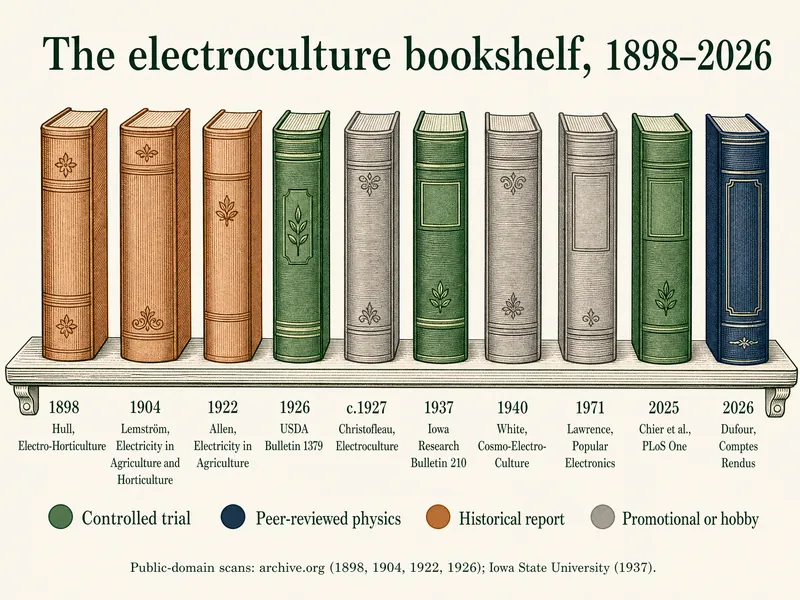
The classic electroculture books run from Hull's 1898 Electro-Horticulture to Lawrence's 1971 magazine article; several are free library scans, and the government bulletins report the most carefully controlled trials.
On this page
Key takeaways
- Five classic electroculture texts are free to read in library scans: Hull (1898), Lemström (1904), Allen (1922), USDA Bulletin 1379 (1926) and Iowa Research Bulletin 210 (1937).
- Hull's Electro-Horticulture is a 45-page popular survey of second-hand reports; Hull himself wrote it was "too early to give satisfactory figures".
- Lemström's 1904 book is the fullest first-hand account by an early experimenter, and it reports losses as well as gains.
- The two government bulletins, USDA 1379 and Iowa 210, report the most carefully controlled trials among the classics, and neither found a dependable yield gain.
- Christofleau's c. 1927 booklet and White's 1940 Cosmo-Electro-Culture are promotional; they report no measured currents or controlled yields.
- The modern reading list is short: Chier et al. 2025 in PLoS One and Thierry Dufour's two 2026 papers in Comptes Rendus Mécanique.
Which electroculture books are worth reading?
The electroculture books most worth reading are the ones that report experiments in their own words: Lemström's 1904 book for the case in favour, and the 1926 USDA and 1937 Iowa bulletins for the controlled tests. Hull's 1898 survey and Allen's 1922 primer are useful history. Christofleau's booklet and White's book are interesting mainly as examples of how the idea was sold.
| Book | Year | Author | What it is | Evidence level | Free legal copy |
|---|---|---|---|---|---|
| Electro-Horticulture | 1898 | George S. Hull, M.D. | Popular survey of reports | Historical report | Yes, archive.org |
| Electricity in Agriculture and Horticulture | 1904 | Selim Lemström | First-hand account of his trials | Historical report | Yes, archive.org |
| Electricity in Agriculture | 1922 | Arthur H. Allen | Farm-electricity primer, one chapter on electroculture | Historical report | Yes, archive.org |
| Electroculture, Bulletin 1379 | 1926 | Briggs, Campbell, Heald, Flint | Government field trials and review | Controlled government or station trial | Yes, archive.org and LoC |
| Electroculture (booklet) | c. 1927 | Justin Christofleau | Sales booklet for his apparatus | Promotional claim or anecdote | None found |
| Research Bulletin 210 | 1937 | Charles S. Dorchester | Station trials incl. a Christofleau apparatus | Controlled government or station trial | Yes, Iowa State University |
| Cosmo-Electro-Culture for Land and Man | 1940 | George Starr White, M.D. | Self-published anecdotes | Promotional claim or anecdote | None found |
| "More Experiments in Electroculture" | 1971 | L. George Lawrence | Hobby electronics article | Promotional claim or anecdote | None found |
What does the 1898 electroculture book say?
The 1898 electroculture book, Electro-Horticulture by George S. Hull of Pasadena, California (Knickerbocker Press, New York), says that most experimenters had reported favourable results, while admitting the figures were not yet reliable. It is a short popular survey in six chapters: 18th-century static-electricity trials, Lemström's overhead wires, atmospheric collectors such as Paulin's géomagnétifère, buried "earth-batteries" of zinc and copper, electric arc light, and a closing speculation on the "electric farm of the future".
Almost every result is second-hand and uncited. Hull reports Paulin's potatoes 50–75 per cent up near Montbrison and Lemström's pot plants 40 per cent ahead, but also negatives: Ingenhousz's 1787 denial of any benefit, radishes losing 45–65 per cent under a naked arc lamp, and seed electrification that sped growth but did "not" raise yield. His only first-hand test, hemp in boxes with and without buried plates, gives "twenty per cent. to forty per cent." with no plant count. On p. 41 he concedes experiments "have not yet been made on a sufficiently large scale to furnish reliable statistics". Read it free in Cornell's scan or the University of California copy.
What did the 1920s books add?
The 1920s books added the first large British field trials and the first government verdict. Arthur H. Allen's Electricity in Agriculture (Pitman's Technical Primers, London, 1922) is mostly about farm power, but chapter X (pp. 97–103) reports the overhead-discharge era in three sets of figures: a 1916 oat crop in Scotland with grain +49% and straw +88%, potatoes at Llantwit Vadre in Wales +17.2% and +12.6% over control plots in 1917–18, and a Board of Agriculture committee's 22% average gain on spring-sown cereals. Allen thought most electrical methods had disappointed, yet he concluded that overhead high-voltage discharge did raise yields, while still calling the method experimental. The University of California scan is free.
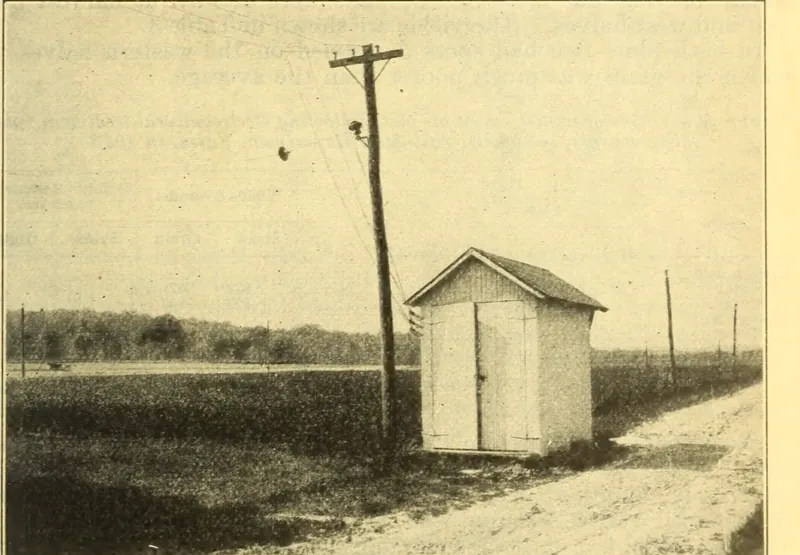
USDA Bulletin 1379 (1926) is the decade's key document. It reports the department's own trials at Arlington, Virginia, from 1907 to 1918, finds no well-defined yield increase and ends with the advice that electroculture "is not recommended". The 1926 USDA report explainer walks through each table. Lemström's 1904 book belongs with these as the work they were all testing; see Selim Lemström.
What is in Christofleau's electroculture book?
Christofleau's electroculture book is a 62-page English sales booklet, Electroculture, issued without a printed date by his sole agents, Alex. Trouchet & Son of Perth, Western Australia; its latest dated items are from July 1927. It contains Christofleau's appeal to farmers, two translated chapters by the promoter Georges Blanchard, press extracts, a short 1921 report from the agricultural station of Metz, installation instructions and dozens of customer letters.
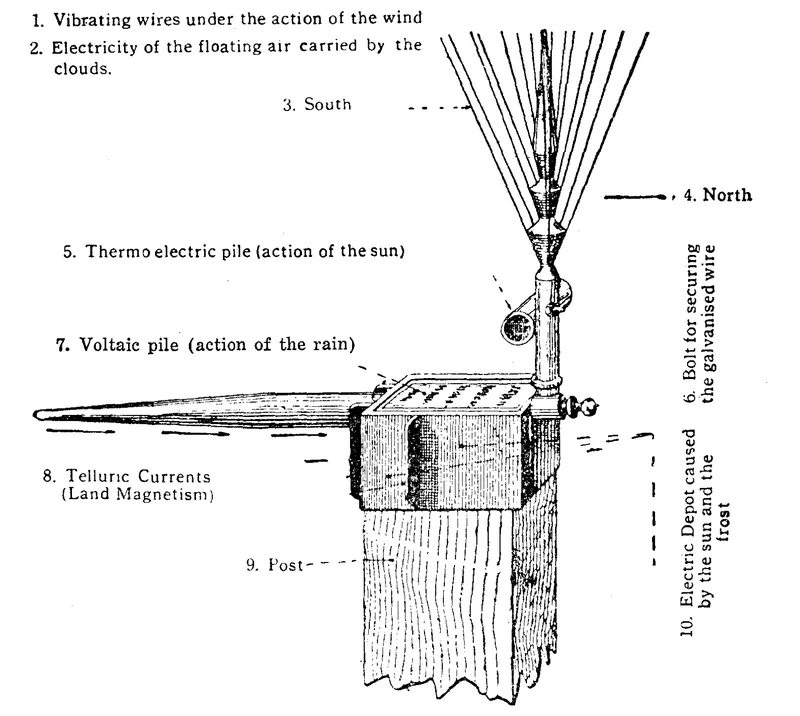
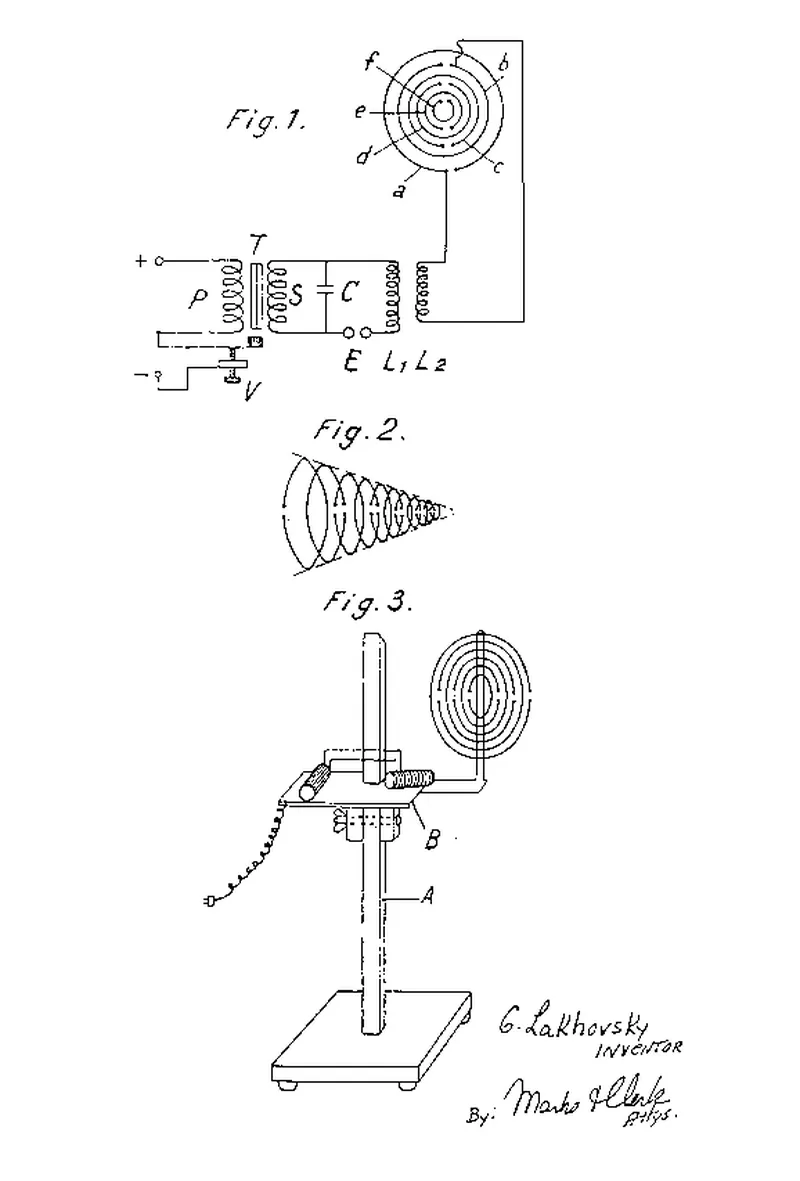
The installation pages describe the apparatus precisely: a metal head with upward wires on a 25 ft post, and a galvanised iron wire laid in a furrow 10 in down, aimed at magnetic north. The claims are sweeping, including yields doubled or more and no need for fertiliser, but no current or voltage is ever measured, and the one witnessed harvest works out to about 9 per cent per vine. The details are on our Justin Christofleau page.
What did later authors like George Lawrence test?
Later authors tested very little. L. George Lawrence's "More Experiments in Electroculture" (Popular Electronics, June 1971) is mostly a build guide for a "plant response detector", a bridge circuit and op-amp that turns tiny changes in leaf resistance into an audio tone. It frames those signals around Cleve Backster's claims of plant "perception", which are not accepted science, and repeats an unreferenced claim about a 1964 tree test. It contains no crop trial.
George Starr White's Cosmo-Electro-Culture for Land and Man (self-published, Los Angeles, 1940) is a book of childhood anecdotes and do-it-yourself metalwork: chicken-wire tree guards, copper rods in ditches, grounded arbours. It reports no measurements, plot sizes or yields, and it mixes plant advice with health claims and a 20,000-volt "Water-Sparker" that this site does not recommend building. The Iowa bulletin of 1937, by contrast, was a real test: Charles Dorchester ran collectors, including an original Christofleau apparatus, over field plots for three seasons and found yields within experimental error.
Where can you find electroculture book PDFs?
You can find free, legal PDFs of the public-domain electroculture classics in library scans on archive.org and in university repositories; each item page has a PDF download link. These are the copies we checked in October 2026:
- Hull, Electro-Horticulture (1898): Cornell University Library scan.
- Lemström, Electricity in Agriculture and Horticulture (1904): Cornell University Library scan.
- Allen, Electricity in Agriculture (1922): University of California scan.
- USDA Bulletin 1379 (1926): National Agricultural Library scan, or the Library of Congress PDF.
- Iowa Research Bulletin 210 (1937): Iowa State University Digital Repository.
We found no library-hosted copy of Christofleau's booklet, White's book or the 1971 magazine article. Files of those passed around in social media groups and file-sharing sites are unofficial uploads, and some are retyped or abridged, so check any figure against a library copy. For modern research, the 2025 PLoS One trial is open access on PubMed Central, and Dufour's 2026 review and modelling paper are free from the journal. To put the books' ideas to a fair test in your own beds, see how to test electroculture; for the overall verdict, does electroculture work.
The electroculture bookshelf in numbers
- 45Pages in Hull's 1898 Electro-HorticultureHull, Electro-Horticulture (1898)
- pp. 97–103Allen's single chapter on electroculture in a farm-power primerAllen, Electricity in Agriculture (1922)
- 32Data tables in USDA Bulletin 1379USDA Bulletin 1379 (1926)
- 3Field seasons Iowa ran its collectors, 1930–32Iowa Research Bulletin 210 (1937)
How we put this page together
The descriptions come from page-referenced notes taken from scans of each book, and the online copies linked here were opened and checked in October 2026: archive.org items from Cornell University Library, the University of California and the USDA National Agricultural Library, the Library of Congress PDF, and Iowa State University's repository. Copies on file-sharing sites, social media groups and private drives are not linked. White's health advice and his high-voltage water device are named but not described.
Common questions
Is there a free PDF of Christofleau's electroculture book?
No library-hosted copy turned up in our searches. Unofficial scans circulate online, but we cannot vouch for their completeness, and the French originals of 1923 and 1925 are harder still to find. The English booklet's content is summarised on our Christofleau page, and wider questions are answered in the electroculture FAQ.
Which electroculture book should a beginner read first?
Start with USDA Bulletin 1379: it is free, clear and explains both the method and why the results disappointed. Then read Lemström's 1904 book to see the strongest historical case in favour, and judge the two side by side.
Is Hull's 1898 book the first electroculture book?
It is the earliest book-length English survey in this collection, but not the first writing on the subject. Bertholon's French treatise on plant electricity appeared in 1783, and Lemström published in French in 1890.
Are modern electroculture books more reliable than the old ones?
Not by default. Most recent books and e-books repeat the historical claims without the controlled results; the reliable modern sources are journal papers, chiefly Chier et al. 2025 and Dufour 2026.
Is Lawrence's 1971 article about growing crops?
Mostly not. It is a circuit project for detecting electrical changes in leaves, framed by the "plant perception" claims of the 1960s, with no yield experiment.
Can you still buy printed copies of these books?
Reprints of several are sold, and the originals turn up in the antiquarian trade. Since the public-domain texts are free in library scans, a reprint is worth buying only for convenience.
Related history

More help: see our electroculture gardening home page.