
Antennas
Electroculture Antennas: Types, Claims and Evidence
Electroculture antennas are passive copper or metal stakes said to channel atmospheric electricity into soil; the one controlled study of copper rods, published in 2025, found no consistent benefit to crops.
Disclosure: Thrive Garden, which sells the electroculture antennas and copper stakes we link to, is a store owned by the same team as this site. Our history pages follow the original documents and our science pages follow peer-reviewed studies, checked October 2026. Store descriptions are reported as the store's own claims. Ownership disclosure
View at Thrive Garden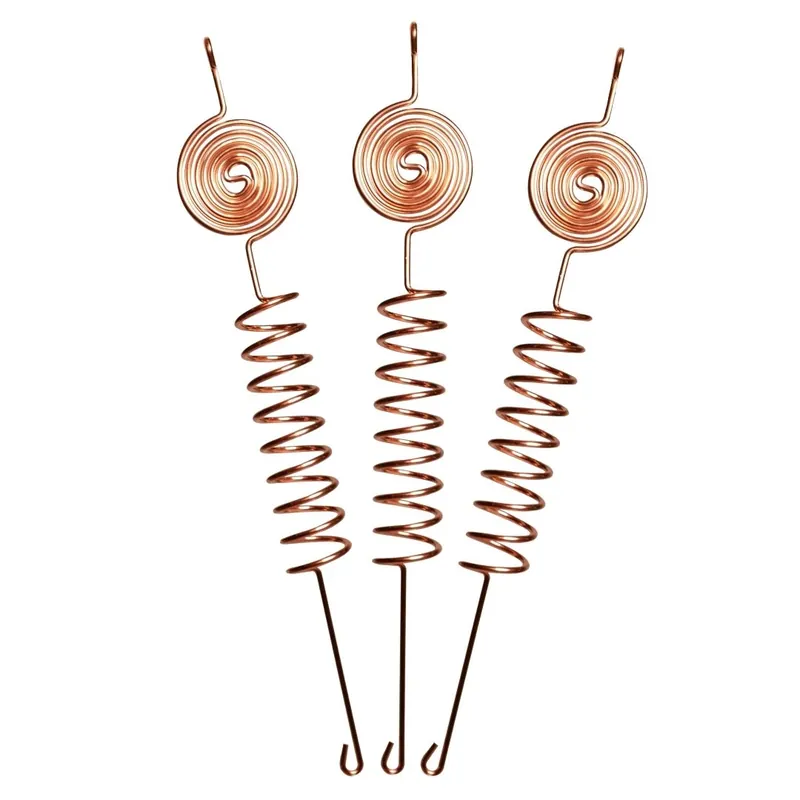
On this page
Key takeaways
- An electroculture antenna has no battery or wire to the mains: it is a passive piece of metal, usually copper, standing in the soil or on a post.
- Five designs come up most often: the coil-on-stake, the Tesla-coil spiral, the butterfly stake, Christofleau's 1920s mast and Lakhovsky's open copper ring.
- Chier et al. 2025 grew four vegetables beside copper-coiled dowels for 8 weeks and saw no consistent gain in growth or yield (controlled, peer-reviewed).
- An original Christofleau apparatus was tested at Iowa State College in 1930–32; yields stayed within experimental error (Research Bulletin 210, 1937).
- Sellers' claims about placement, spacing and coverage radius are their own observations, not trial results.
- Thrive Garden, which shares its owners with this site, sells many electroculture products; three of them are covered here: the Tesla Coil 3-pack at $39, Copper Butterfly stakes at $39.95 for 3, and a Christofleau-style apparatus at $1,499 (store prices, October 2026).
What is an electroculture antenna?
An electroculture antenna is a passive metal object, most often bare copper wire, pushed into garden soil or raised on a post in the belief that it gathers natural electricity from the air and passes it to plants. Nothing powers it. The idea rests on a real phenomenon, modelled in Dufour's 2026 paper on Bertholon's mast: on a fine day the air near the ground carries a vertical electric field of roughly 100 volts per metre, and a faint current of a few trillionths of an amp per square metre flows down through it.
The question is whether a stake in a vegetable bed can turn that into anything a plant notices. Chier and colleagues measured it: their copper rods carried about 2 millivolts into the soil, rising to about 20 mV only when a rod stood within 4 cm of a fluorescent light. For the background on fields, lightning and nitrate, see atmospheric electricity and plants, and for the wider idea, what electroculture is.
What types of electroculture antennas are there?
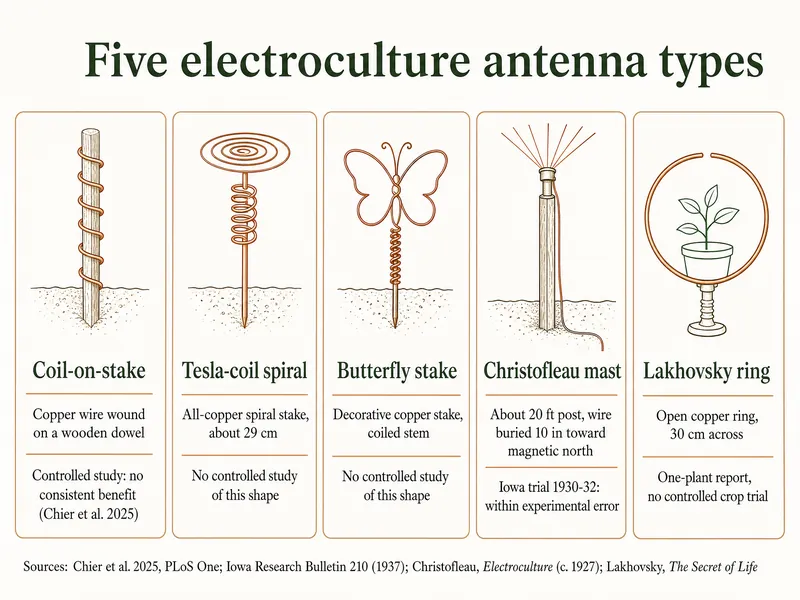
Five types of electroculture antennas account for most of what gardeners see, and they come from very different periods. Two are modern garden stakes, two are historical devices from the 1920s and 1930s, and one, the butterfly, is a decorative variant of the modern coil.
- Coil-on-stake. Bare copper wire wound around a wooden dowel or bamboo cane. This is the design the 2025 PLoS One study tested, and the one most DIY guides describe; see how to make an electroculture antenna.
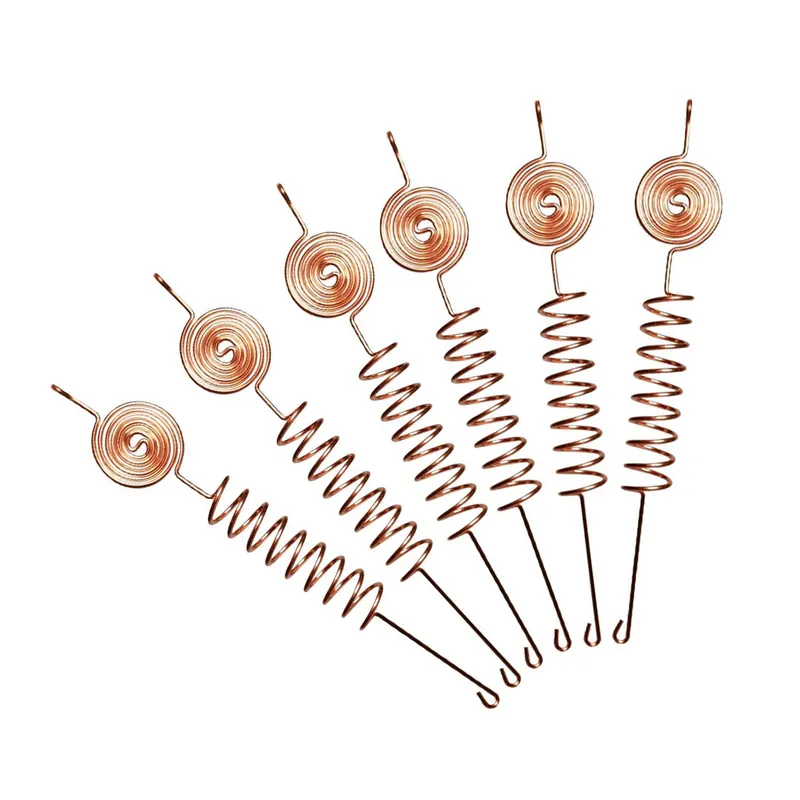
- Tesla-coil spiral. An all-copper stake with a flat spiral on top and a sprung coil below. Despite the name it is not a Tesla coil; our Tesla Coil antenna page explains the difference.
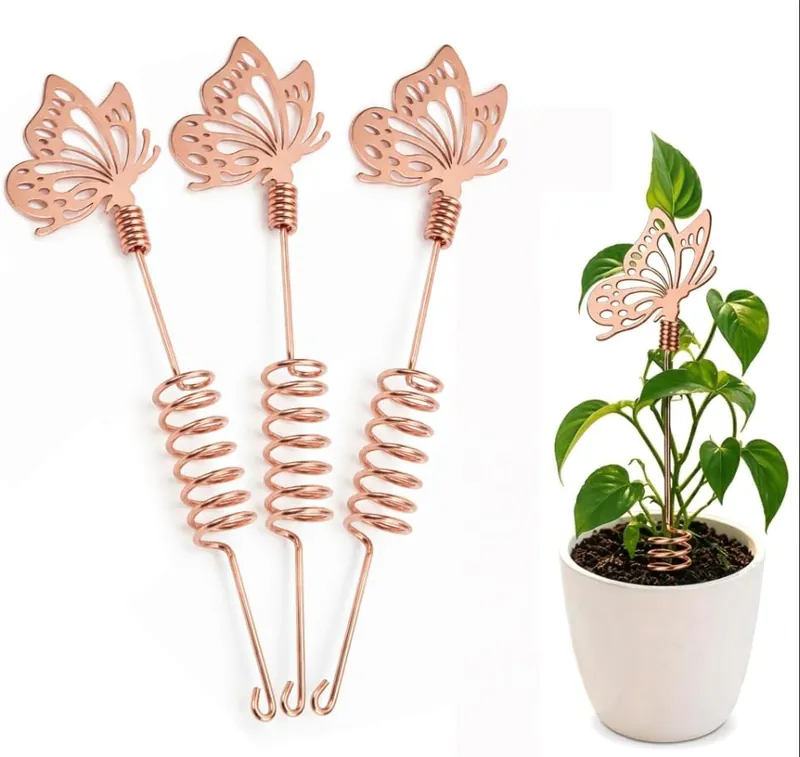
- Butterfly stake. A copper wire butterfly on a coiled stem, sold both as garden decor and as an antenna; see copper garden stakes.
- Christofleau mast. Justin Christofleau's apparatus from his booklet Electroculture (c. 1927): a metal head with a fan of upward wires on a 25 ft post, about 20 ft above ground, feeding a galvanised iron wire buried 10 in deep toward magnetic north. It used no copper coil. More on Justin Christofleau.
- Lakhovsky ring. An open copper ring with its ends not joined. Georges Lakhovsky described placing a 30 cm copper spiral around a single potted geranium in The Secret of Life, then photographed that one treated plant beside two untreated plants, with no measurements; see the Lakhovsky coil.
| Antenna type | Era and origin | What it is claimed to do | Evidence level |
|---|---|---|---|
| Coil-on-stake | 2020s, online guides | Collect atmospheric energy and pass it to roots | Controlled, peer-reviewed: no consistent benefit (Chier et al. 2025) |
| Tesla-coil spiral | Modern store design | Same as the coil, with "coverage" of 2.5–3 ft claimed by the seller | Promotional claim or anecdote; no study of this shape |
| Butterfly stake | Modern store design | Decorative support, plus the antenna claim | Promotional claim or anecdote; no study of this shape |
| Christofleau mast | France, 1920s booklet | Gather air and "telluric" currents into a 14 ft strip of soil | Controlled government or station trial: within experimental error (Iowa, 1930–32) |
| Lakhovsky ring | France, 1925 | Absorb "radiations" around a plant | Historical report: a single treated geranium pictured next to two untreated ones, nothing measured |
What do sellers claim electroculture antennas do?
Sellers claim that electroculture antennas make plants grow faster and healthier, and some go further, to bigger harvests, less watering and fewer chemicals. Thrive Garden's Tesla Coil listing says it has observed that antennas on the south side of a plant did better, that plants within 2.5–3 ft looked improved, and that the base should go 3–4 in into the soil. Those are the store's own observations: no protocol, plot count or measurement is published with them, so treat them as anecdote.
Historical sellers went further. Christofleau's booklet claimed yields up 100 to 200 per cent, no need for fertiliser and protection from insects and mildew. The one witnessed result printed in the same booklet, a 1922 vine harvest, works out on its own figures to about 9 per cent more grapes per vine, and it had no matched control. Any claim about pests, frost or fertiliser should be read in that light.
What does the evidence say about antennas?
The evidence on electroculture antennas is thin, and the best of it is negative. Only one modern controlled study has tested passive copper rods, and only one government station has tested a commercial antenna of the 1920s.
What the trials measured
- 2 mVTypical signal a copper rod passed to the potChier et al. 2025, PLoS One
- 10Plants per crop in each arm of the Marquette pot studyChier et al. 2025, PLoS One
- 1930–32Years Iowa State College trialled an original Christofleau apparatusIowa Research Bulletin 210 (1937)
- 1926Year the USDA said electroculture "is not recommended"USDA Department Bulletin 1379
In the 2025 Milwaukee trial, four leafy and root crops spent 8 weeks in 1-gallon pots under LED lamps, with either a 40 cm dowel wrapped in copper wire and set 10 cm deep, or a 10 cm wrapped dowel fully buried. Height and leaf greenness did not change. Buried copper raised beet and turnip leaf mass by about 2.5 g (p < 0.01), while exposed copper, the arrangement most antennas use, did not. The authors concluded that passive copper gave container vegetables no reliable advantage. Its limits are real: small samples, indoor pots, no field plots.
The older record points the same way. In Iowa Research Bulletin 210, five atmospheric collectors, one of them an original Christofleau apparatus, fed buried copper cables under six crops; yields ran from about 4 per cent lower to 11 per cent higher, all within experimental error. The USDA's 1926 bulletin used overhead wires charged to 30,000–60,000 volts, far more than any passive antenna, and still found no well-defined increase. A peer-reviewed review by Dufour (2026) calls Christofleau's antenna "scientifically unfounded", behaving "more like a lightning rod than a genuine energy transfer system". The full summary is on does electroculture work and the 1926 USDA report page.
Which Thrive Garden antennas can you try?
These are three of the electroculture products Thrive Garden sells, and the people who run it also run this site, so read the following as a description, not a review. All prices are the store's own, checked in October 2026.
- Tesla Coil antenna starter pack (sold by Thrive Garden, a store we own). The store lists it as 99.9% copper, about 11.5 in (29 cm) long, with a clockwise coil. Packs of 3, 6, 12 and 24 cost $39, $73, $141 and $272. At about $11 to $13 a stake it is the cheapest way to run a small side-by-side trial.
- Copper Butterfly garden stakes (sold by Thrive Garden, a store we own). The store describes them as 10-gauge, 99.9% copper. Packs of 3, 6, 12 and 24 cost $39.95, $74.90, $144.80 and $279.60. They work as plant supports and markers whatever the antenna question turns out to be.
- Christofleau-style antenna apparatus (sold by Thrive Garden, a store we own). A modern apparatus the store describes as "based on Justin Christofleau's patent", at $1,499. Its listing links the device to "magnetic water", an idea that does not appear in Christofleau's own 1927 booklet, and the original design was the one Iowa found to give only small, non-significant differences. It is a historical piece; it is not a sensible first experiment.
Everything else Thrive Garden sells for electroculture is in its electroculture collection (a store we own).
How should you use an antenna as an experiment?
Use an electroculture antenna as one arm of a fair comparison, not as a treatment you assume works. The minimum is two matched groups of plants, same variety, same soil, same water and light, with antennas in one group only, assigned by coin toss rather than by which spot looks best.
- Pick a fast crop you can weigh, such as radishes, lettuce or bush beans.
- Make at least four antenna plots and four plain plots, alternated along the bed so one sunny end cannot decide the result.
- Place the antennas the same way in every treated plot; if you follow the store's 3–4 in depth, write that down.
- Weigh the harvest from each plot on the same day and record it.
- Compare the averages and the spread. A 5 to 10 per cent gap between two small groups is well inside normal plot-to-plot variation; the USDA once saw an unelectrified plot beat its neighbour by 43 per cent on soil alone.
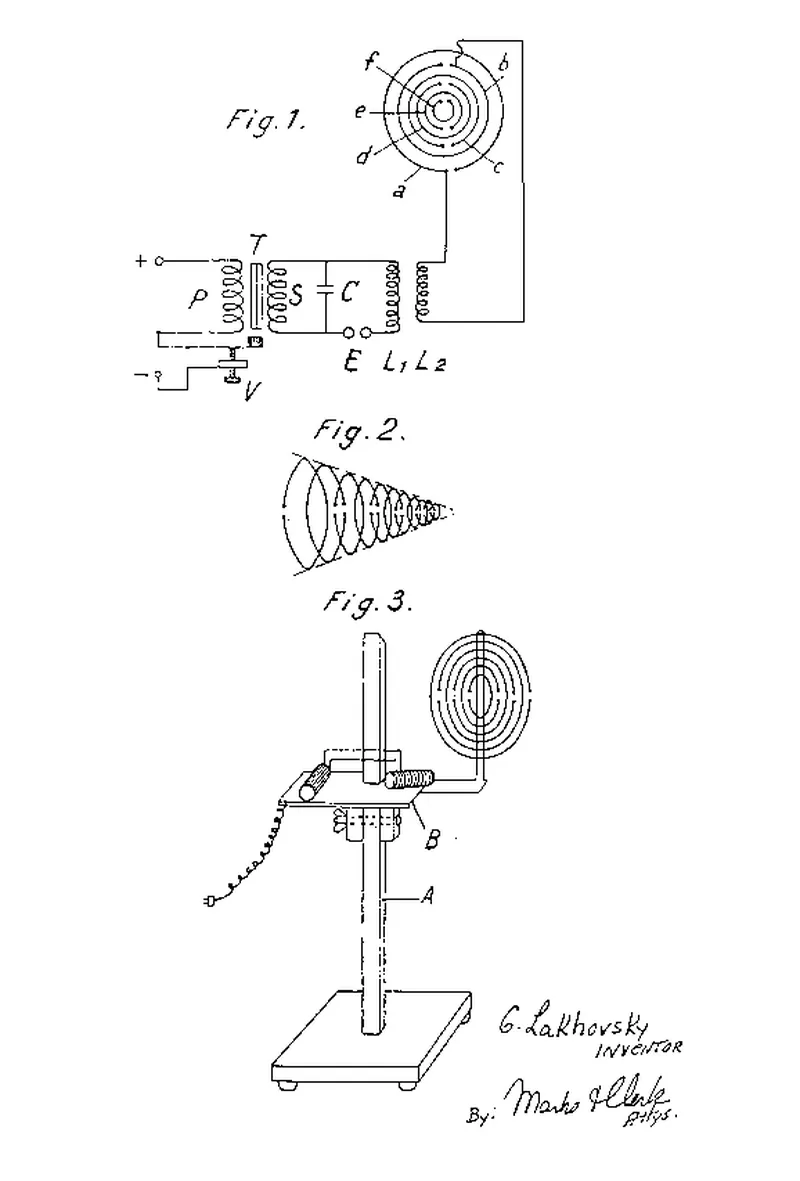
The step-by-step version, with a record sheet, is on how to test electroculture. For spacing and direction choices, see antenna placement, and for the original diagrams, electroculture antenna designs.
How we put this page together
This page is based on Chier et al. 2025 (PLoS One), Iowa Agricultural Experiment Station Research Bulletin 210 (Dorchester, 1937), USDA Department Bulletin 1379 (1926), Dufour 2026 (Comptes Rendus Mécanique), Christofleau's booklet Electroculture (c. 1927) and Lakhovsky's The Secret of Life. Thrive Garden prices, sizes and placement advice come from the store's product pages, checked on 23 October 2026, and are reported as the store's own claims. Left out: forum and social-media reports, health claims attached to Lakhovsky's rings, and design rules (winding direction by hemisphere, compass alignment) that no controlled study has examined.
Common questions
Do electroculture antennas need a battery or power?
No. Every antenna on this page is passive: it has no battery, solar panel or mains connection. Any electrical effect would have to come from the natural field in the air, which delivered about 2 mV into the soil in the 2025 copper rod study.
Are copper antennas better than steel or aluminium ones?
No study has compared metals for garden antennas. Copper is popular because it conducts well, resists corrosion and looks good. Christofleau's own 1920s design used galvanised iron wire underground, not copper.
How long do copper electroculture antennas last outdoors?
Solid copper lasts many years in soil and weather. It darkens to brown within months and slowly turns green; the copper skin of the Statue of Liberty took about thirty years to form a full green patina.
Is a bigger antenna or a taller post more effective?
Height does raise the voltage difference between the top of a conductor and the ground; that is why Christofleau set his mast about 20 ft up. But the Iowa trial of his 20 ft apparatus still found yields within experimental error, so no height has a demonstrated crop effect.
Can an antenna replace fertiliser or pest control?
No controlled study has shown that any passive antenna replaces fertiliser, pesticides or watering. Keep feeding, watering and protecting antenna plots exactly as you do the comparison plots, or the test tells you nothing.
Why do so many gardeners report good results?
Most reports compare this year with last year, or a favoured bed with an ordinary one, and weather, soil and extra attention can easily swing a harvest: the USDA saw two plots differ by 43 per cent in a year when neither was electrified. Without a matched untreated group, a good season looks like an antenna effect.
Are electroculture antennas safe in a vegetable bed?
Copper stakes are inert in normal use, and garden soils already contain about 2 to 100 parts per million of copper. Avoid placing them where they could be struck by a mower, and do not connect any antenna to mains power or high-voltage equipment.
More on antennas
 AntennasElectroculture antenna designs
 AntennasTesla Coil electroculture antenna
 AntennasCopper garden stakes
 Try itHow to test electroculture
Try it in your own beds
Tesla Coil Electroculture Antenna Starter Pack
Check current pack sizes and prices at Thrive Garden, then set up a fair side-by-side test.
View at Thrive GardenThrive Garden, which sells the electroculture antennas and copper stakes we link to, is a store owned by the same team as this site. Ownership disclosure
More help: see our guide to electroculture gardening.