
History
Justin Christofleau and His Electroculture Apparatus
Justin Christofleau was a French inventor who patented and sold a mast-mounted electroculture apparatus in the 1920s; his booklet promised huge harvests, but an Iowa State test of his device found yields within experimental error.
Disclosure: Thrive Garden, which sells the electroculture antennas and copper stakes we link to, is a store owned by the same team as this site. Our history pages follow the original documents and our science pages follow peer-reviewed studies, checked October 2026. Store descriptions are reported as the store's own claims. Ownership disclosure
View at Thrive Garden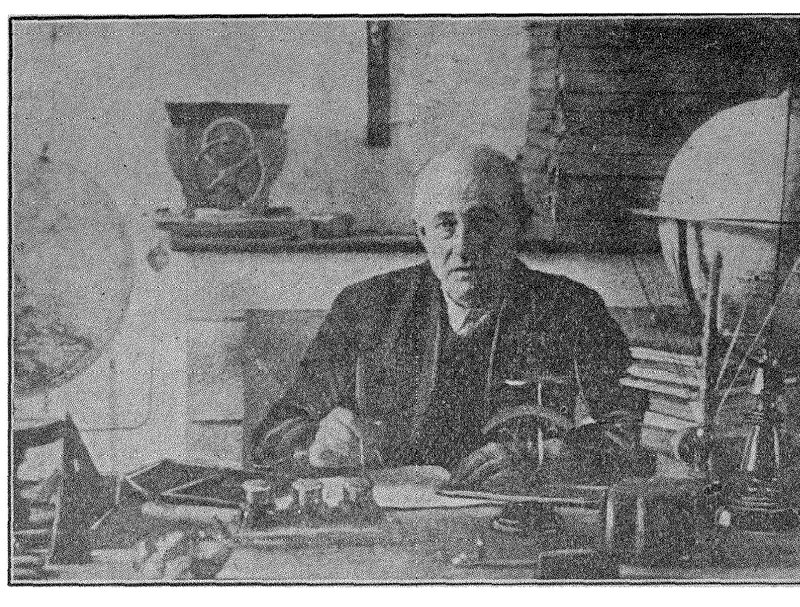
On this page
Key takeaways
- Justin-Etienne Christofleau worked from La Queue-les-Yvelines, near Rambouillet, and filed French patents from 1902 onward; his 1920 electroculture patent is FR 528,468.
- His English booklet Electroculture, issued around mid-1927 by sole agents Alex. Trouchet & Son of Perth, priced the apparatus at £6 and says it was "patented throughout the world" without printing a single patent number.
- The device was a metal head with about 12 upward wires on a 25 ft post, feeding a galvanised iron wire buried 10 in deep toward magnetic north: not a copper coil.
- The booklet's one bailiff-witnessed harvest (a 1922 vineyard) works out on its own figures to roughly 9 per cent more per vine, against an advertised 100–200 per cent.
- Iowa State College ran an original Christofleau apparatus over field plots in 1930–32; no crop moved beyond experimental error (Research Bulletin 210).
- A 2026 peer-reviewed review calls the antenna scientifically unfounded, "behaving more like a lightning rod than a genuine energy transfer system".
Who was Justin Christofleau?
Justin Christofleau was a French inventor and promoter whose electroculture apparatus sold in Europe and Australia in the 1920s. The title page of his English booklet lists him as a Knight of Merit of Agriculture, a Gold Medallist of the Society of Encouragement for National Industries and a member of the Society of Scientists and Inventors of France. The Perth agents called him "a well-known French scientist", but the booklet gives no degree or academic post.
Press extracts in the booklet place him "at the village of La Queue-les-Yvelines, near the forest of Rambouillet" in 1921, and the Iowa station later ordered its apparatus from that address. French patent records on Google Patents list a Justin-Etienne Christofleau as inventor on filings that run from an aero-hydraulic motor (1902) and bakery-oven equipment (1904) to an atmospheric engine (1917), a "réseau thermo-magnétique moto-solaire" for raising farm output (FR 528,468, filed 12 June 1920, published 12 November 1921) and an "Appareil d'électroculture" (FR 683,614, filed 1929). He was, in other words, a working inventor with many interests, of whom electroculture was the best known.
What did Christofleau's apparatus look like?
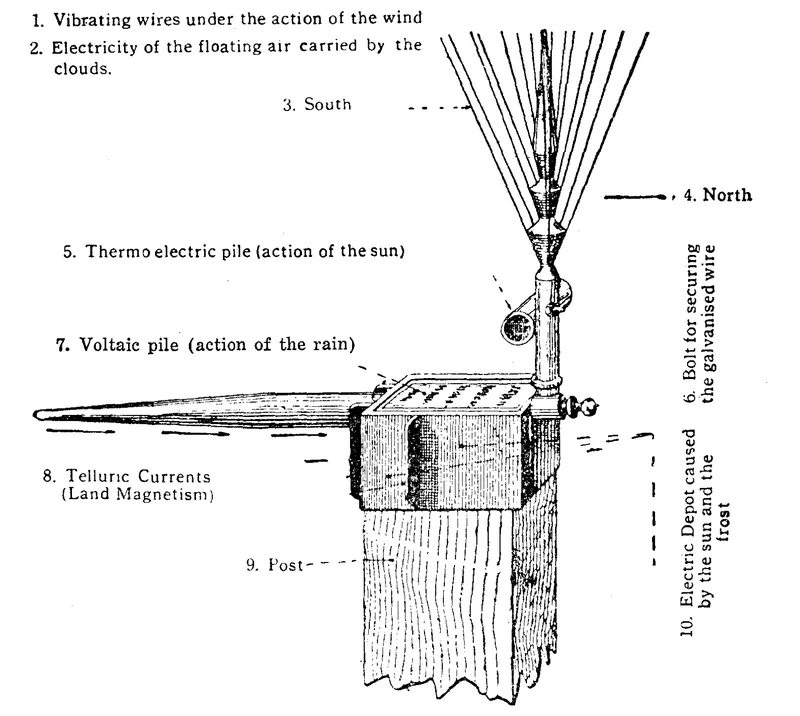
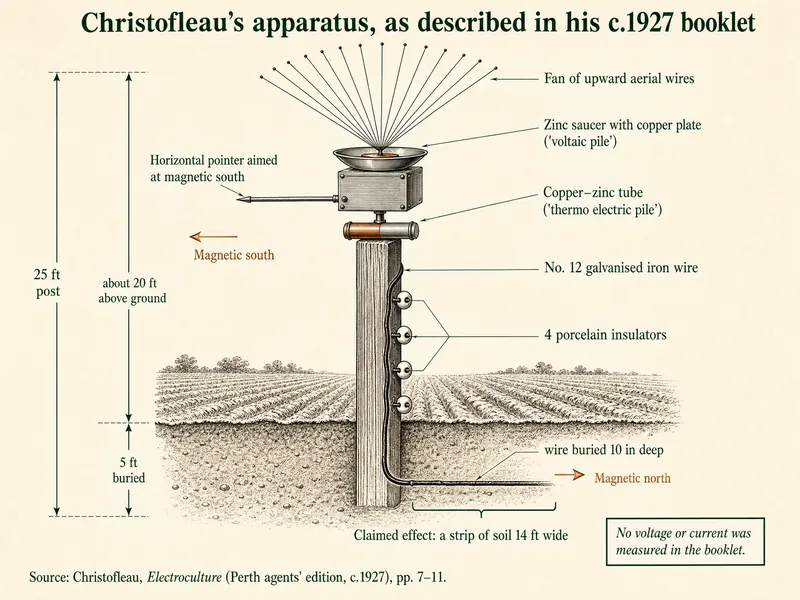
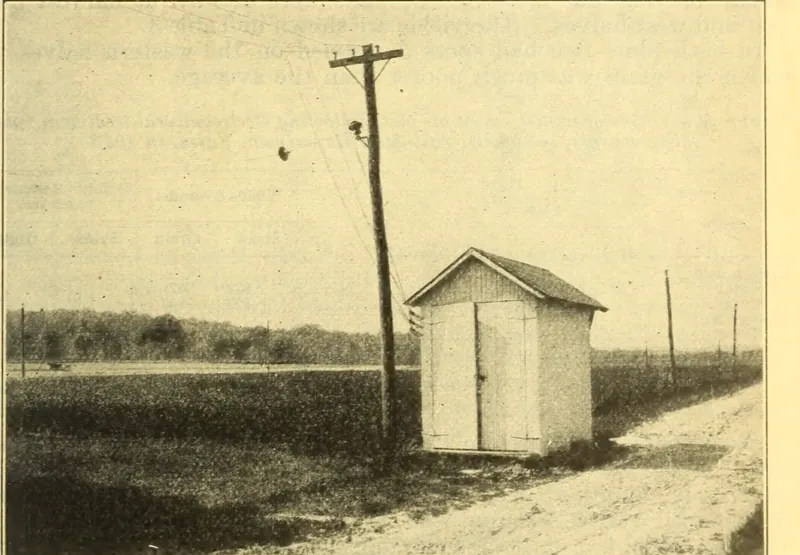
Christofleau's apparatus was a metal head on a tall wooden post, wired to a long buried wire. The booklet's description (printed pp. 7–11) is exact. The head carried a fan of thin upward "aerial" wires and a vertical point, plus a long sideways pointer set toward magnetic south. On top sat a zinc dish with a copper plate riveted to it, called a "voltaic pile" that worked with rain; on the stem was a soldered copper–zinc tube, called a "thermo electric pile" that worked with sunshine.
The head went on a 25 ft post of dry timber, buried 5 ft, leaving about 20 ft in the air, with tarred ends and three guy wires. A No. 12 soft galvanised iron wire ran down the post beside four porcelain insulators, turned at a buried double insulator, and ran 10 in deep in a straight furrow "direct magnetic North" for the length of the field. The booklet said the apparatus "influences a strip of ground 14ft. wide" and that it worked only if aligned exactly.
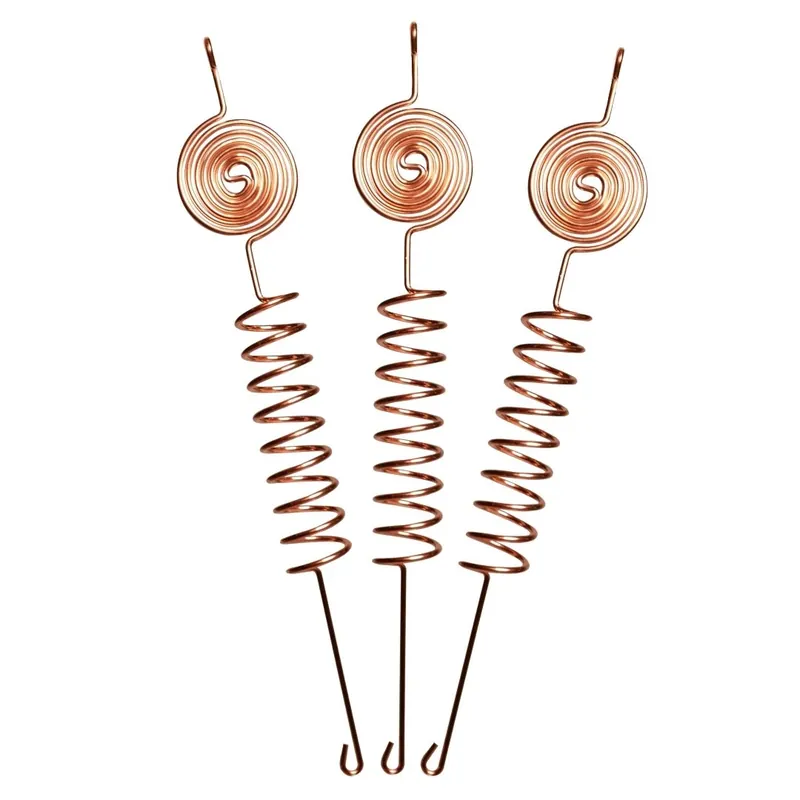
Three details matter for anyone comparing it with today's products. The buried wire was galvanised iron, not copper. There is no coil anywhere. And the booklet never reports a voltage or current reading, so the claim that it fed electricity into the soil was never measured by its maker. For how that design relates to modern stakes, see electroculture antenna designs.
What did Christofleau claim in his 1927 book?
Christofleau's booklet claimed almost everything a grower could want: yields up "100 to 200 per cent. and more", no need for fertiliser, destruction of insects and parasites, cures for mildew, phylloxera and curl-leaf, and sweeter, earlier crops. It also claimed "upwards of a million apparatus in use" and that the device was "patented throughout the world". These are promotional claims with no data behind them in the booklet.
The booklet contradicts itself in places. It tells growers to "use manure for the first year, as if the apparatus were not there", despite the no-fertiliser promise. One contributor says the current flows from south to north and another says north to south. The only patent wording is the agents' phrase and two press quotes; no number, country or year is printed, and the "631,588" on the scanned cover is a library shelf mark.
The firmest-looking evidence in the booklet is thin when read closely:
- Metz, 1921. A one-paragraph note from the agricultural station of Metz said a bean plot with the apparatus produced "THREE TIMES the crop" of its comparison plot in a drought year. No weights or plot sizes are given, and the note itself asks for two or three more years of trials.
- The Claret vineyard, 1922. A court bailiff watched 924 electrified vines produce 100 tubs (comportes) of grapes. The grower said 2,000 manured vines elsewhere gave 199 tubs, a figure nobody witnessed. That works out to about 0.108 against 0.0995 tubs per vine: roughly 9 per cent more.
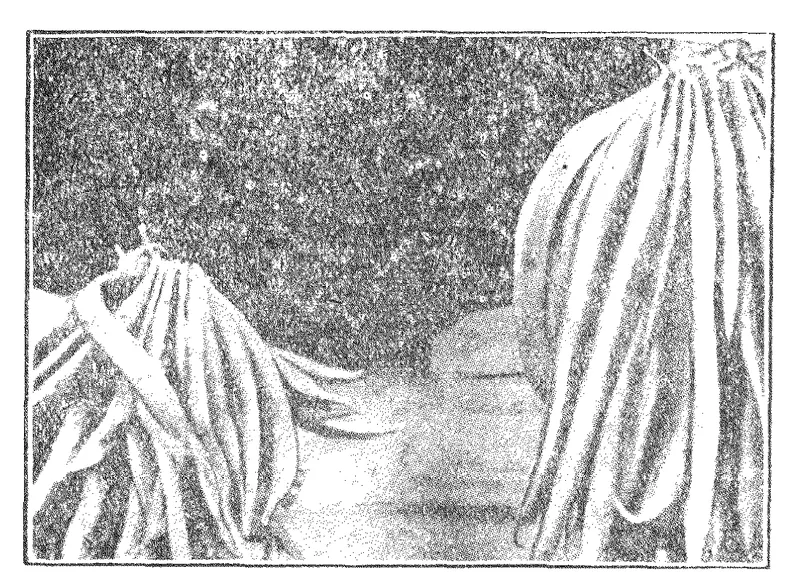
- Everything else is customer letters, press clippings and photographs of tall peas, beans and clover with no comparison plot in view.
Were Christofleau's results ever tested?
Yes: Christofleau's own apparatus was tested in a controlled trial, and it made no measurable difference. Charles Dorchester of Iowa State College set up five atmospheric collectors along a field at the Ames Agronomy Farm, including "one original Christofleau apparatus" bought from La Queue-les-Yvelines, each feeding buried cables under crop plots. Over 1930–32, the six crops (corn, soybeans, turnips, chard, beets, string beans) came out between 3.95 per cent below and 11.05 per cent above their controls, which Dorchester judged within experimental error. The collectors passed currents of only about a billionth of an amp in fair weather (Iowa Research Bulletin 210, March 1937).
A 2026 review by a plasma physicist reaches the same view. Thierry Dufour's 2026 history of plasma agriculture describes the antenna as "behaving more like a lightning rod than a genuine energy transfer system", and says Christofleau's bean photographs compared plots that differed in fertiliser, soil, season and rainfall. His companion model of an 18th-century collector found that a passive mast concentrates the fair-weather field only within millimetres to centimetres of its tips. The wider evidence is summarised on does electroculture work.
Christofleau's apparatus in numbers
- 25 ftPost length in the booklet, 5 ft of it buriedChristofleau, Electroculture (c. 1927), p. 10
- 14 ftWidth of soil strip the booklet claimed one apparatus treatedChristofleau, Electroculture (c. 1927), p. 12
- about 9%Per-vine gain implied by the booklet's own 1922 vineyard figuresChristofleau, Electroculture (c. 1927), p. 45
- 6 cropsTested under Iowa's collectors, including a Christofleau, with no gain beyond errorIowa Research Bulletin 210 (1937)
- 1920Filing year of Christofleau's French patent FR 528,468Google Patents record
- 1926Year the USDA reviewed electroculture and did not recommend itUSDA Bulletin 1379
| Claim in the booklet | What the record shows | Evidence level |
|---|---|---|
| Yields up 100–200 per cent | Witnessed 1922 vineyard figures imply about 9 per cent per vine, unmatched control | Promotional claim or anecdote |
| Beans "three times" the crop at Metz, 1921 | One season, no weights, station asked for more years | Historical report |
| Captures atmospheric and "telluric" electricity | No current measured in the booklet; Iowa measured about 1 billionth of an amp | Controlled government or station trial |
| Higher yields in the field | Six crops within experimental error, 1930–32 | Controlled government or station trial |
| "Patented throughout the world" | French patents found; no number printed in the booklet | Patent record |
| Works like a power source for plants | "More like a lightning rod" | Peer-reviewed review/model |
Where can you read Christofleau's electroculture book?
The English booklet Electroculture survives as a 62-page scan of a copy from the Parliamentary Library in Canberra; it carries no printed date, but its latest dated items are newspapers of July 1927. We have not found a library-hosted public copy to link, and copies circulating on file-sharing sites and social media groups are unofficial uploads. The Iowa bulletin cites an earlier French edition, Augmentation des récoltes et sauvetage des arbres malades par l'électroculture (La Queue-les-Yvelines, 1923), and Dufour cites a 1925 French title reprinted by Éditions Permafutur. Our electroculture books page explains where the legitimate public-domain classics can be read.
Can you buy a Christofleau-style apparatus today?
Yes. Thrive Garden, run by the people behind this library, sells the Electroculture Antenna Apparatus (a store we own) at $1,499 (the store's price, checked October 2026), a modern apparatus the store describes as "based on Justin Christofleau's patent". We have not compared its parts with the booklet's drawing piece by piece. The store's listing describes the device in terms of "magnetic water", an idea that does not appear in the 1927 booklet; read it as the store's framing, not Christofleau's.
Buy it, if at all, as a striking piece of electroculture history or a garden centrepiece, not as a yield booster: the one controlled test of an original found no effect. If you want to judge it yourself, set up matched plots on both sides of the buried wire and follow our guide to a fair side-by-side trial.
A piece of electroculture history
Electroculture Antenna Apparatus (Christofleau-style)
Thrive Garden sells a modern apparatus it describes as based on Christofleau's patent. Buy it as a working display of 1920s design; no controlled trial has shown a yield gain from this kind of apparatus.
View at Thrive GardenThrive Garden, which sells the electroculture antennas and copper stakes we link to, is a store owned by the same team as this site. Ownership disclosure
How we put this page together
This page is based on Christofleau's English booklet Electroculture (Alex. Trouchet & Son, Perth, c. 1927), with page images checked for every quoted figure; Iowa Research Bulletin 210 (Dorchester, 1937); the two 2026 Dufour papers; and French patent records on Google Patents, all checked in October 2026. Google Patents' coverage of 1920s filings outside France is incomplete, so foreign patents may exist that we did not find. Unverified biographical details circulating online, such as birth dates and factory sales figures, were left out, as were the booklet's health and pest claims beyond naming them.
Common questions
Did Christofleau invent electroculture?
No. Electroculture experiments go back to Maimbray's myrtles in 1746 and Bertholon's collector of 1783, and Lemström's high-voltage trials began in 1885. Christofleau designed and patented one apparatus in the 1920s and promoted it widely; see electroculture history.
Is Christofleau's apparatus the same as a copper coil antenna?
No. His device put a metal head on a mast about 20 ft high and ran galvanised iron wire underground toward the north. The copper wire wound on a stake that gardeners use today, such as the Tesla coil style antenna, does not appear anywhere in his booklet.
What is the Christofleau patent number?
The booklet prints none. French records show a 1920 filing by Justin-Etienne Christofleau, FR 528,468, for a thermo-magnetic network to raise farm output, and a 1929 filing, FR 683,614, titled "Appareil d'électroculture". The number 631,588 on the scanned booklet is a library shelf mark, not a patent.
How much did the apparatus cost in 1927?
The Perth agents priced it at £6, cash with order, packed free on rail at Perth. They also sold "electrified" seeds at 10 shillings an ounce.
Why must the wire point to magnetic north?
The booklet says currents "invariably travel South to North" and that the device fails if misaligned, but another contributor in the same booklet says the opposite direction. No measurement supports either version.
Did the Metz agricultural station endorse Christofleau?
Its 1921 note reported a strong bean result from one split field in a dry year and asked for two or three more years of trials. The booklet prints only a translation, with no weights or plot sizes, so it cannot be checked.
Has the modern store apparatus been tested?
No controlled trial of the modern apparatus exists. The only controlled test of the design used an original apparatus at Iowa State College in 1930–32 and found yields within experimental error.
More from the archive
More help: see our guide to electroculture gardening.