
History
Electroculture History: Who Invented It and When
Electroculture history begins in 1746 with electrified myrtles in Edinburgh; no single person invented it, and after 280 years no controlled field trial has shown a dependable yield gain.
On this page
Key takeaways
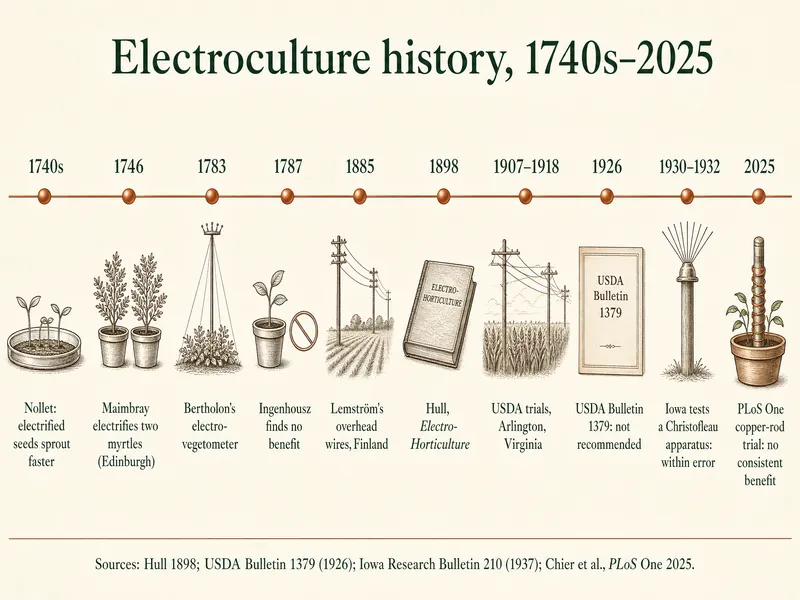
- The first reported plant-electricity experiment was Maimbray's two electrified myrtles in Edinburgh in 1746, as Hull's 1898 Electro-Horticulture records.
- Abbé Bertholon described the first purpose-built collector, the electro-vegetometer, in 1783; a 2026 physics model found its effect confined to millimetres or centimetres of its tips.
- Selim Lemström's overhead-wire trials in Finland from 1885 reported gains of 40 per cent and more, and set off the high-voltage era.
- The USDA tested charged wire networks at Arlington, Virginia, in 1907–1918 and concluded in Bulletin 1379 (1926) that electroculture "is not recommended".
- Iowa State College tested an original Christofleau apparatus in 1930–32; every crop stayed within experimental error (Research Bulletin 210).
- The 2020s social-media revival met its first controlled test in Chier et al. 2025, which found no consistent benefit from passive copper rods.
Who invented electroculture?
Nobody invented electroculture in a single act: it grew out of 18th-century experiments with static electricity, and the credit depends on what you count. The first recorded plant experiment belongs to a Dr. Maimbray (also written Demainbray) of Edinburgh, who in 1746 passed current from a friction machine through two young myrtles and reported that it "stimulated their growth", according to Hull's survey (p. 1). The Iowa bulletin adds that his myrtles branched and blossomed in October while unelectrified ones did not.
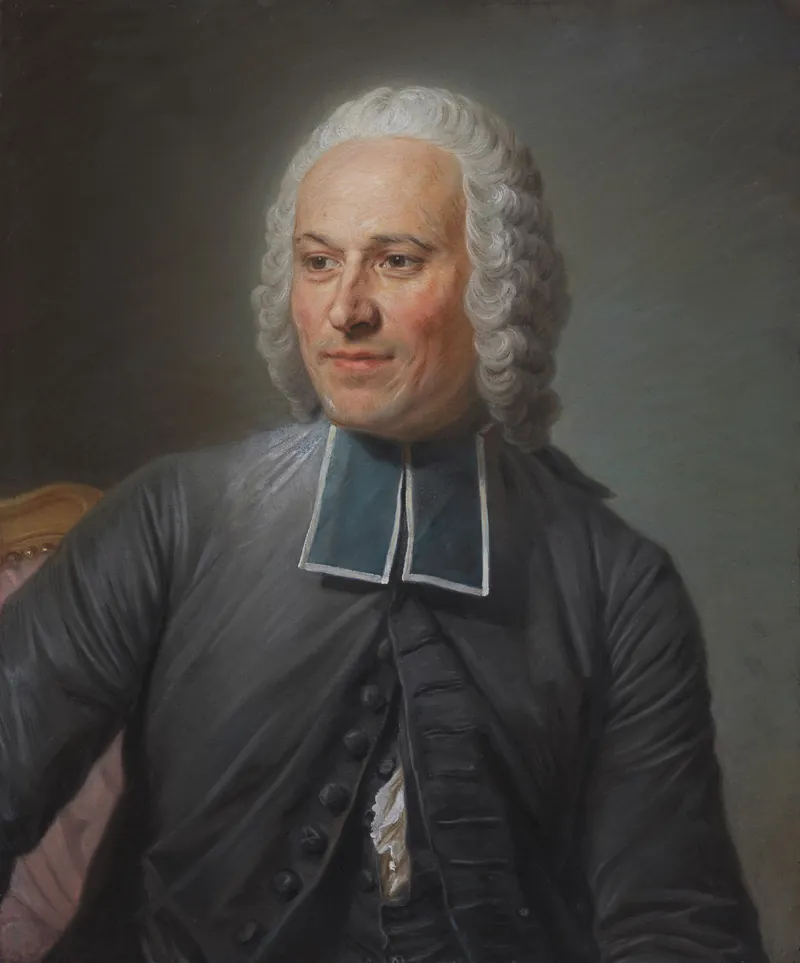
The first technically described device came later. Abbé Pierre Bertholon's De l'électricité des végétaux (1783) set out an insulated mast with an iron point that gathered atmospheric charge and fed it to a crown of points over the crop. A 2026 historical review by the plasma physicist Thierry Dufour credits Bertholon with the first technically described electroculture devices, while noting that none of them came with measurements, controls or randomisation.
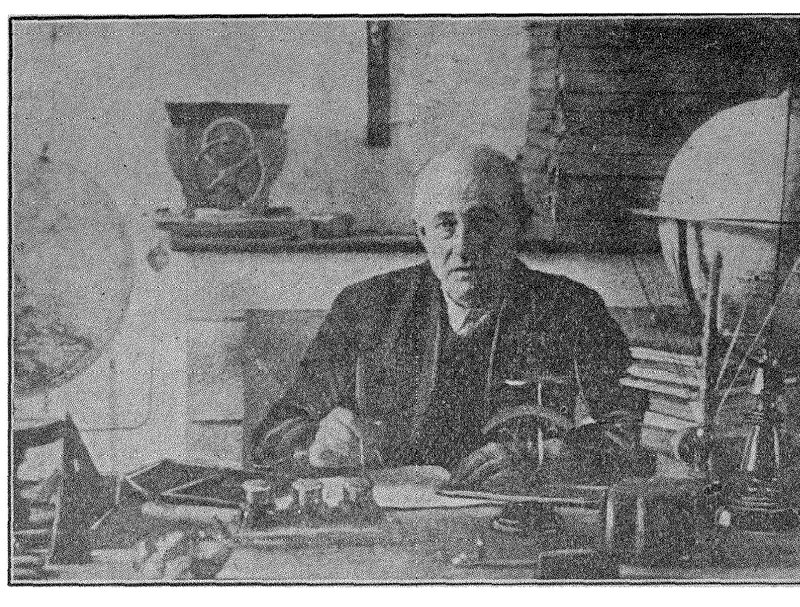
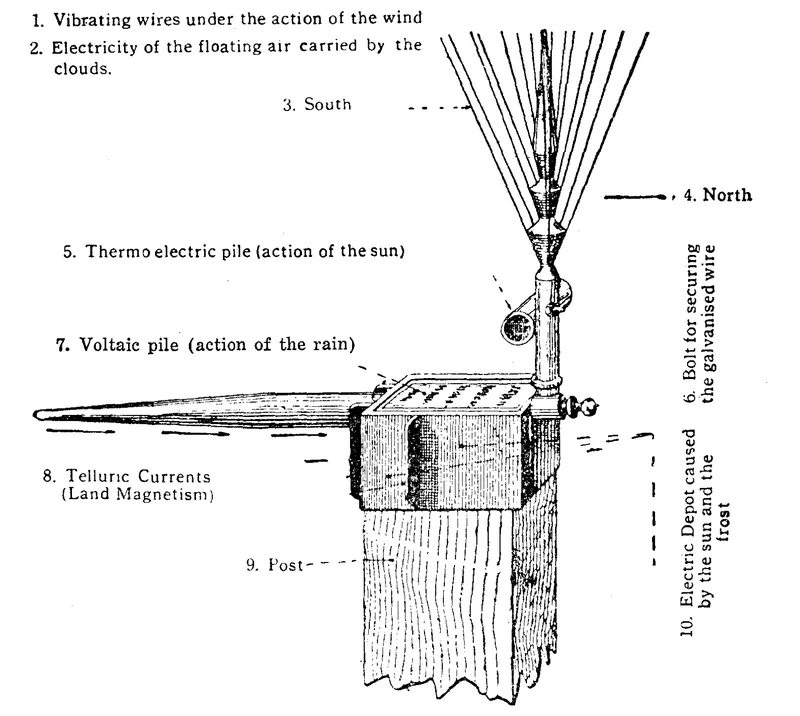
Many websites name Justin Christofleau as the inventor. He was a 1920s promoter who patented and sold an apparatus some 170 years after Maimbray; see Justin Christofleau for what his booklet actually says.
What happened in the 1700s and 1800s?
The 1700s produced a string of favourable reports and one influential rebuttal; the 1800s produced the first larger series, and most of them came out mixed or negative. In the late 1740s Abbé Nollet reported that electrified seeds sprouted faster. Others repeated similar trials, and Bertholon summarised them in 1783. Then Jan Ingenhousz published experiments in 1785–88 showing that "electrified seeds would not germinate quicker than others", and the Genevan botanist Senebier judged in 1800 that the sceptical view was "more logical", as the USDA bulletin recounts (p. 31).
The 19th century moved electricity into the soil. The USDA's literature review lists Solly's 70 small tests in England (1845/46): 19 helped, 16 harmed, 35 showed no effect. Holdefleiss in 1884 found "no difference in growth" in rows wired to a battery, though zinc–copper plates gave 15–24 per cent more beets and potatoes. Wollny's plots of 1883–87 found the control "in nearly all cases" gave the best yield. In France, Brother Paulin's lightning-rod-like géomagnétifère near Montbrison, from about 1891, was reported by Hull to raise potato yields 50–75 per cent: a historical report with no published control data.
What did Lemström add around 1900?
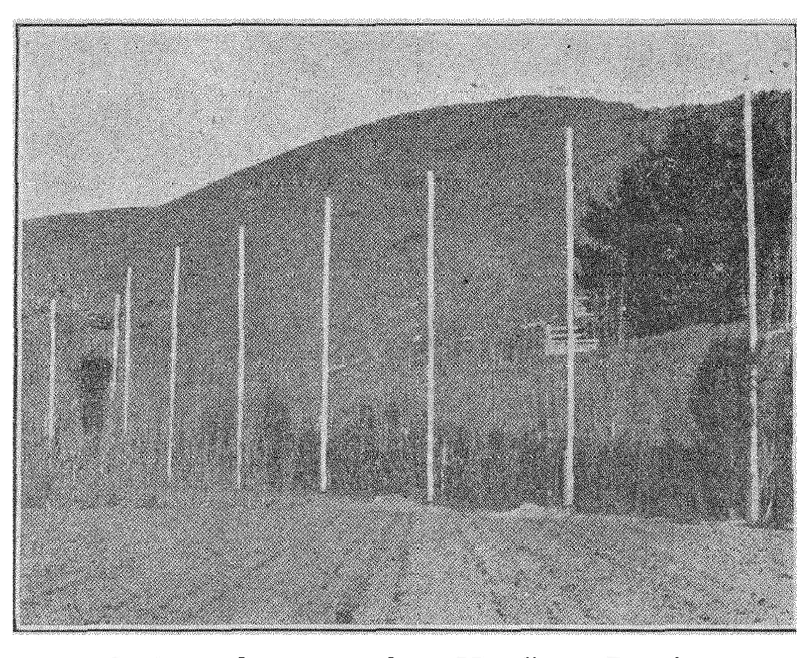
Selim Lemström, a Finnish physicist who studied the aurora, brought high voltage and scale. Starting in 1885 he hung insulated wires with downward points over pots and fields and charged them from an influence machine. His first laboratory pots grew an estimated 40 per cent more, and in his 1904 book he put the smallest real gain at about 45 per cent on land of average fertility, while warning that treatment in hot sunshine did harm.
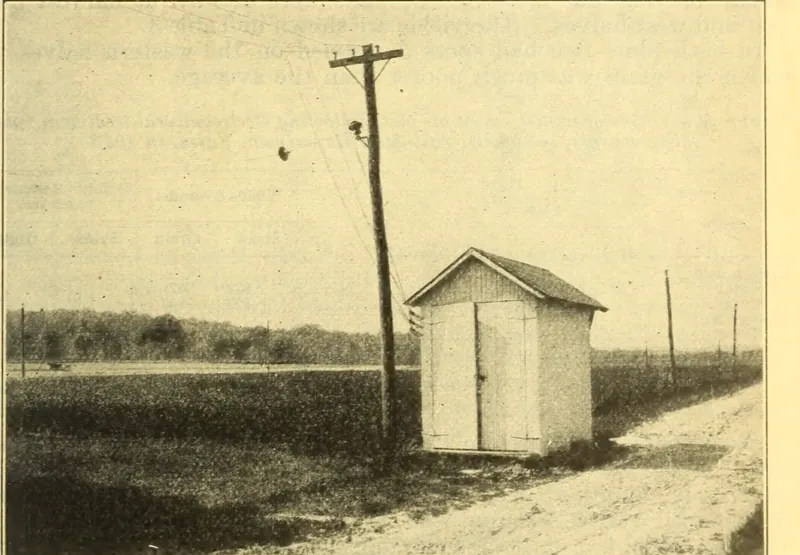
Those figures are historical reports: small plots, few repeats, no statistics. They were persuasive enough that British researchers built on them. Sir Oliver Lodge and J. E. Newman ran networks at Evesham, and the Board of Agriculture's committee, led by V. H. Blackman, ran 33 field trials between 1915 and 1920. The full story is on our Selim Lemström page.
Why did electroculture peak in the 1920s?
Electroculture peaked in the 1920s because the British field trials looked encouraging and promoters were selling devices to farmers. Arthur Allen's 1922 primer (pp. 97–101) reported oats on Miss Dudgeon's farm up 49 per cent in grain and 88 per cent in straw in 1916, and a committee average of 22 per cent for spring oats and barley. Allen judged most electrical methods disappointing but concluded overhead high-voltage discharge raised yields, while calling it still experimental.
The careful checks came in the same decade. The USDA had run its own networks at Arlington Experiment Farm, Virginia, in 1907–08 and 1911–18, at 30,000–60,000 volts. Across the main winter-wheat seasons of 1914–18, the plot under the wires yielded between 11 per cent less and 3 per cent more grain than its control. Rye that beat its control by 40 per cent in 1915 beat it again by 43 per cent in 1916, on the same ground with the current switched off. Re-reading Blackman's work, the USDA found his 47 pot trials averaged just 1 per cent, "well within the experimental error". Its 1926 verdict: electroculture "is not recommended". Our guide to the 1926 USDA report walks through every table.
Meanwhile Justin Christofleau, working from La Queue-les-Yvelines near Paris, was filing French patents and selling his mast-mounted apparatus through agents as far away as Perth. Georges Lakhovsky, also in Paris, reported in 1925 that an open copper spiral around a single geranium cleared its bacterial tumour: one treated plant photographed beside two untreated plants, no measurements. It is the origin of the garden Lakhovsky coil.
Why did electroculture fade after the 1930s?
Electroculture faded after the 1930s mainly because the controlled trials kept failing to find a dependable gain. In Charles Dorchester's field tests at Iowa State College (1930–32), an original Christofleau apparatus and four other atmospheric collectors fed buried cables under crop plots: six crops varied from −3.95 to +11.05 per cent, all within experimental error. His one statistically significant gain came in a 1932 greenhouse test of copper–zinc earth cells on poor soil: oat grain +9.9 per cent with the earth cells alone and +16.2 per cent where dry cells boosted the current. On richer soil that year the earth-cell flats yielded about 6 per cent less, and the 1932–33 repeat showed no grain gain. He concluded that the matter "must remain debatable".
After that, the idea lived on mostly in self-published books and hobby magazines, such as George Starr White's Cosmo-Electro-Culture (1940) and L. George Lawrence's 1971 Popular Electronics article; our electroculture books page weighs each one. Serious research moved to powered treatments with measured doses. Today's plasma agriculture is not a descendant: Dufour traces it to plasma physics and medical sterilisation from the 1970s, not to the old antennas.
How did electroculture come back?
Electroculture came back in the 2020s through social media, in a do-it-yourself form: a length of bare copper coiled around a dowel and set upright among the vegetables. Chier and colleagues note that "home gardeners on social media have adopted the term electroculture" and that big-box stores began stocking copper-wrapped dowels. In July 2024, WSU Extension quoted horticulturist Linda Chalker-Scott: "none of these promises are backed with any reliable scientific evidence."
The revival brought the first modern tests. The 2025 PLoS One trial grew mustard greens, kale, turnips and beets for eight weeks beside exposed or buried copper-coiled dowels and found no consistent benefit; buried copper did add about 2.5 g of beet and turnip biomass, which the authors thought likely a result of small sample sizes. The rods carried about 2 millivolts into the soil. Dufour's 2026 model of Bertholon's collector found fair-weather effects "subtle and highly localized", and his review called Christofleau's antenna scientifically unfounded. For the full evidence, see does electroculture work and our table of electroculture studies.
Electroculture history in numbers
- 1746Year of the first reported plant experiment, Maimbray's myrtlesHull, Electro-Horticulture (1898), p. 1
- 19 of 70Solly's 1840s soil tests that showed any benefitUSDA Bulletin 1379 (1926), p. 17
- +1%Average gain across 47 British pot trials, within errorUSDA Bulletin 1379 (1926), p. 29
- −3.95% to +11.05%Crop differences under five Iowa collectors, all within errorIowa Research Bulletin 210 (1937)
- 2 mVSignal copper rods carried into soil in 2025Chier et al. 2025, PLoS One
| Year | Who | What was tried | What was reported | Evidence level |
|---|---|---|---|---|
| 1746 | Maimbray, Edinburgh | Friction-machine current through two myrtles | Faster growth, early blossom | Historical report |
| 1783 | Bertholon, France | Pointed atmospheric collector over crops | Better growth claimed, nothing measured | Historical report |
| 1785–88 | Ingenhousz | Electrified seeds | No faster germination | Historical report |
| 1885–1904 | Lemström, Finland | Charged overhead wires | Gains of 40% and more | Historical report |
| 1907–1918 | USDA, Arlington | Charged networks at 30–60 kV | No well-defined increase | Controlled government or station trial |
| 1915–1920 | Blackman, Britain | Committee field and pot trials | +14% in the field, +1% in pots | Controlled government or station trial |
| 1930–1932 | Dorchester, Iowa | Christofleau and other collectors | Within experimental error | Controlled government or station trial |
| 2025 | Chier et al., Marquette | Passive copper rods, 4 crops | No consistent benefit | Controlled, peer-reviewed |
If you want to see for yourself, the honest next step is a fair side-by-side trial: how to test electroculture shows how. New to the subject? Start with what electroculture is, and the electroculture FAQ covers the common questions.
How we put this page together
This timeline draws on the original documents, read page by page: Hull (1898), Lemström (1904), Allen (1922), the USDA's 1926 bulletin, Christofleau's booklet Electroculture (c. 1927), the Iowa station's 1937 bulletin, the 2025 Marquette trial and Dufour's two 2026 papers, all checked in October 2026. Dates for 18th-century work come from those documents, which sometimes disagree; where they do, a decade is given instead of a year. Forum posts, sellers' histories and unreferenced web timelines were left out.
Common questions
Is electroculture an ancient practice?
No document in this library supports an ancient origin. The earliest recorded plant experiment with electricity is Maimbray's in 1746, shortly after the Leyden jar made stored static charge available. Claims that older cultures used copper antennas in fields have no primary source behind them.
Did Nollet or Bertholon come first?
Nollet's seed experiments of the late 1740s came before Bertholon's 1783 book. Bertholon was the first to describe a dedicated collecting device in technical detail, which is why Dufour's 2026 review gives him that credit. Maimbray's 1746 myrtles predate both.
When was the word electroculture first used?
The documents here show the term in common use by the 1900s: a First Congress of Electroculture was held at Rheims in 1912, according to Christofleau's booklet, and the USDA titled its 1926 bulletin simply Electroculture. Earlier writers such as Hull in 1898 preferred "electro-horticulture".
Why did the British trials look better than the American ones?
Blackman's field trials averaged 14 per cent more yield, but the USDA traced the biggest gains at Lincluden to control strips that yielded only 28.9 and 33.0 bushels an acre against 43–46 elsewhere. His tighter pot trials averaged 1 per cent. The USDA attributed the largest gains to soil differences.
Was electroculture suppressed by the fertilizer industry?
None of the historical documents supports that story. The record shows electroculture fading because government and university trials found no reliable effect, while the authors of those trials called openly for more research where differences looked real.
What sparked the 2020s revival?
Posts on social media popularised copper coils on wooden stakes, and shops started stocking them, as the 2025 PLoS One paper notes. The revival borrowed old names such as Lemström and Christofleau, though their devices were high-voltage networks and tall masts, not garden coils.
Has any modern lab confirmed the old yield claims?
No. The one controlled study of passive copper rods, published in 2025, found no consistent benefit. Modern work showing real plant effects uses powered electric fields or cold plasma at measured doses, which Dufour stresses is a separate line of research.
Keep reading
More help: see our guide to electroculture gardening.