
Learn
Electroculture Studies: Every Documented Trial Compared
Electroculture studies span 280 years, from 1746 myrtle trees to a 2025 PLoS One copper-rod trial, and the better controlled each study was, the smaller its reported yield gain became.
On this page
This page gathers every electroculture trial we could trace to an original document into one table, with who ran it, when, on what crop, by what method, what they found and how much weight the result can bear. The evidence levels are the same ones used across this library: controlled, peer-reviewed; controlled government or station trial; historical report; and promotional claim or anecdote, with physics models and reviews marked peer-reviewed review/model.
Key takeaways
- USDA Bulletin 1379 (1926) reported Arlington trials from 1907-1908 and 1911-1918 and reviewed dozens of earlier studies from Europe and the United States.
- Iowa's Research Bulletin 210 (1937) produced the only statistically significant yield gain in either bulletin: on poor greenhouse soil in 1932, oat grain rose 9.9% with copper-zinc earth cells and 16.2% with earth cells boosted by a dry cell, a gain that did not repeat.
- V. H. Blackman's British field trials, published in the Journal of Agricultural Science in 1924, averaged +14% across 33 trials; the companion pot trials averaged +1%.
- E. Solly's 70 small tests in the 1840s split 19 beneficial, 16 harmful and 35 with no effect, according to the USDA's review.
- Chier et al. 2025 is the only controlled, peer-reviewed test of the passive copper rods sold to gardeners.
- Powered seed treatments are a separate, active field: Sun et al. 2024 raised chili seed germination rate by 20.45% with a high-voltage field.
What does electroculture research show overall?
Electroculture research follows a clear pattern: large gains in early, loosely controlled reports and small or absent gains once researchers used proper control plots. The 18th- and 19th-century record, mostly relayed by George Hull's 1898 Electro-Horticulture, includes reported gains of a third or more. The USDA and Iowa field programmes of 1907-1934, which measured how much untreated plots differed on their own, found no reliable effect.
Modern research splits in two. The one controlled test of passive copper antennas found no consistent benefit. Powered treatments, where seeds get a measured dose from a high-voltage field or cold plasma, do show lab effects, but they are a different technology. For the short verdict, see does electroculture work?.
- 33British field trials Blackman ran, averaging +14%Blackman 1924, J. Agric. Sci., via USDA p. 28
- 47British pot trials, averaging +1%Blackman and Legge 1924, via USDA p. 29
- 5Atmospheric collectors Iowa tested, one an original ChristofleauIowa Research Bulletin 210, p. 11
- 10Plants in each treatment group, per crop, in Marquette's pot testChier et al. 2025, PLoS One
| Group | Who | Year | Crop | Method | Result | Evidence level | Source |
|---|---|---|---|---|---|---|---|
| Historical | Maimbray, Edinburgh | 1746 | Two myrtles | Current from a frictional machine | "Stimulated their growth", no figures | Historical report | Hull 1898, p. 1 |
| Historical | Ingenhousz | 1787 | Seeds and plants | Electrification | No benefit found | Historical report | Hull 1898, p. 6; USDA p. 31 |
| Historical | E. Solly, England | 1845-46 | Grains, vegetables, flowers | Small soil plates | 19 better, 16 worse, 35 no effect | Historical report | USDA p. 17 |
| Historical | Wollny | 1883-1887 | Rye, beans, potatoes and others | Current through soil | Control usually best | Historical report | USDA pp. 18-19 |
| Historical | Holdefleiss | 1884 | Sugar beets, potatoes | Battery; zinc-copper plates | Battery: no difference; plates +15 to +24% | Historical report | USDA p. 18 |
| Historical | Lemström, Niemis, Finland | 1885 | Barley | Charged wires from a Holtz machine | Crop up one third | Historical report | Hull 1898, p. 7 |
| Historical | Paulin, near Montbrison | from 1891 | Potatoes | Collector feeding buried wires | +50 to +75% | Historical report | Hull 1898, pp. 9-10 |
| Historical | Bailey, Cornell | before 1898 | Radishes | Naked arc light | -45 to -65% | Historical report | Hull 1898, p. 22 |
| Historical | Newman, Evesham | 1905-1911 | Wheat | Overhead network | +21% average grain | Historical report | USDA p. 23 |
| Historical | Kövessi | 1912 | Various | Direct current, about 1,100 experiments | Unfavourable | Historical report | USDA p. 21 |
| Station | USDA, Arlington | 1907 | 10 vegetables | Network above 50,000 V | 8 of 10 yielded less | Controlled government or station trial | USDA pp. 3-4 |
| Station | USDA, Arlington section E | 1914-1918 | Winter wheat | Networks at 30,000-60,000 V | Grain between 0.89 and 1.03 times the untreated plot | Controlled government or station trial | USDA pp. 4-9 |
| Station | USDA, Arlington section A | 1915-16 | Rye | Network in 1915, none in 1916 | +40%, then +43% with no electricity | Controlled government or station trial | USDA pp. 12-13 |
| Station | USDA plant house | 1918 | Cowpeas | Charged pots | Water use 449 vs 429, about 4% more | Controlled government or station trial | USDA p. 15 |
| Station | Dudgeon farm, Dumfries | 1916 | Oats | Overhead discharge, 848 hours | +49% grain, +88% straw | Controlled government or station trial | Allen 1922, p. 100 |
| Station | Llantwit Vadre, Wales | 1917-18 | Potatoes | Network at 30,000-39,000 V | +17.2% and +12.6% | Controlled government or station trial | Allen 1922, pp. 100-101 |
| Station | Blackman and colleagues | 1915-1920 | Oats, barley, wheat | Overhead discharge, 33 field trials | +14% average; 21 up, 12 down | Controlled government or station trial | USDA pp. 27-29 |
| Station | Blackman and Legge | to 1924 | Pot crops | Discharge over pots, 47 trials | +1% average; 26 up, 21 down | Controlled government or station trial | USDA p. 29 |
| Station | Rothamsted; Sutton and Sons | 1919 | Seed grain | Wolfryn electrolysed seed | Unfavourable | Controlled government or station trial | Allen 1922, p. 102 |
| Station | Dorchester, Iowa | 1930-1932 | Corn, soybeans, turnips, chard, beets, beans | 5 collectors incl. Christofleau's | -3.95% to +11.05%, all within error | Controlled government or station trial | Iowa pp. 10-16 |
| Station | Dorchester, Iowa | 1931 | Oats | 7,000-20,000 V to roots | 94-102% of control | Controlled government or station trial | Iowa pp. 16-19 |
| Station | Dorchester, Iowa | 1932-33 | Oats | Copper-zinc earth cells | 1932, poor soil: earth cell +9.9% grain, dry-cell-boosted +16.2% (significant); 1933: roots -7.7% and -10.8% | Controlled government or station trial | Iowa pp. 19-29 |
| Peer-reviewed | Chier et al., Marquette Univ. | 2025 | Mustard greens, kale, turnips, beets | Passive copper rods, exposed or buried | No height or SPAD effect; buried +2.5 g in beets and turnips | Controlled, peer-reviewed | PLoS One |
| Peer-reviewed | Dufour, Sorbonne/CNRS | 2026 | None (model) | Simulated Bertholon collector | Field gain within mm-cm of tips | Peer-reviewed review/model | CR Mécanique |
| Powered seed | Patwardhan and Gandhare | 2013 | Tomato seed | 10-30 kV/cm field, 10-30 s | 100% vs about 76% germination, mainly ozone | Controlled, peer-reviewed | Acta Agrophysica |
| Powered seed | Sun et al. | 2024 | Chili seed | High-voltage polarisation | Germination rate +20.45% | Controlled, peer-reviewed | Scientific Reports |
| Powered seed | Mitra et al. | 2014 | Chickpea seed | 1 min cold plasma | 89.2% germination; fewer microbes | Controlled, peer-reviewed | Food Bioprocess Technol. |
| Powered seed | Perez et al. | 2019 | Tomato seedlings | Plasma-activated water spray | Up to 61% less leaf-spot severity | Controlled, peer-reviewed | PLoS One |
| Promotional | Christofleau booklet | c.1927 | Beans, vines, oats | Collector head on a 20 ft post | Says 100-200% more; its vineyard counts imply about +9% per vine | Promotional claim or anecdote | Booklet, printed in Perth |
Which historical electroculture experiments were reported?
The historical experiments run from Maimbray's myrtles in 1746 to field trials before 1914, with mixed results from the start. Hull relays Lemström's barley at Niemis, a third more in 1885, and Paulin's potatoes near Montbrison, reportedly up 50-75%. The same book records Ingenhousz finding no benefit in 1787 and arc-lit radishes losing 45-65%.
The USDA's literature review adds the negative series that popular accounts tend to skip: Solly's 70 tests in the 1840s, Wollny's soil-current trials in the 1880s, where the control plot usually did best, and Kövessi's roughly 1,100 unfavourable experiments. None of these early studies used the replicated, measured controls that modern work requires, so all carry the label historical report. The people behind them are profiled in electroculture history and Selim Lemström.
What did the 1926 USDA study conclude?
The 1926 USDA study concluded that its trials showed no well-defined yield increase from electrical treatment and that electroculture should not be recommended. Lyman Briggs, A. B. Campbell, R. H. Heald and L. H. Flint of the Bureau of Plant Industry ran wire networks charged to roughly 30,000-60,000 volts over wheat, rye, corn, soybeans, cowpeas and vegetables at Arlington Experiment Farm, Virginia.
Their design had one feature most earlier trials lacked: they also grew crops on the same plots with no treatment, to see how much the plots differed naturally. In section A, rye under the network beat its control by 40% in 1915, and the same plot beat it by 43% in 1916 with the power off. They also found charge drifting to control plots as far as 1,000 feet downwind. Our page on the 1926 USDA electroculture report tells the whole story.
What did modern controlled studies find?
Modern controlled studies detected no steady advantage from passive copper and no physical mechanism strong enough to expect one. The Marquette team's 2025 experiment put exposed and buried copper-coiled dowels beside four vegetables and measured about 2 millivolts entering the soil. Exposed antennas, the design meant to gather atmospheric charge, changed nothing measured. Buried copper did add roughly 2.5 g of aboveground biomass to beets and turnips (p < 0.01), though the authors attribute that pattern to small samples. Their closing advice is blunt: producing or purchasing such products "would waste both financial and natural resources".
Thierry Dufour's 2026 physics model of Bertholon's 1783 collector found fair-weather fields boosted 175 to 700 times at the tips but returning to background within a few centimetres, with fair-weather currents of trillionths of an amp per square metre. His companion historical review concludes that modern plasma results "do not validate 18th-century claims". The powered seed studies in the table, such as Sun et al. 2024 on chili seed, belong with plasma agriculture and electric fields and plant growth, not with garden antennas.
How strong is each study's evidence?
Each study's strength depends on its controls, replication and peer review, and the electroculture record sits low on that scale. Only Chier 2025 and Dufour 2026 are modern peer-reviewed work on passive electroculture, and Dufour's is a model with no plants.
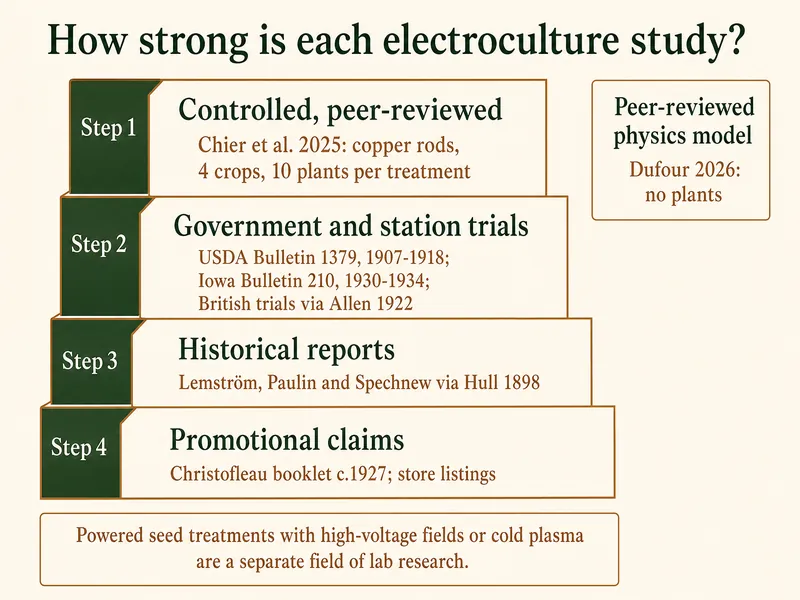
The USDA and Iowa bulletins are the strongest field evidence: multi-year, with controls and, in Iowa's case, statistics. Blackman's trials were careful for their era, but soil differences could explain his biggest gains. Christofleau's booklet is sales material; its own vineyard counts imply about 9% more grapes per vine (see Justin Christofleau).
What electroculture research is still missing?
The missing research is a large, randomised, multi-season field trial of the passive antennas people actually buy. No such study exists. Chier's team worked indoors in pots with 10 plants per group, and the outdoor field trials either used powered high-voltage networks (USDA) or tall atmospheric collectors on 20 ft posts feeding buried cable (Iowa, 1930-32), not garden-sized copper coils.
A convincing study would randomise antenna and control plots across several sites, measure soil voltage directly, weigh harvests and repeat over two or more seasons; Dufour asks for electrical and biological measurements in the same experiment. A small home version is set out in how to test electroculture.
How we put this page together
Rows come from the original documents with page numbers (USDA 1926, Iowa 1937, Hull 1898, Allen 1922, Christofleau's booklet) or from the modern papers themselves (Chier, Dufour, Sun), rechecked in October 2026. Blackman's results come from the USDA's summary tables; the Christofleau per-vine figure is our arithmetic. Left out: trials known only from web compilations, a 2025 okra preprint, a widely repeated 1964 tree claim with no traceable report, and health claims.
Common questions
Which electroculture study is the most reliable?
For passive copper antennas, Chier et al. (2025) in PLoS One, because it is controlled, peer-reviewed and tests the device gardeners use. For field conditions, the USDA's 1926 bulletin and Iowa's 1937 bulletin are the strongest multi-year records.
Are there any peer-reviewed electroculture studies with positive results?
Yes, for powered treatments: high-voltage seed polarisation and cold plasma improve germination or disease resistance in lab studies at defined doses. For passive antennas, the only positive peer-reviewed result is the small buried-copper biomass gain in Chier 2025, which the authors treat cautiously.
What was Blackman's electroculture research?
V. H. Blackman led Britain's overhead-discharge programme from about 1915 to 1920 and published it in the Journal of Agricultural Science in 1924. His field trials averaged +14% and his pot trials +1%; the USDA judged the field results to lack "definite assurance".
Did anyone test Christofleau's apparatus scientifically?
Iowa State College did. Charles Dorchester set up an original Christofleau apparatus, shipped from La Queue-les-Yvelines in France, as one of five collectors, and its plots differed from controls by no more than experimental error over three seasons.
Where can electroculture research papers be read for free?
USDA Bulletin 1379 is on the Library of Congress site, Iowa Bulletin 210 is in the Iowa State University digital repository, Hull's and Allen's books are on the Internet Archive, and Chier 2025 is open access on PubMed Central. The electroculture books page lists them.
Why is Lemström's 40-70% gain not counted as strong evidence?
Lemström's figures come from his own reports and Hull's second-hand summary, without the replicated controls later trials used. The USDA noted German trials did not substantiate his claims about soil fertility.
Related guides
More help: see our electroculture gardening.