
Electroculture FAQ: Questions and Answers
Electroculture FAQ, answered from the documents: the idea dates to the 1740s, it has been tested many times, and no controlled trial has found a reliable gain from passive antennas.
On this page
- What is electroculture?
- Does electroculture work?
- Is electroculture real or a scam?
- Who invented electroculture?
- How do you make an electroculture antenna?
- Which direction should an electroculture coil be wound?
- Is copper better than other metals for electroculture?
- Can electroculture antennas harm plants or soil?
- How do you test electroculture at home?
- What did the 2025 electroculture study find?
Key takeaways
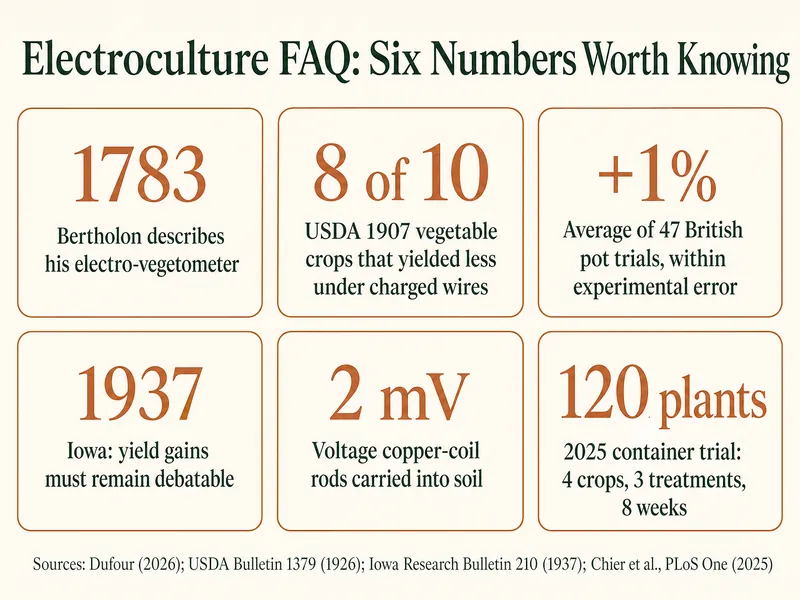
- Electroculture has been tested since the 1740s; Abbé Bertholon described an "electro-vegetometer" in 1783 (Dufour 2026).
- The USDA's Arlington trials of 1907–08 and 1911–18 found no "well-defined increase in yield", and Bulletin 1379 (1926) did not recommend the method.
- Iowa tested an original Christofleau apparatus in 1930–32; all six crops stayed within experimental error (Research Bulletin 210).
- The 2025 PLoS One container trial grew 120 plants for 8 weeks and found "no consistent evidence" that passive copper rods help.
- No controlled study in these sources compares clockwise with counterclockwise coils.
- A fair home test needs a control group, random placement and a scale; the method is in How to Test Electroculture.
- 1783Bertholon describes his passive electro-vegetometerDufour 2026, Comptes Rendus Mécanique
- +1%Average result of 47 British pot trials, called "well within the experimental error"USDA Bulletin 1379, p. 29
- 120Plants in the 2025 trial: 4 crops, 3 treatments, 10 plants eachChier et al. 2025, PLoS One
- 20 mVHighest voltage a copper rod carried into soil, measured next to a fluorescent lightChier et al. 2025, PLoS One
What is electroculture?
Electroculture is the practice of applying electricity to plants, seeds or soil in the hope of better growth, either from a powered source or by trying to collect the natural electricity of the air. Early versions used static machines and charged overhead wires; Selim Lemström in Finland ran barley under charged wires at Niemis in 1885, according to Hull's 1898 book Electro-Horticulture (p. 7). Today the word mostly means passive copper antennas: copper wire wound on a wooden stake and pushed into a garden bed, with no battery or power supply. Our plain-English definition of electroculture covers both kinds and the terms that go with them.
Does electroculture work?
The controlled evidence says passive electroculture has not produced a reliable yield gain. The USDA ran wire-network trials at Arlington, Virginia, over 10 seasons and concluded: "These experiments do not show any well-defined increase in yield due to electrical treatment" (USDA Bulletin 1379, p. 16). Iowa's 1930s collectors gave differences of a few percent either way, all within error, and the 2025 PLoS One trial found no consistent benefit from copper rods. One Iowa result was a statistically significant gain: on poor greenhouse soil in 1932, copper–zinc earth cells raised oat grain by 9.9%, and earth cells boosted with a dry cell by 16.2%, but it did not repeat on richer soil or in 1933 (Iowa Research Bulletin 210, pp. 23–29). The full weighing is in Does Electroculture Work?
| Test | Years | What was tried | Result | Evidence level |
|---|---|---|---|---|
| USDA, Arlington, Va. | 1907–08, 1911–18 | Overhead wires at 30,000–60,000 V over wheat, rye, corn and vegetables | No well-defined yield increase; "not recommended" | Controlled government or station trial |
| Blackman and colleagues, Britain | 1915–20 | Overhead discharge; 33 field and 47 pot trials | Field average +14%, pots +1%, pots within error | Controlled government or station trial (via USDA) |
| Iowa Agricultural Experiment Station | 1930–32 collectors; 1931–33 earth cells | Five air collectors incl. an original Christofleau apparatus; earth cells | Collectors within error; one earth-cell gain that did not repeat | Controlled government or station trial |
| Chier et al., Marquette University | 2025 | Copper-coiled dowels, exposed or buried, in 1-gallon pots | No effect on height or leaf greenness; small biomass gain in 2 crops with buried copper only | Controlled, peer-reviewed |
Is electroculture real or a scam?
Electroculture is a real and old idea that has been tested repeatedly, not a modern invention, but passive antennas lack controlled support. Powered treatments are a separate matter: high-voltage and cold-plasma seed treatments show measurable, dose-dependent effects in the lab, as Dufour's 2026 review of plasma agriculture describes. The large promises are where caution belongs. Christofleau's 1920s booklet advertised gains of "100 to 200 per cent. and more" (PDF p. 63), yet Iowa found only small, non-significant differences from his own apparatus. Most copper antennas cost little, so trying one does little harm; just treat any seller's yield figures as promotional claims and test them yourself. The electroculture history guide shows how the claims grew over time.
Who invented electroculture?
No single person invented electroculture; it grew out of 18th-century experiments with static electricity. Reports describe a Dr. Maimbray of Edinburgh electrifying two myrtles in 1746 (Hull 1898, p. 1), and Abbé Nollet reported faster germination in the 1740s. Abbé Pierre Bertholon gave the first technical description of a device, his electro-vegetometer, in 1783 (Dufour 2026). Selim Lemström carried the idea into field trials from 1885, and Justin Christofleau popularised a post-mounted "atmospheric" apparatus in France in the 1920s. Read about Justin Christofleau and Selim Lemström for the details.
How do you make an electroculture antenna?
The common modern antenna is bare copper wire wound in a coil around a wooden stake, with the lower end pushed into the soil. The 2025 PLoS One researchers used a 40 cm wooden dowel coiled with copper wire, set 10 cm into the pot (Chier et al. 2025), which is a reasonable template if you want to match a published design. Christofleau's original was very different: a metal head on a post about 20 ft above ground, feeding a galvanised iron wire buried 10 in deep (booklet, pp. 8–11). Never connect a homemade antenna to mains power, batteries or any high-voltage source. The step-by-step build is in How to Make an Electroculture Antenna.
Which direction should an electroculture coil be wound?
No controlled study in the documents behind this site has compared clockwise with counterclockwise coils, so winding direction is a belief, not a tested rule. Online advice often ties the direction to the hemisphere, but the 2025 PLoS One paper did not even record which way its wire was wound, and its rods carried only about 2 mV into soil. Christofleau's booklet used no coil at all; its "absolutely essential" rule was to point the horizontal rod to magnetic south and run the buried wire to magnetic north. If you are curious, wind some coils each way and compare them in the same trial. Our antenna placement guide covers direction, height and spacing claims.
Is copper better than other metals for electroculture?
Copper is the usual choice because it conducts well, resists rust and lasts outdoors, but no controlled trial shows it works better than another metal for plant growth. The historical devices mixed metals: Christofleau's buried wire was galvanised iron, and the Iowa earth cells paired copper with zinc to make a weak battery of about 0.5 mA (Iowa Bulletin 210, p. 19). Hull's 1898 book says iron in place of zinc was "almost too weak" for an earth battery (pp. 36–37). For a passive stake, the metal matters less than the fact that very little current flows. The copper wire guide and copper rods guide compare gauges and forms.
Can electroculture antennas harm plants or soil?
Passive copper stakes showed no direct harm in the 2025 trial, and the authors judged that copper "likely does not leach from the metal rod fast enough" to reach roots (Chier et al. 2025). They also note that excess copper can inhibit photosynthesis, so adding copper salts to soil is a different matter. Powered methods have caused damage: under the 1907 Arlington network 8 of 10 vegetable crops yielded less than controls (USDA Bulletin 1379, pp. 3–4), and Iowa's 1933 earth cells with dry cells cut oat root weight by 7.7% and 10.8% (Bulletin 210, p. 29). High voltage is also dangerous to people. More on this is in Copper Rods in the Garden.
How do you test electroculture at home?
Grow one crop in at least four matched pairs of plots or pots, toss a coin in each pair to decide which one gets the antenna, and weigh every harvest. Use the same soil, seed and watering throughout, with several plants in each plot; the 2025 trial used 10 plants per treatment. Pairing spreads treated and untreated plots across the bed rather than putting all antennas on one side, which matters because soil differences can be large: an Arlington rye plot yielded 43% more than its control in 1916 with no electricity applied (USDA Bulletin 1379, p. 13). Record weights pair by pair, count how many pairs the antenna won, and repeat next season. The full layout is in our home-trial guide.
What did the 2025 electroculture study find?
The 2025 study found "no consistent evidence" that passive copper rods helped potted vegetables grow or yield more (Chier et al., PLoS One). Researchers at Marquette University grew mustard greens, kale, turnips and beets in 1-gallon pots under LED lights for 8 weeks, with 10 plants per treatment: no copper, an exposed copper-coiled rod, or a buried one. Height and leaf greenness did not change. Buried copper added about 2.5 g of aboveground biomass to beets and turnips, while exposed rods, the form most gardeners use, did nothing measurable. The authors note the limits: indoor containers and small samples. The electroculture studies guide places it among the older trials.
How we put this page together
These answers come from USDA Department Bulletin 1379 (1926), Iowa Research Bulletin 210 (1937), Hull's Electro-Horticulture (1898), Christofleau's English-language booklet (about 1927), the 2025 container trial by Chier and colleagues, and both of Dufour's 2026 papers; every figure was checked in October 2026. Page numbers refer to the printed documents. Forum reports, seller listings and health claims are not used, and no answer relies on a trial we could not trace to its original document.
More help: see our electroculture gardening library.