
Science
Electric Fields and Plant Growth: The Research
Electric fields and plant growth are linked in real research, but the effects come from powered treatments with measured voltages and doses, and they vary by crop, dose and setup rather than following one simple rule.
On this page
- Do electric fields affect plant growth?
- What did Blackman's 1920s field trials find?
- What happens to plants in ionized air?
- Can small electric currents in soil change growth?
- How do high-voltage seed treatments work?
- What did the 2018 review conclude?
- Active vs passive electric fields in the garden
- Common questions
When scientists apply electricity to plants on purpose, with a power supply, a meter and a control group, they sometimes see faster germination, more biomass or higher yields, and sometimes nothing or harm. This page walks through the main lines of that powered research and the setup behind each result. None of it involves the passive copper antennas sold for gardens, which have no power source; that distinction runs through every section below.
Key takeaways
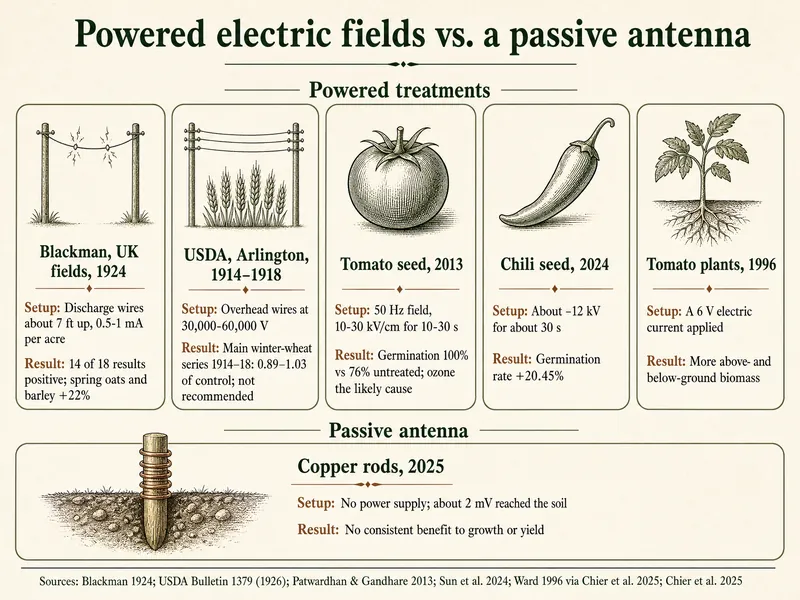
- V. H. Blackman's 1924 field trials ran discharge wires about 7 ft above crops at 0.5 to 1 mA per acre; 14 of 18 comparable results were positive (J. Agric. Sci.).
- Under the USDA's own overhead wires at 30,000-60,000 V, its main winter-wheat series, 1914–18, came in at 0.89–1.03 of control, or −11% to +3% (Bulletin 1379, 1926).
- Tomato seeds exposed to a 50 Hz field of 10-30 kV/cm germinated at up to 100%, against about 76% untreated, with ozone the likely cause (Patwardhan and Gandhare, Acta Agrophysica, 2013).
- A 2024 Scientific Reports study raised chili seed germination rate by 20.45% with about 12 kV of negative polarisation for about 30 seconds (Sun et al. 2024).
- Kale grown under air anions reached about 1.5 times the control's shoot fresh weight in 4 weeks (Lee et al. 2015).
- Passive copper rods carried about 2 mV into soil and gave no consistent benefit (Chier et al. 2025).
Do electric fields affect plant growth?
Yes, strong applied electric fields can affect plant growth, but the direction and size of the effect depend on the dose, the crop and the method. In 1963 L. E. Murr of Pennsylvania State University reported in Nature that "sufficiently high electric fields have a definite effect on plant growth" (Murr 1963). His next paper, in 1964, was titled "Mechanism of Plant-Cell Damage in an Electrostatic Field" (Murr 1964), a reminder that more is not better.
The fields in this research are far above anything in nature. The fair-weather field over a garden is about 100 V/m, as explained on our page on atmospheric electricity and plants. A seed-treatment field of 20 kV/cm equals 2,000,000 V/m, about 20,000 times stronger. That gap is why results from powered setups cannot be carried over to a coil on a stake.
- 14 of 18Comparable field results that were positive in Blackman's trialsBlackman 1924, J. Agric. Sci.
- +1%Average gain across 47 matched pot trials by Blackman and LeggeUSDA Bulletin 1379, p. 29
- 100% vs 76%Tomato seed germination after a 50 Hz field, against untreated seedPatwardhan and Gandhare 2013, Acta Agrophysica
- 20.45%Rise in chili seed germination rate after high-voltage polarisationSun et al. 2024, Scientific Reports
- 2 mVSignal unpowered copper rods delivered to potting soilChier et al. 2025, PLoS One
What did Blackman's 1920s field trials find?
Blackman's trials found mostly positive but inconsistent yield differences under overhead electrical discharge, and the best-controlled part of his programme found almost none. Working for Britain's electroculture committee, he stretched thin insulated wires about 7 ft above oats, barley, wheat and clover and fed them a high-voltage discharge at 0.5 to 1 milliamp per acre. His 1924 paper in the Journal of Agricultural Science reported 14 positive and 4 negative results out of 18 comparable ones, with a mean gain of 22% for spring oats and barley, while clover was "probable" and winter wheat uncertain (Blackman 1924).
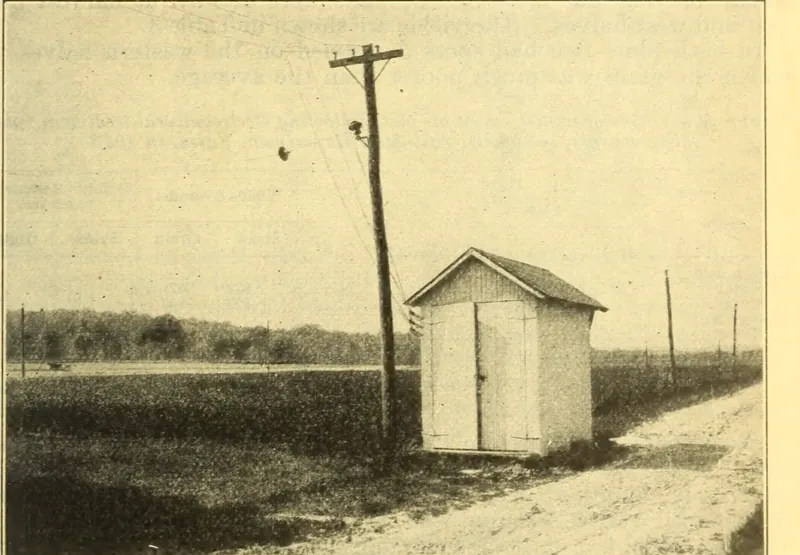
The USDA reviewed the same programme in 1926 and called it "perhaps the best evidence of plant response to electrical discharge" (p. 27). Its tally of 33 field trials averaged +14%, with 21 up and 12 down, and it traced the largest gains to control strips on poorer soil. The matched pot trials of Blackman and Legge averaged +1%. Under the USDA's own Arlington networks, charged to between 30,000 and 60,000 V, the main winter-wheat series, 1914–18, gave 0.89–1.03 of control (−11% to +3%), and the bulletin concluded that electroculture "is not recommended" as it then stood. The full story is on our 1926 USDA report page.
What happens to plants in ionized air?
Plants grown in air enriched with negative ions have grown faster in some controlled studies, while other ion experiments found harm, so the result depends on species, concentration and growing system. H. A. Pohl and G. W. Todd framed the idea in their 1981 paper "Electroculture for crop enhancement by air anions" in the International Journal of Biometeorology (Pohl and Todd 1981). Overhead discharge networks like Blackman's also produce ions, which is one proposed reason they had any effect.
A modern example is a 2015 plant-factory study. Kale under LED lights received air anions at 2.9, 5.4 or 7.8 × 10⁵ ions per cubic centimetre for four weeks, and the medium and high levels reached about 1.5 times the control's shoot fresh weight (Lee et al. 2015). That is a controlled, peer-reviewed result in hydroponics with a powered ion generator. Earlier work pointed the other way for one crop: a 1965 Plant and Cell Physiology paper described air-ion-enhanced iron chlorosis in barley seedlings (Kotaka, Krueger and Andriese 1965).
Can small electric currents in soil change growth?
Small applied currents have changed growth in some studies, though the record is thinner and less consistent than for high-voltage fields. The 2025 PLoS One paper summarises R. G. Ward's 1996 study in Acta Physiologiae Plantarum: the lowest voltage tested in the electroculture literature, 6 V, "increased both above and belowground biomass of tomato plants" (Chier et al. 2025). The original paper could not be checked online for this page, so treat the setup details as second-hand.
Older station work was mixed. In a 1932 greenhouse test on poor soil, Iowa's 1937 bulletin found that copper-zinc earth cells raised oat grain by 9.9%, and flats where dry cells boosted the current by 16.2%, a statistically significant result; on richer soil the earth cells yielded about 6% less, and the 1932-33 repeat showed no grain gain. That history is on our electroculture studies page. An earth cell is a galvanic cell, two different metals in moist soil giving about 0.5 mA at about 1 V in Iowa's measurements, not something a single copper rod produces.
How do high-voltage seed treatments work?
High-voltage seed treatments expose dry seeds to a strong field for seconds, and the gains reported so far are in germination speed and rate rather than final yield. In a study published in Acta Agrophysica in 2013, Patwardhan and Gandhare exposed tomato seeds to 50 Hz fields of 10 to 30 kV/cm for 10 to 30 seconds. Untreated seed germinated at about 76%, and the best treatment reached 100%, with heavier seedlings. The authors concluded that "ozone generation by partial discharges between seeds" was the main effective factor, which makes it partly a chemical treatment.
A 2024 study in Scientific Reports tested negative, positive and alternating polarisation on dried chili pepper seeds. The best combination was about 12.08 kV for about 30 seconds of negative polarisation, which raised germination potential by 9.09% and germination rate by 20.45% over controls (Sun et al. 2024). Both are controlled, peer-reviewed results with a measured dose. Cold plasma treatments, which go a step further and ionise the gas around seeds, are covered on our plasma agriculture page.
What did the 2018 review conclude?
D. Dannehl's 2018 review in Scientia Horticulturae gathered decades of powered experiments and found that responses depend heavily on the crop and the electrical treatment (Dannehl 2018). As summarised in the 2025 PLoS One paper, the tests it covered used voltages from 6 to 1,200 V, most of them over 200 V, and the effect "appears to depend on both the plant species and the type and magnitude of electrical current applied" (Chier et al. 2025).
The older record fits. Blackman got gains in some years and losses in others; Murr found both growth effects and cell damage; air ions helped kale but were linked to chlorosis in barley. A dose that helps one crop can do nothing for another, so good studies report voltage, current and exposure time with every result.
| Study | Setup | Crop | Result | Evidence level |
|---|---|---|---|---|
| Blackman 1924 | Overhead discharge wires about 7 ft up, 0.5-1 mA per acre | Oats, barley, wheat, clover | 14 of 18 positive; +22% spring oats and barley | Controlled government or station trial |
| Blackman and Legge, via USDA 1926 | Discharge over pots, 47 trials | Wheat, barley, maize | +1% average, within error | Controlled government or station trial |
| USDA Arlington, main winter-wheat series, 1914-18 | Overhead networks at 30,000-60,000 V | Winter wheat | 0.89-1.03 of control (−11% to +3%) | Controlled government or station trial |
| Murr 1963-64 | Strong laboratory electrostatic fields | Seedlings | Growth effects and cell damage | Peer-reviewed lab study |
| Lee et al. 2015 | Air anions up to 7.8 × 10⁵ per cm³, 4 weeks | Kale, hydroponic | About 1.5 times shoot fresh weight | Controlled, peer-reviewed |
| Ward 1996, via Chier 2025 | 6 V applied current | Tomato | More above- and below-ground biomass (details second-hand) | Peer-reviewed lab study |
| Patwardhan and Gandhare 2013 | 50 Hz, 10-30 kV/cm, 10-30 s | Tomato seed | 100% vs about 76% germination | Controlled, peer-reviewed |
| Sun et al. 2024 | About -12 kV, about 30 s | Chili seed | Germination rate +20.45% | Controlled, peer-reviewed |
| Chier et al. 2025 | Passive copper rods, no power | Four vegetables | No consistent benefit; about 2.5 g more beet and turnip biomass over buried copper | Controlled, peer-reviewed |
Active vs passive electric fields in the garden
Active electroculture uses a power supply to deliver a chosen voltage or current, while passive electroculture relies on rods, coils or antennas with no power at all, and the active kind has produced far more of the measurable effects in controlled research. The 2025 Marquette trial tested the passive kind directly: copper-coiled dowels, exposed or buried, in pots of mustard greens, kale, turnips and beets. Buried copper added about 2.5 g of beet and turnip biomass (p<0.01), which the authors judged "likely ... simply a result of small sample sizes"; overall they "found no consistent evidence that passive electroculture is beneficial to crop growth or yield in container gardens" (Chier et al. 2025).
The physics explains why. A passive rod sits in a 100 V/m field that drives about two trillionths of an amp per square metre, and it delivered about 2 mV to the soil. The powered studies above used thousands to millions of times more. Magnets are a separate idea with their own evidence, covered on magnetoculture. If you want to try a passive antenna anyway, run it as a fair side-by-side test, and read does electroculture work? for the overall evidence.
How we put this page together
This page follows the original papers where they could be read (Blackman 1924 abstract; USDA Bulletin 1379; Murr 1963-64; Patwardhan and Gandhare 2013, Acta Agrophysica 20(2):403-413; Sun et al. 2024; Lee et al. 2015 abstract; Chier et al. 2025), checked October 2026. Ward 1996 and Dannehl 2018 are reported as summarised by Chier et al., because their full texts were not available. Pohl and Todd 1981 is cited by title only. Left out: Soviet-era figures and magazine claims that could not be traced to a primary paper.
Common questions
What voltage did Blackman use?
His 1924 paper describes the dose as a current rather than a voltage: a high-tension discharge at 0.5 to 1 milliamp per acre from thin wires about 7 ft above the crop. The USDA bulletin notes overhead networks of this kind ran at tens of thousands of volts. He also noted that the energy delivered was far too small to explain any effect directly.
Is electrostatic seed treatment used commercially?
The studies cited here are laboratory experiments with measured doses on small seed lots. They report germination, not harvest yield, and the optimum settings differ between crops. Scale-up evidence for growers is limited in the papers reviewed for this page.
Why did ozone matter in the tomato seed study?
Strong alternating fields cause small partial discharges between seeds, which make ozone. Patwardhan and Gandhare concluded that this ozone was the main factor behind the faster germination, so part of the effect is chemical rather than purely electrical.
Is it safe to treat seeds with high voltage at home?
Kilovolt equipment can cause serious shocks, burns and fires, and the studies used purpose-built rigs with controlled exposure. Buying good, fresh seed and following the packet's sowing advice is the safer route for a home garden.
Why are results so inconsistent between studies?
Crops, voltages, field type, exposure time, soil and weather all differ, and early trials often lacked uniform control plots. Dannehl's 2018 review, as summarised by Chier et al., found that effects depend on both species and the type and size of the current.
Does this research support copper coil antennas?
No. Every positive result on this page came from a powered device with a measured dose. The only controlled trial of unpowered copper rods reported no consistent gain, and Dufour's 2026 physics model shows a passive point boosts the field only within centimetres of its tip.
Related guides

More help: see our electroculture gardening.