
Science
Atmospheric Electricity and Plants: What Science Knows
Atmospheric electricity and plants meet every day: a fair-weather field of roughly 100 V/m surrounds every garden, but its current is about 2 trillionths of an amp per square metre, far too little for a passive rod to collect.
On this page
The air above a garden is never electrically quiet. Thunderstorms around the world keep the upper atmosphere charged, and a weak current trickles down through clear skies onto every leaf and lawn. That is the real physics behind electroculture, and it is worth knowing in numbers before deciding what a copper antenna could do with it.
Key takeaways
- The fair-weather field near the ground is about 100-300 V/m, driven by a worldwide thunderstorm current of about 1 kA (Bering, Few and Benbrook, Physics Today, 1998).
- The current that reaches the ground in fair weather is about 2 pA per square metre, according to a 2025 review in Atmosphere.
- Lightning fixes about 5 Tg of nitrogen a year (Schumann and Huntrieser 2007), roughly 1% of the 413 Tg fixed worldwide (Fowler et al. 2013).
- Copper rods in a 2025 PLoS One trial carried about 2 mV into the soil, not the 4 V the field difference suggests (Chier et al. 2025).
- A 2026 physics model found that pointed collectors raise the field only within millimetres to centimetres of their tips (Dufour 2026).
- Powered fields thousands of times stronger than the natural one do change seeds and plants in labs; see electric fields and plant growth.
Can you stimulate plant growth with electricity?
Yes, with powered equipment: laboratory and field studies that apply measured voltages, discharges or currents have changed germination and growth, sometimes for the better and sometimes for the worse. A passive antenna is a different matter. It has no power source, so it can only redirect the tiny natural current that already flows through the air, and the one controlled test of passive copper rods found no consistent benefit.
The difference is one of scale. The USDA's 1926 Electroculture bulletin describes overhead wire networks delivering 0.1 to 1 milliampere per acre, which its authors put at "10,000 to 100,000 times" the normal air-earth current (p. 5). Even at that boost, the Arlington trials did not show a well-defined yield increase. The powered research is covered on our page on electric fields and plant growth; this page covers the natural electricity that passive devices are meant to tap.
What is the atmospheric electric field?
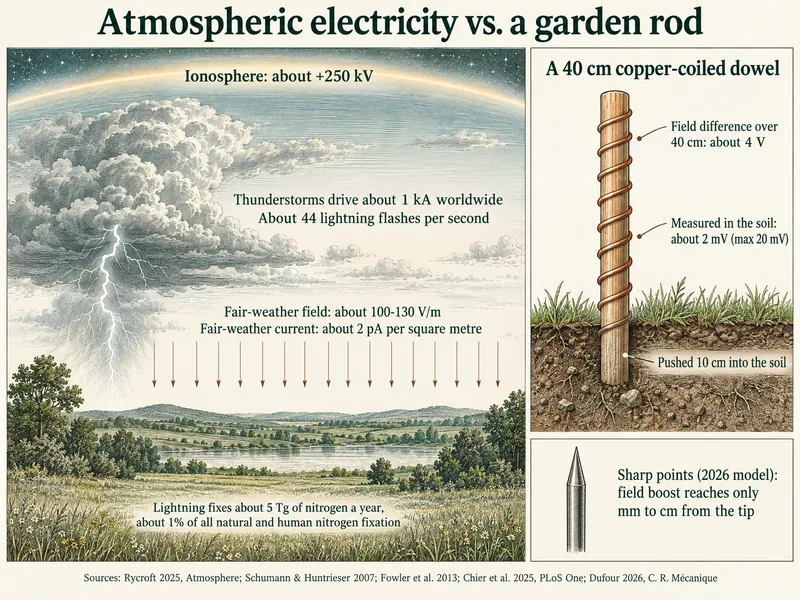
The atmospheric electric field is the voltage difference between the charged upper atmosphere and the ground, and in fair weather it averages roughly 100 to 130 volts for every metre of height. Physicists call the whole system the global electric circuit. Thunderstorms act as its generators, pushing current up to the ionosphere, which a 2025 review in Atmosphere puts at about 250 kV above the surface (Rycroft 2025).
That charge leaks back down through the slightly conductive air everywhere it is not storming. Physics Today summarised the circuit as a current "totaling one kiloamp worldwide", with a downward field of 100 to 300 V/m at the surface (Bering et al. 1998). Spread over the planet, the return current is tiny: Rycroft gives about 2 pA per square metre, and estimates generally fall between about 1.5 and 2.2 pA/m².
A volt per metre sounds large until you look at the current. Two trillionths of an amp across a 10 square metre bed is 20 pA; at that rate, simple arithmetic says it would take more than 1,500 years to move one coulomb of charge, about what a phone charger delivers in a second.
- 100 V/mTypical fair-weather field near the ground (often quoted 100-300)Bering, Few and Benbrook 1998, Physics Today
- 2 pA/m²Fair-weather current reaching each square metre of groundRycroft 2025, Atmosphere
- 1 kAWorldwide current driven by thunderstormsBering, Few and Benbrook 1998, Physics Today
- 5 TgNitrogen fixed by lightning each year (range 2-8)Schumann and Huntrieser 2007, Atmos. Chem. Phys.
- 2 mVVoltage passive copper rods carried into soilChier et al. 2025, PLoS One
Does lightning really feed plants?
Lightning does fix nitrogen, but it supplies only a small share of what plants receive. The heat of a stroke splits nitrogen and oxygen molecules, which recombine as nitrogen oxides; NASA's Aura team calls lightning "the major source of NOx" in the mid- to upper troposphere and estimates about 180 moles per flash (NASA Science). Those oxides turn into nitrate, which rain carries to the soil.
A 2007 review of three decades of measurements put the global flash rate at 44 per second and the yearly lightning source at about 5 teragrams of nitrogen, with an uncertainty range of 2 to 8 (Schumann and Huntrieser 2007). For comparison, a Royal Society review counts 413 Tg of nitrogen fixed each year by all routes, half of it by people, mostly as fertilizer (Fowler et al. 2013). Lightning is therefore roughly 1% of the total.
Washington State University Extension points to this chemistry when explaining why gardens look greener after storms: lightning "fixes atmospheric nitrogen into a solid form (nitrate)" that dissolves in rain (WSU Extension, 2024). Rain itself, cooler air and cleaner leaves help too. None of this depends on a rod in the bed, and a copper antenna does not make nitrate.
How do plants respond to atmospheric electricity?
Plants sit inside the atmospheric field all the time, and the clearest documented response so far involves pollinators rather than growth. In 2013 researchers reported in Science that bumblebees can detect and learn the electric fields around flowers, and that a bee's own charge changes those fields within seconds (Clarke et al. 2013). A 2016 follow-up found the sensors are the bees' mechanosensory hairs (Sutton et al. 2016, PNAS).
Growth effects need much stronger fields. In 1963 L. E. Murr reported in Nature that "sufficiently high electric fields have a definite effect on plant growth", while noting his laboratory conditions were "magnified rather grossly" compared with nature (Murr 1963). A year later he described damage to plant cells in strong electrostatic fields (Murr 1964). The lesson from that early work is that dose matters in both directions.
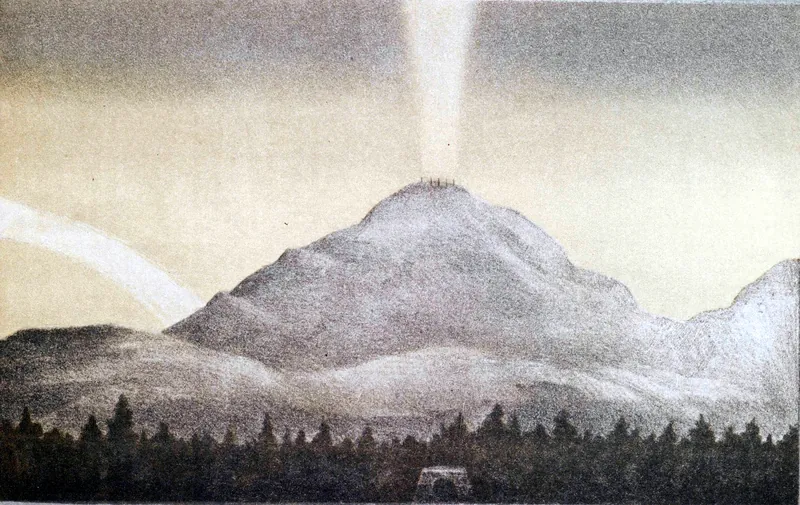
Historically, the northern lights drew Finnish physicist Selim Lemström to the idea. He produced an artificial aurora over a Lapland fell in 1882 and later linked the fast growth of northern summers to atmospheric electricity; the USDA bulletin records his claim of at least a 45% increase from charged overhead wires, a historical report without modern controls (p. 22). His story is on our Selim Lemström page.
Can a copper antenna capture atmospheric electricity?
A copper antenna connects to the atmospheric field, but measurements and models show it collects very little. In the 2025 Marquette University trial, which used a 40 cm copper-coiled dowel pushed 10 cm into the soil, or a 10 cm coiled dowel buried completely, the authors noted that a 100 V/m gradient implies only about 4 V across 40 cm, and their oscilloscope found the rods "transmit only 2 millivolts into the soil", rising to 20 mV only within 4 cm of a fluorescent light (Chier et al. 2025). Across four crops they "found no consistent evidence" of benefit from passive copper; buried copper did add about 2.5 g of beet and turnip biomass, which they thought likely a small-sample effect. This is a controlled, peer-reviewed result, though from indoor pots.
Physicist Thierry Dufour reached a similar picture from the other direction. His 2026 model of Bertholon's 1783 pointed collector, published in Comptes Rendus Mécanique, found the points raise the local field 175 to 700 times, but only within millimetres to centimetres of each tip, with currents still in the pA to nA per square metre range (Dufour 2026). He concludes that any fair-weather effect on crops "was subtle and highly localized". The model has no plants in it, so it limits what is physically possible rather than testing a crop.
Coil shape, winding direction and orientation do not change those magnitudes; a coil is still a short grounded conductor in a 100 V/m field. Our pages on copper rods in the garden and electroculture antennas cover the products themselves.
| Quantity | Typical value | Source | Evidence level |
|---|---|---|---|
| Fair-weather field near ground | About 100-300 V/m | Bering et al. 1998, Physics Today | Review article (Physics Today) |
| Fair-weather current density | About 2 pA/m² | Rycroft 2025, Atmosphere | Peer-reviewed review/model |
| Storm field near ground | Up to several kV/m | Dufour 2026, CR Mécanique | Peer-reviewed review/model |
| Lightning nitrogen fixation | About 5 Tg N a year (2-8) | Schumann and Huntrieser 2007 | Peer-reviewed review/model |
| Voltage copper-coiled dowels carried into soil | About 2 mV (max 20 mV) | Chier et al. 2025, PLoS One | Controlled, peer-reviewed |
| Field boost at a pointed collector | 175-700 times, within mm-cm | Dufour 2026, CR Mécanique | Peer-reviewed review/model |
| Overhead networks, 1907-1918 | 10,000-100,000 times natural current | USDA Bulletin 1379, p. 5 | Controlled government or station trial |
What do we still not know?
The open questions are about very local effects, not about whether a rod can harvest meaningful energy. Dufour's model shows strong field concentration at sharp points within a few centimetres, and nobody has yet measured whether seedlings growing in that zone respond. Storm conditions are also different: tip fields approach the level where corona discharge starts, which can make ozone and nitrogen oxides, and Dufour notes their effect on plants is "not necessarily beneficial".
The controlled evidence is also thin. The 2025 trial used 10 plants per treatment per crop, indoors, for 8 weeks; a field trial outdoors under real weather has not been published. Until it is, the fair reading is that passive devices have not shown a consistent growth effect, while powered electric fields have shown real but variable ones. If you want to see for yourself, a side-by-side test with randomized plots is the way to do it, and the wider evidence is summarised in does electroculture work?.
How we put this page together
This page is based on peer-reviewed atmospheric physics (Bering et al. 1998; Rycroft 2025; Schumann and Huntrieser 2007; Fowler et al. 2013), NASA's Aura lightning summary, the 2025 PLoS One copper-rod trial, Dufour's 2026 model in Comptes Rendus Mécanique, Murr's 1963-64 Nature papers and USDA Bulletin 1379 (1926), all checked in October 2026. The 1,500-year charge figure is our own arithmetic from the 2 pA/m² current. Left out: claims that antennas gather "earth energy" or prevent frost, which have no measurements behind them, and forum reports.
Common questions
How strong is the electric field in my garden on a clear day?
Roughly 100 to 130 volts per metre of height near the ground, and often quoted as 100 to 300 V/m. It varies with humidity, pollution, time of day and nearby objects such as trees and buildings, which distort and shield it. The field is always there; the current it drives is what is tiny.
Is the field stronger under a thunderstorm?
Yes. Dufour's 2026 model paper puts storm fields at the surface at up to several kilovolts per metre, many times the fair-weather value. That is when sharp points can glow with corona discharge, which is a safety hazard near tall metal objects rather than a gardening tool.
Why does my garden look greener after a thunderstorm?
Rain soaks deeper than most hand watering, lightning adds a little nitrate, and the cooler, cloudier air reduces stress. WSU Extension cites the lightning nitrate as one reason. A copper antenna is not needed for any of it.
Could a taller antenna collect more?
Height raises the voltage difference, since the field is about 100 V per metre, but the available current stays in the trillionths of an amp per square metre. Dufour's model found that making the mast taller or adding more points did not materially change the crown's field. Tall metal masts also attract lightning.
Do plants have their own electrical charge?
Flowers carry measurable electric fields that change within seconds when a charged bee visits, and bumblebees can sense and learn them, according to Clarke et al. 2013 in Science. That is a pollination finding, not evidence that extra charge helps growth.
Does the Earth's magnetic field matter in the same way?
Magnetic effects on plants are a separate line of research with its own weak and inconsistent findings. Our magnetoculture page covers what has been measured and what is only claimed.
Is cold plasma the same thing as atmospheric electricity?
No. Cold plasma is made by powered devices at thousands of volts and kilohertz frequencies, producing reactive oxygen and nitrogen species at a measured dose. It is covered on our plasma agriculture page.
Related guides
More help: see our guide to electroculture gardening.