
Antennas
Electroculture Antenna Placement: Where and Which Way
Electroculture antenna placement rules, from north–south alignment to coil direction, come from 1920s booklets, web pages and store advice; no controlled study has tested direction, so place antennas by coin toss.
On this page
Key takeaways
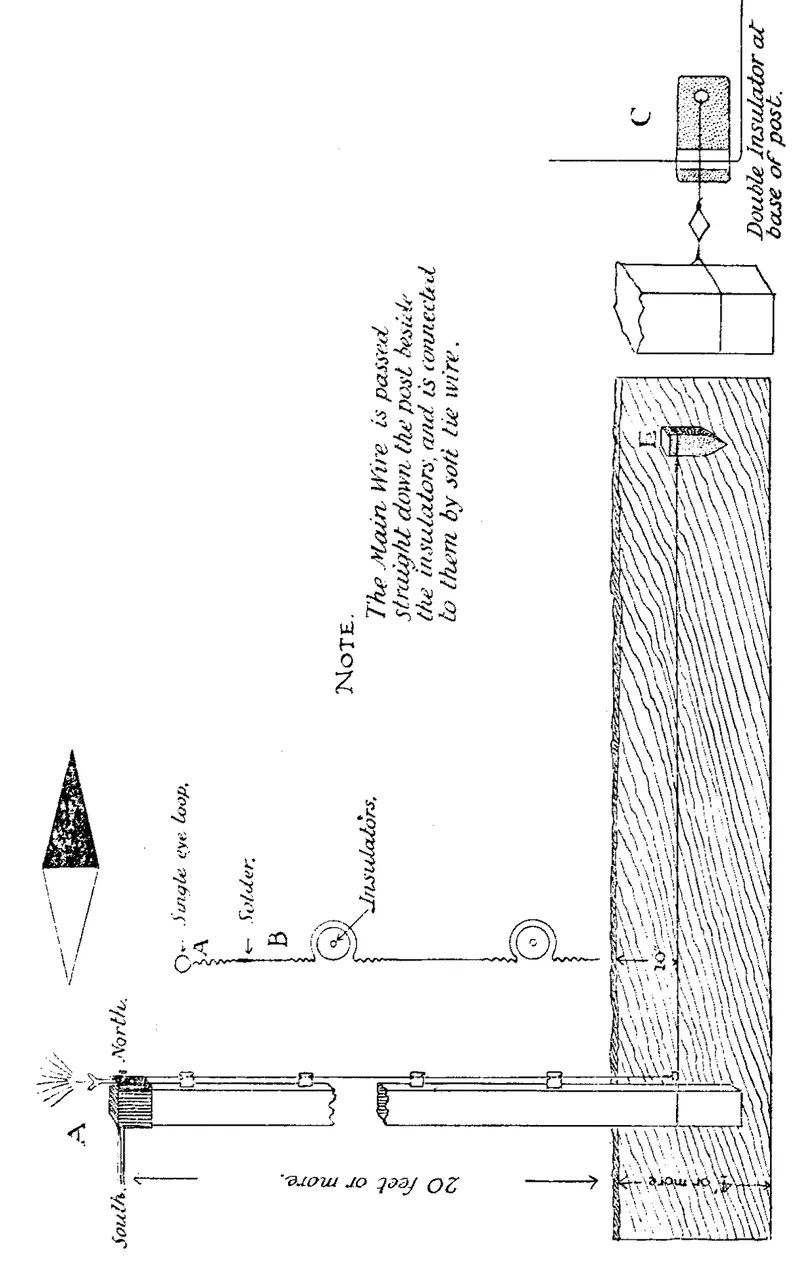
- Christofleau's booklet (c. 1927) told buyers to aim the pointer at magnetic south and bury the wire toward magnetic north, calling the alignment "absolutely essential".
- Iowa State College laid its collector cables north–south in 1930–32 and still saw yields within experimental error; it never compared directions (Research Bulletin 210).
- The best-known coil-direction rule, counter-clockwise in the Northern Hemisphere, comes from a web page that cites no source, and a common store antenna is wound the other way.
- Thrive Garden's product page suggests a depth of 3 to 4 inches and an effect within about 2.5 to 3 ft, and says antennas on the south side of a plant boost "health and vitality more"; those are store observations, not test results.
- The 2025 PLoS One trial assigned rods to plants at random and rotated pots weekly, and found no consistent benefit.
- For a home test, the placement decision that matters is random assignment, as extension guides such as Oregon State's EM 9381 explain.
Placement rules in numbers
- 14 ftWidth of the strip Christofleau's booklet claimed one mast coveredChristofleau, Electroculture (c. 1927)
- 10 inDepth his booklet gave for the buried iron wireChristofleau, Electroculture (c. 1927)
- 12 inDepth Iowa buried its north–south collector cablesIowa Research Bulletin 210 (1937)
- 2.5–3 ftSpacing the store suggests between antennasThrive Garden product listing
Where should electroculture antennas go?
Electroculture antennas usually go beside individual plants or in the middle of a small bed, pushed in at planting time so they do not cut through established roots. That is a practical habit, not a tested rule: no study has compared positions in a bed, distances from the stem or sides of the plant.
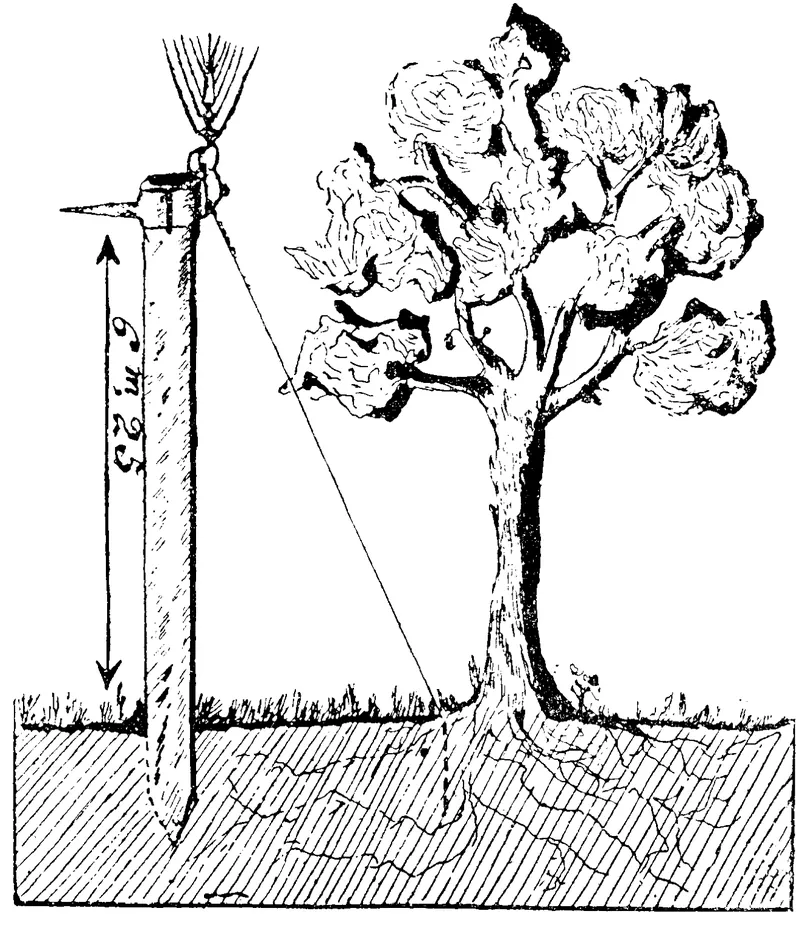
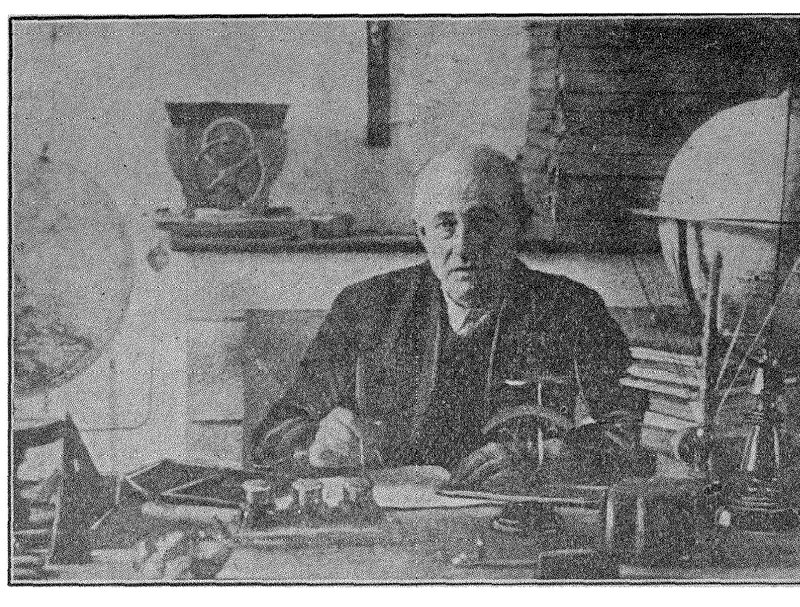
The sources disagree on the details. Christofleau's booklet put a single 20 ft mast at the south end of a field, with its buried wire running north under the crop; for a single fruit tree it placed the post within 3 ft of the trunk, "the tree being North of the apparatus". Robert A. Nelson's Rex Research web page puts a small coil "about 1 ft north of a plant", the reverse arrangement. Thrive Garden's Tesla Coil page simply says to set antennas "by your plants" and, in containers, to use one per pot or grow bag. Where these rules came from is covered on electroculture antenna designs and Justin Christofleau.
How far apart should antennas be?
No controlled study has tested antenna spacing, so any distance is a guess. The figures in circulation are all claims from the people selling or promoting the devices.
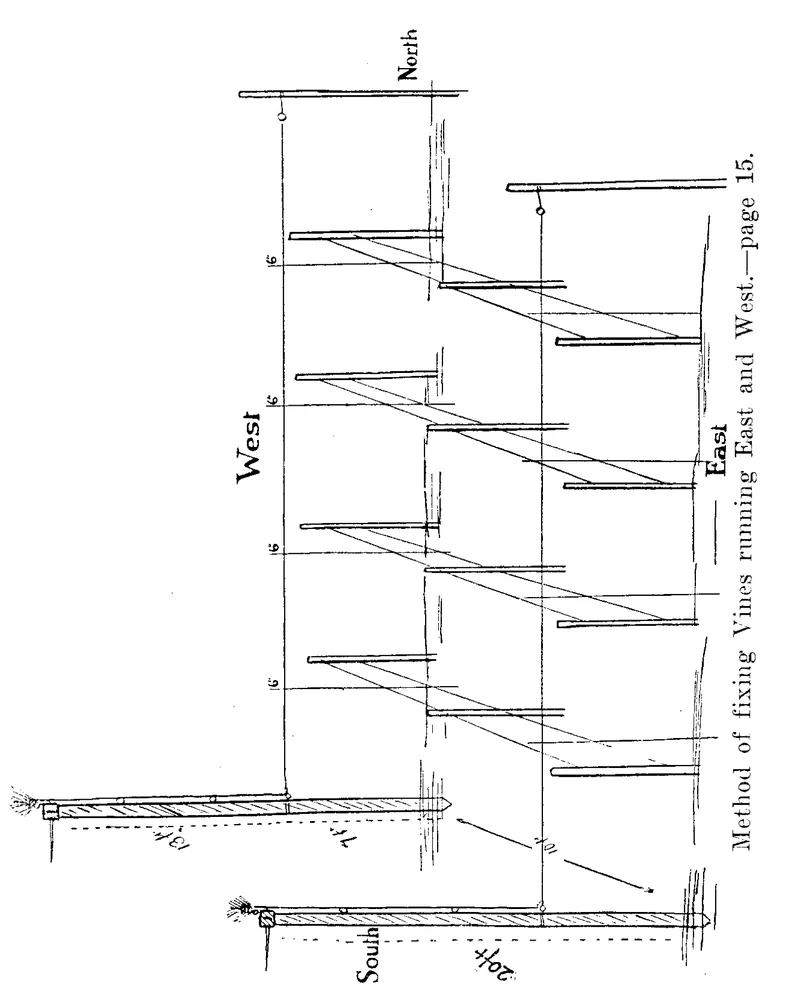
- Christofleau (booklet, c. 1927): one apparatus "influences a strip of ground 14ft. wide" along its buried wire; for vine rows running east–west, posts 14 ft apart at the south end. An extract by Abbé Moreux in the same booklet says posts "at a distance of 10ft.", so the booklet contradicts itself.
- Thrive Garden (product page, October 2026): each antenna has a visible effect within "a 2.5' to 3' foot radius" and one antenna covers "9-16 Sq ft". Both are the store's own figures, presented as its observations, and they do not quite agree: a 2.5–3 ft radius would cover about 20–28 sq ft.
- Iowa State College (1930–32): buried cable lines 30 ft apart, each under a 12 ft treated plot, with control plots of the same width between and 3 ft border strips separating everything. That is a test layout, not a recommendation for density.
For a home trial, spacing between antennas matters less than spacing between treated and untreated plots. A gap of a few feet between them, like Iowa's border strips, keeps roots, shade and watering from blurring the comparison.
Should the antenna coil face north?
There is no evidence that facing north, or aligning anything north–south, changes how plants grow near a passive antenna. The north–south rule is real history, though. Christofleau's installation page told buyers to aim the horizontal pointer "direct South (magnetic)" and run the buried wire "direct magnetic North", to set the compass on a dry board away from iron, and to avoid trees within about 100 yards to the south. It stated that the device's "successful working" depended "entirely" on that alignment.
His own booklet then disagrees on why. A chapter by his promoter G. Blanchard says the current travels "always" from south to north; an article by Dr. Foreau De Courmelles in the same booklet has it travelling from north to south. The Rex Research page repeats a version of the idea ("A north-south orientation will take advantage of geomagnetic polarity") without a source.
The one controlled station trial to use the rule never tested it. In Iowa Research Bulletin 210, Dorchester laid seven-strand copper cable "parallel to the magnetic axis of the earth" under each treated plot, with collectors on the south side, one an original Christofleau head. Yields of six crops ran from about 4 per cent below to 11 per cent above controls, all within experimental error. Because every cable ran north–south, the trial says nothing about whether another direction would have done better or worse.
Clockwise or counterclockwise?
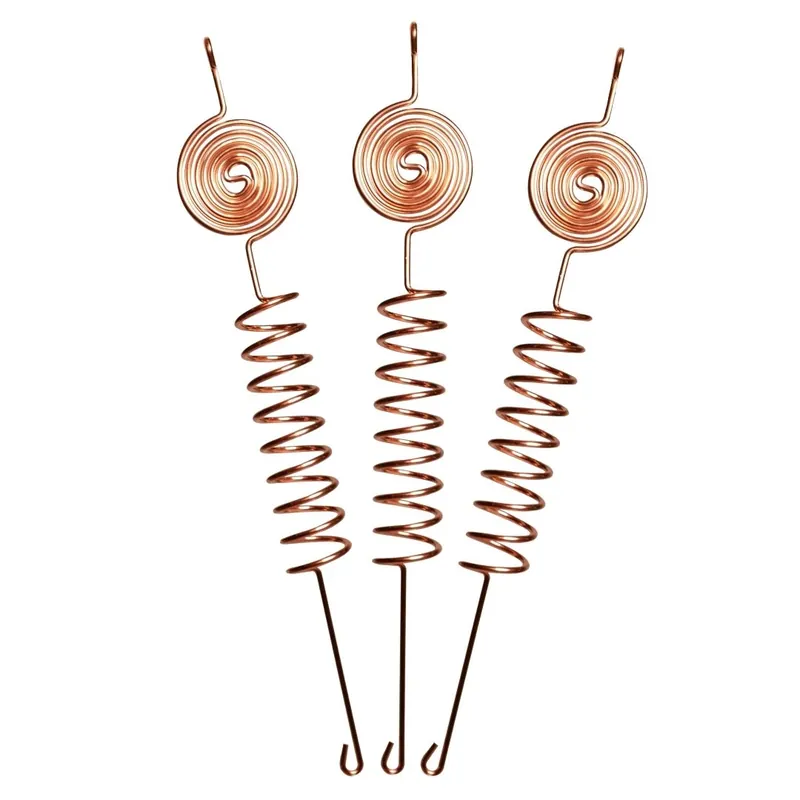
Nobody knows whether clockwise or counterclockwise coils behave differently, because no study has compared them. The rules that exist point in opposite directions. The Rex Research web page says counter-clockwise in the Northern Hemisphere and clockwise in the Southern, with no source. Thrive Garden describes its Tesla Coil antenna as wound clockwise. The 2025 PLoS One trial, the only controlled test of copper coils, did not record which way its wire was wound, and Christofleau's 1920s apparatus had no coil at all, only straight wires.
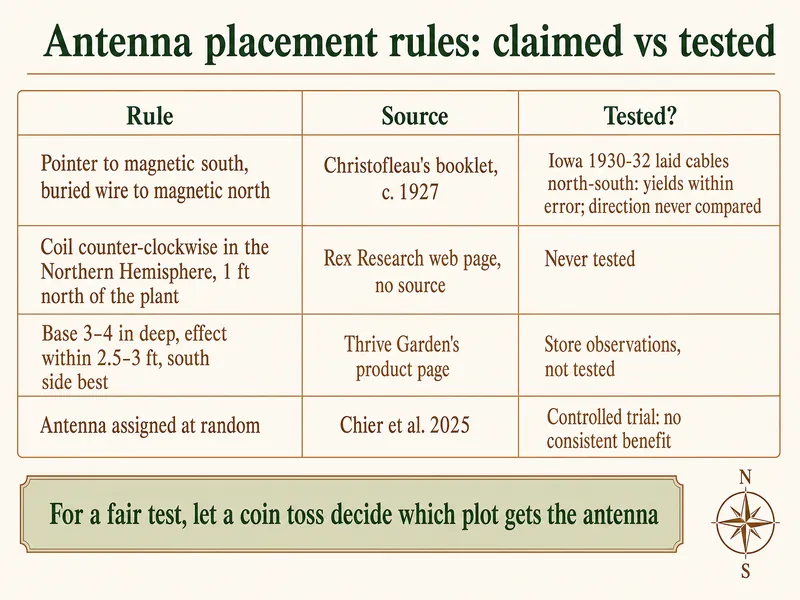
| Rule | Source | Evidence level | Tested? |
|---|---|---|---|
| Pointer to magnetic south, buried wire to magnetic north | Christofleau booklet, c. 1927 | Promotional claim | No; Iowa used it in 1930–32 but compared no other direction |
| Coil counter-clockwise north of the equator, 1 ft north of plant | Rex Research web page | Unsourced claim | No |
| Coil wound clockwise | Thrive Garden Tesla Coil description | Store description | No |
| Base 3–4 in deep, effect within 2.5–3 ft | Thrive Garden product page | Store observation | No |
| South side of the plant "boosts health and vitality more" | Thrive Garden product page | Store observation | No |
| Treated pots chosen at random, rotated weekly | Chier et al. 2025, PLoS One | Controlled, peer-reviewed | Yes: no consistent benefit |
If direction interests you, it is a cheap thing to test: wind half your stakes one way and half the other, add plain stakes as a third group, and let a coin decide where each goes. The build is on how to make an electroculture antenna.
How deep should the antenna go?
Most garden antennas go about 8 to 10 cm (3 to 4 in) into the soil, enough to stand firmly; no study has tested depth. In the 2025 trial, exposed copper dowels were inserted 10 cm into one-gallon pots, and that arrangement showed no effect on height or leaf greenness. A separate buried treatment placed the copper coil entirely under the soil; it gave beets and turnips about 2.5 g more aboveground biomass, which the authors thought was "likely" a result of small samples.
Older systems went deeper because they were burying wire, not standing a stake. Christofleau's booklet specified galvanised iron wire buried 10 in deep, at least 4 in below plough depth, with vine "droppers" buried 18 in; Iowa buried its copper cable about 12 in. Thrive Garden suggests 3 to 4 in for its stakes. Any of these is fine for a test as long as every treated plot gets the same depth. For more on the stakes themselves, see copper rods in the garden.
How do you place electroculture antennas for a fair test?
Place antennas for a fair test by letting chance decide which plots get them, inside pairs of plots that are as alike as possible. Choosing the "best" spot for the antenna is the most common way a home trial goes wrong, because sun, drainage and soil depth can matter more than any device.
The University of Nebraska's on-farm research guide gives the reason in plain terms: a treatment that always sits on the same side of a field cannot be told apart from that side's soil (UNL CropWatch, 2016). It suggests a coin flip to assign treatments within each block. Oregon State University Extension recommends grouping similar plots into blocks, one plot per treatment in each, and says "four replicates are a good place to start".
- Divide the bed into pairs of plots that share sun, soil and watering.
- In each pair, toss a coin: heads gets the antenna, tails a plain stake of the same size.
- Keep a few feet between the plots in each pair.
- Use the same depth, direction and number of antennas in every treated plot.
- Draw a map, because labels move.
The USDA learned this the hard way. In its 1926 bulletin, a rye plot that beat its control by 40 per cent under electrified wires beat it by 43 per cent the next year with no electricity, because the soil, not the treatment, differed. The complete trial method is on how to test electroculture.
How we put this page together
This page draws on Christofleau's booklet Electroculture (Perth edition, c. 1927; installation instructions printed pp. 8–16, Blanchard and De Courmelles chapters, Moreux extract), Iowa Agricultural Experiment Station Research Bulletin 210 (Dorchester, 1937, pp. 11–16), Chier et al. 2025 (PLoS One), USDA Department Bulletin 1379 (1926), Oregon State University Extension EM 9381 (2023), University of Nebraska CropWatch (2016), Robert A. Nelson's Rex Research web page (reported as an unsourced claim, not cited as evidence) and Thrive Garden's Tesla Coil product page, checked in October 2026. Left out: lunar-phase planting rules, hemisphere rules for magnets, and placement claims from videos and forums, none of which any study has tested.
Common questions
Should electroculture antennas go on the south side of a plant?
No study has tested which side of a plant an antenna should stand on. Thrive Garden's product page says that in its own testing antennas on the south side of a plant boost "health and vitality more", an untested store observation with no published measurements. Christofleau's booklet also put the apparatus south of a lone tree, while a popular web rule puts a coil north of the plant; these cannot all be right, and none was tested.
Do you need a compass to place electroculture antennas?
Only if you want to follow Christofleau's rules, which called for magnetic north and south and a compass set away from iron. Since no study has shown direction matters, a compass is optional; recording which way your stakes face is still good practice.
Can antennas go too close to the plant stem?
A stake pushed in beside an established plant can tear roots, so set antennas at sowing or transplanting, a few centimetres from the seed or root ball. No source gives a tested minimum distance.
Will an antenna in one bed affect the untreated bed next to it?
There is no measurement of a passive antenna's reach in soil; the 2025 rods carried about 2 millivolts into their own pots. The USDA's powered wires at 30,000 volts and more did leak charge to controls (it measured drifting charge 1,000 ft downwind in 1918), so leaving a gap of a few feet between treated and untreated plots is a sensible precaution.
Does placement differ for raised beds and containers?
The same logic applies: identical containers or bed sections, antennas assigned by coin toss, plain stakes in the rest. Thrive Garden suggests one antenna per pot or grow bag; that is the store's advice rather than a tested rule.
Should antennas be moved during the season?
Leave them where they are once the test starts, so each plot keeps the same treatment from sowing to harvest. If pots can move, move every pot in turn at set intervals, the way the 2025 researchers shifted theirs each week, so no group keeps the sunniest spot.
Does the Southern Hemisphere need different placement?
Only according to unsourced rules about coil direction. No study has compared hemispheres, directions or orientations for passive antennas, so the same fair-test layout works anywhere.
Related antenna guides
More help: see our electroculture gardening.