
Science
Plasma Agriculture: Cold Plasma for Seeds and Crops
Plasma agriculture uses powered devices to make cold plasma, an electrically excited gas that can clean seed surfaces, speed germination and charge water with nitrogen compounds, with results that depend tightly on dose and remain mostly lab-stage.
On this page
Plasma agriculture is a modern, measured way of treating crops with electricity, though not a descendant of electroculture: it grew from plasma physics and medical sterilisation. Its tools run at thousands of volts and thousands of cycles per second, its doses are timed in seconds, and its results are published with control groups and statistics. It is also a field where too much treatment harms seeds, and where most results come from petri dishes and greenhouses rather than farms.
Key takeaways
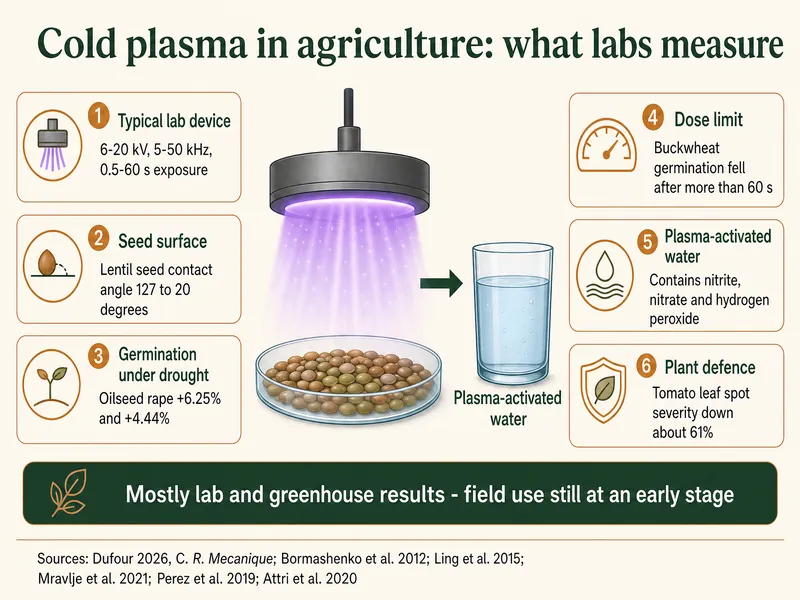
- A 2026 review in Comptes Rendus Mécanique lists typical lab plasma settings of 6-20 kV, 5-50 kHz and 0.5-60 seconds of exposure (Dufour 2026).
- Cold radiofrequency air plasma cut the water contact angle of lentil seeds from 127° to 20°, making them wet faster (Bormashenko et al. 2012).
- Plasma raised oilseed rape germination under drought by 6.25% and 4.44% in two cultivars (Ling et al. 2015).
- Buckwheat germination suffered after more than 60 seconds of plasma, showing the dose limit (Mravlje et al. 2021).
- Plasma-activated water gave tomato plants about 61% protection against bacterial leaf spot when applied 1 hour before infection (Perez et al. 2019).
- Dufour writes that electroculture "did not directly evolve into or compete with" plasma technologies.
What is plasma agriculture?
Plasma agriculture is the use of cold, or non-thermal, plasma to treat seeds, plants, water and harvested food. A plasma is a gas in which an electrical discharge has knocked electrons loose, creating a mix of charged particles, excited molecules, ultraviolet light and reactive oxygen and nitrogen species. In a cold plasma the electrons are energetic but the gas stays near room temperature, so seeds and leaves can be exposed without cooking them.
The physics is old. Thierry Dufour's 2026 review traces it from Werner von Siemens's "silent" discharge for making ozone in 1857, through the Birkeland-Eyde arc that fixed nitrogen for fertilizer in 1903, to Irving Langmuir naming plasma in 1928 (Dufour 2026). The term "plasma agriculture" itself only gained traction after the mid-2010s, according to the same review. A 2021 review in Plasma Processes and Polymers describes the field as covering "the role of nonthermal plasma in the development of plants from seeds to crops" (Ranieri et al. 2021).
- 6-20 kVTypical voltage of lab dielectric barrier discharges for seedsDufour 2026, C. R. Mécanique
- 127° → 20°Lentil seed water contact angle before and after RF air plasmaBormashenko et al. 2012, Sci. Rep.
- 60 sTreatment time beyond which buckwheat germination sufferedMravlje et al. 2021, Plants
- 61%Protection of tomato against bacterial leaf spot from plasma-activated waterPerez et al. 2019, PLoS One
How does cold plasma seed treatment work?
Cold plasma seed treatment works mainly on the seed surface: it etches and oxidises the outer coat, kills some of the microbes living there and leaves reactive chemicals that can trigger the seed's own stress and growth signals. The most common lab device is a dielectric barrier discharge, two electrodes separated by an insulating layer and a gap of 0.5 to 5 mm, run at 6 to 20 kV and 5 to 50 kHz for half a second to a minute, according to Dufour's review.
The surface change is easy to measure. In a 2012 Scientific Reports study, cold radiofrequency air plasma reduced the water contact angle of lentil, bean and wheat seeds from 127°, 98° and 115° to 20°, 53° and nearly 0°, and changed both germination speed and germination rate (Bormashenko et al. 2012). The authors detected new nitrogen-containing groups on the treated seed coats. Seeds that wet more easily take up water sooner, which is one route to faster sprouting.
The cleaning effect is the other main route. Dufour's review reports that 2 to 5 minutes of plasma cut the microbes on chickpea seeds by 1 to 2 log units, and that a 1-minute treatment gave the best germination, 89.2% (Mitra et al. 2014, as summarised by Dufour). A low-pressure plasma removed up to 99.999% of the mould Aspergillus parasiticus from hazelnut surfaces, a 5-log reduction, in work from 2008 cited in the same review.
What is plasma-activated water?
Plasma-activated water is ordinary water exposed to a cold plasma, which dissolves reactive species into it and leaves nitrite, nitrate and hydrogen peroxide, usually with a drop in pH. In a 2019 PLoS One study, a dielectric barrier discharge over sterile water produced exactly those species (Perez et al. 2019). A 2018 analysis in Water Research went further and tracked 16 chemical species in plasma-treated tap water, including ammonium, nitrite, nitrate and hydrogen peroxide (Judée et al. 2018).
The nitrogen in that water is real plant nutrient, made from air in a way that echoes lightning, which our page on atmospheric electricity and plants covers. In Judée's study, lentil seedlings watered with tap water plasma-treated daily grew 34.0% longer after 3 days of activation and 128.4% longer after 6 days than seedlings on untreated tap water. That is a controlled lab result, and it comes from a powered reactor.
The defence effect is subtler. Perez and colleagues found the activated water had no direct antibacterial effect on Xanthomonas vesicatoria in the dish, yet applied to tomato roots it reduced bacterial leaf spot, giving relative protection of about 61%, 51% and 38% when applied 1 hour, 24 hours and 6 days before infection. A 2019 Scientific Reports study on tomato seedlings found that water treated for 30 minutes carried reactive species at levels that "can induce non-toxic signaling", raising defence hormones and gene expression (Adhikari et al. 2019).
What do plasma agriculture studies report on germination?
Plasma agriculture studies report modest, dose-dependent gains in germination and seedling vigour, and losses when the dose is too high. Under drought stress, cold plasma raised oilseed rape germination by 6.25% in a drought-sensitive cultivar and 4.44% in a tolerant one, and lifted the antioxidant enzymes superoxide dismutase and catalase by 13 to 18% (Ling et al. 2015). These are controlled, peer-reviewed results with small, measured effects.
The dose limit shows up clearly in buckwheat. Treating common and Tartary buckwheat seeds for 15 to 120 seconds, a 2021 study in Plants found that treatments above 60 seconds harmed germination in both species, while the fungal load only fell significantly at 90 and 120 seconds (Mravlje et al. 2021). The authors concluded the treatment suited food processing, "but not for further seed sowing". Dufour's review reports the same pattern for basil and warns that responses are species-specific.
| Study | Treatment | Crop | Result | Evidence level |
|---|---|---|---|---|
| Bormashenko et al. 2012 | Cold RF air plasma on dry seeds | Lentil, bean, wheat | Contact angle 127°, 98°, 115° fell to 20°, 53°, ~0° | Controlled, peer-reviewed |
| Mitra et al. 2014, via Dufour | Cold atmospheric plasma, 1-5 min | Chickpea | 1-2 log fewer microbes; 89.2% germination at 1 min | Controlled, peer-reviewed |
| Ling et al. 2015 | Cold plasma, then drought stress | Oilseed rape | Germination +6.25% and +4.44% | Controlled, peer-reviewed |
| Judée et al. 2018 | Plasma-activated tap water, daily | Lentil seedlings | Length +34.0% at 3 days, +128.4% at 6 days | Controlled, peer-reviewed |
| Perez et al. 2019 | Plasma-activated water on roots | Tomato | About 61% protection from leaf spot | Controlled, peer-reviewed |
| Mravlje et al. 2021 | Low-pressure oxygen plasma, 15-120 s | Buckwheat | Germination harmed above 60 s | Controlled, peer-reviewed |
| Christofleau, 1920s | Passive "atmospheric" antenna | Beans, vines | Large gains claimed, no controls | Promotional claim or anecdote |
How is plasma agriculture related to electroculture?
Plasma agriculture shares electricity with electroculture but not its lineage, its methods or its evidence. Dufour, a plasma physicist at Sorbonne Université and CNRS, is direct about this: the historical current of electroculture "did not directly evolve into or compete with plasma-based technologies" (Dufour 2026). He traces plasma agriculture instead to plasma physics and to medical sterilisation, which used cold plasmas from the 1970s onward.
He is equally clear about the old devices. Of Bertholon's 1783 work he writes that the contribution "is methodological rather than evidentiary", and he describes Christofleau's antenna as "behaving more like a lightning rod than a genuine energy transfer system". Modern plasma results, he concludes, "do not validate 18th-century claims". Our pages on Justin Christofleau and electroculture history give the background.
The practical gap is the dose. A dielectric barrier discharge puts kilovolts across millimetres; a copper coil in the garden sits in a natural field of about 100 V/m and, in the 2025 PLoS One trial, delivered about 2 mV to the soil with no consistent growth benefit (Chier et al. 2025). Nothing in a passive antenna produces ozone, ultraviolet light or nitrate on demand. The powered research between these extremes is on our page about electric fields and plant growth.
Can home gardeners use plasma agriculture?
Not in any practical way yet: plasma seed and water treatment needs high-voltage equipment, careful dosing and ventilation, and most published work is still in laboratories. A 2020 review in Processes states that the pre-harvest use of plasma is "still in its early stage" and discusses the possibility of using it in the actual agriculture field as a prospect rather than a routine (Attri et al. 2020). Dufour adds that "most studies remain limited to controlled environments, with little information on field robustness".
The hazards are real. Plasma devices make ozone and nitrogen oxides, which irritate lungs, and they run at voltages that can injure. The same chemistry that helps at one dose damages seeds at another, as the buckwheat work shows. For a gardener curious about electricity and plants, the realistic home project is a careful side-by-side test of whatever passive device interests you, read alongside does electroculture work?.
How we put this page together
This page is based on Dufour's 2026 peer-reviewed review in Comptes Rendus Mécanique and on the original studies it cites where they could be read: Bormashenko et al. 2012, Ling et al. 2015, Perez et al. 2019, Adhikari et al. 2019, Mravlje et al. 2021 and Judée et al. 2018 (abstracts and full texts on PMC or publisher pages), plus the Attri et al. 2020 and Ranieri et al. 2021 reviews, all checked in October 2026. The chickpea and hazelnut figures are reported as summarised by Dufour. Left out: company marketing for plasma devices, and any claim that passive antennas produce plasma effects.
Common questions
Is cold plasma the same as the plasma in a lightning bolt?
Both are ionised gas, but a lightning channel is extremely hot while a cold plasma keeps the gas near room temperature, so seeds can be treated without burning. Lightning does fix nitrogen into nitrate, which is one reason researchers make plasma-activated water as a nitrogen source.
Does plasma-activated water work as fertilizer?
It carries nitrite and nitrate, which plants can use, and lentil seedlings watered with it grew longer in Judée's 2018 study. The amounts depend on treatment time, and field-scale nutrition trials are scarce, so it is not a drop-in replacement for fertilizer.
Can plasma treatment harm seeds?
Yes. Buckwheat germination fell after more than 60 seconds in a 2021 study, and Dufour's review reports similar declines for basil and buckwheat at longer exposures. The useful window is narrow and differs by species.
How long do the effects of seed treatment last?
The studies reviewed here mostly measure germination over days and seedling growth over a few weeks. Long-term effects on yield are rarely reported, which is part of why reviews still call the field lab-stage.
Is plasma-treated food safe to eat?
Food safety approval is a regulatory question outside this page. The studies cited here treat seeds and seedlings for growing, not food for sale.
Could a copper antenna make plasma in my garden?
Not in fair weather. A garden antenna, as described on what is electroculture, is a passive conductor, and Dufour's model of a pointed collector found tip fields an order of magnitude below the level needed for corona discharge in fair weather, approaching it only in storm conditions, when a tall metal point is a lightning hazard.
Who is doing plasma agriculture research?
University and national laboratories in Europe, Asia and North America, including Dufour's group at the Laboratoire de Physique des Plasmas in Paris, whose lentil and tap-water work appears in the table above.
Related guides

More help: see our electroculture gardening home page.