
History
Selim Lemström and His Electroculture Experiments
Selim Lemström, a Finnish aurora physicist, ran the first large high-voltage electroculture trials from 1885 and claimed gains of at least 45 per cent; later controlled trials of similar overhead networks found no well-defined increase.
On this page
Key takeaways
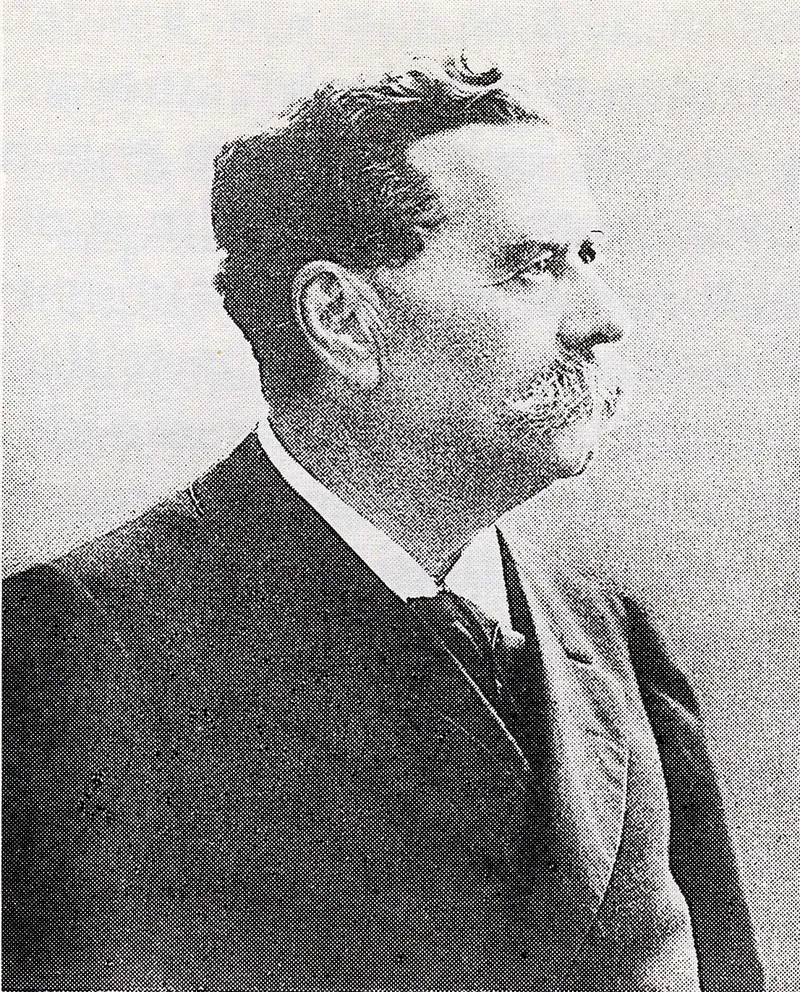
- Selim Lemström (1838–1904) taught physics at the University of Helsingfors (Helsinki) and joined polar voyages to Spitsbergen in 1868 and to Finnish Lapland in 1871, 1882 and 1884.
- In December 1882 his wire array on the Oratunturi fell glowed nightly and showed the auroral spectral line, as he reported in Nature in 1883.
- His first pot trials in 1885 grew an estimated 40 per cent more under charged wires, and in his 1904 book he put the smallest real gain at 45 per cent for land of average fertility.
- His own tables include losses: carrots down 51 per cent and cabbage down 44 per cent at Helsingfors in 1886, and potatoes down 26.5 per cent on second plots at Durham in 1903.
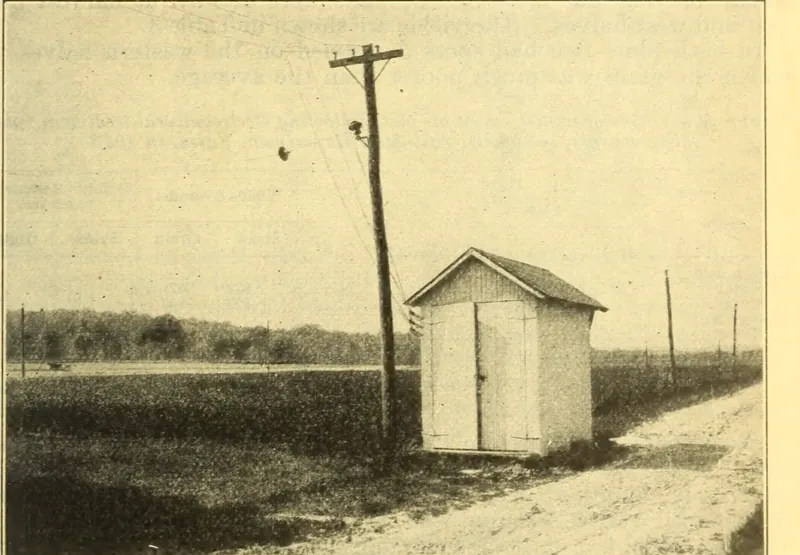
- The USDA ran similar positively charged networks at Arlington in 1907–1918 and found no well-defined increase (Bulletin 1379).
- His book, Electricity in Agriculture and Horticulture (London, 1904), is free to read in Cornell's scan on archive.org.
Who was Selim Lemström?
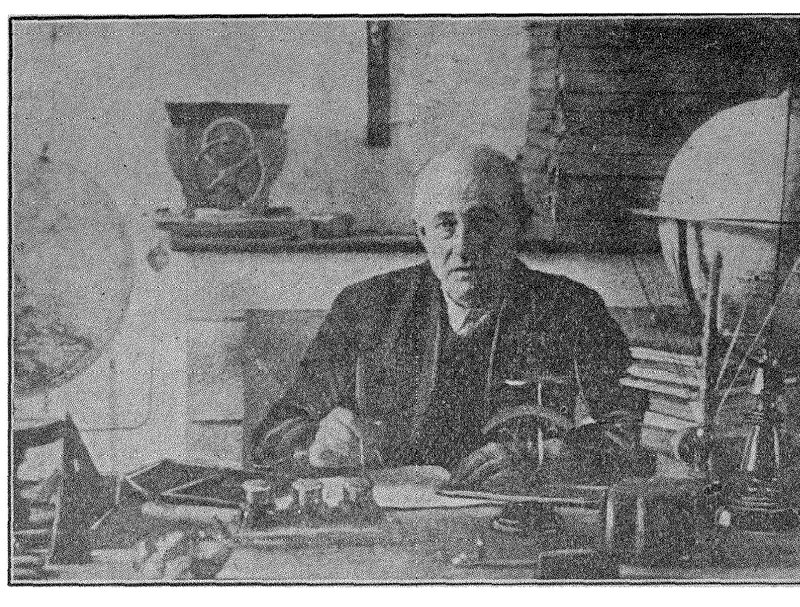
Selim Lemström was a Finnish physicist, born in 1838 and died in 1904, best known in his lifetime for work on the aurora and atmospheric electricity. He ran experiments in "the physical laboratory of the University of Helsingfors", the Swedish name for Helsinki, and the title page of his 1904 book names him "Prof. S. Lemström". His dates come from Cornell University Library's record of that book.
He came to plants through fieldwork. In the opening pages of Electricity in Agriculture and Horticulture he lists polar voyages "1868 to Spitzbergen and the north of Norway, and 1871, 1882, 1884 to Finnish Lapland". His other books include L'Aurore boréale (Paris, Gauthier-Villars, 1886), a general study of the aurora as an effect of electric currents in the atmosphere.
Why did Lemström link the aurora and plant growth?
Lemström linked the aurora to plant growth because he thought the same atmospheric currents that light the polar sky might explain the vigour of Arctic crops. He wrote that plants in the far north, when they escaped frost, showed "a degree of development which greatly surpasses" that of plants farther south, with rye returning up to 40 bushels per bushel sown. Since the long Arctic day delivers less heat and light than people assumed, he reasoned, the cause "must be sought elsewhere", and he looked to "electrical currents, the effect of which appears in the Polar light" (pp. 1–3).
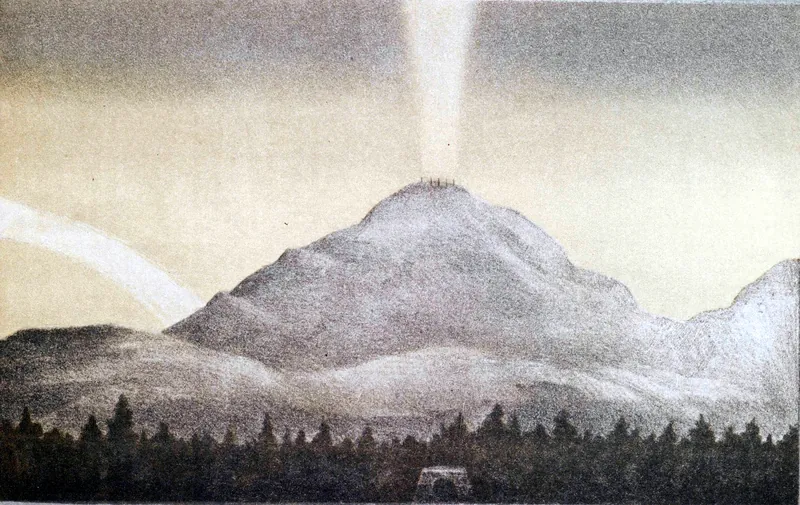
He also believed he had made those currents visible. During the Finnish International Polar Expedition of 1882–84 he laid a bare copper wire with points every half metre over 900 square metres of the Oratunturi summit near Sodankylä. From 5 December 1882, he reported in Nature, "there appeared almost every night a yellow-white luminosity around the summit", and a spectroscope picked up the auroral green line. He also noted a link between tree-ring widths in northern pines and the sunspot and aurora cycles. That chain of reasoning, from aurora to current to crop, is his hypothesis; none of it measured a plant response.
How did Lemström's overhead-wire setup work?
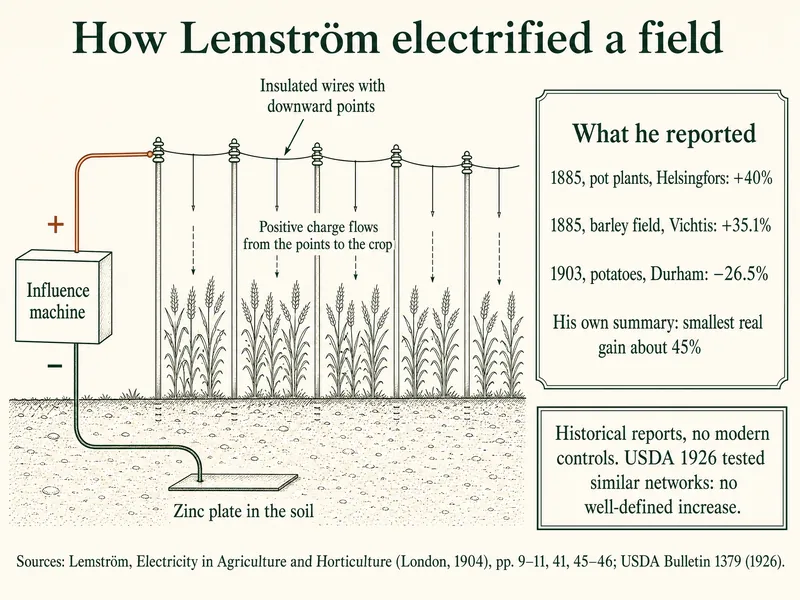
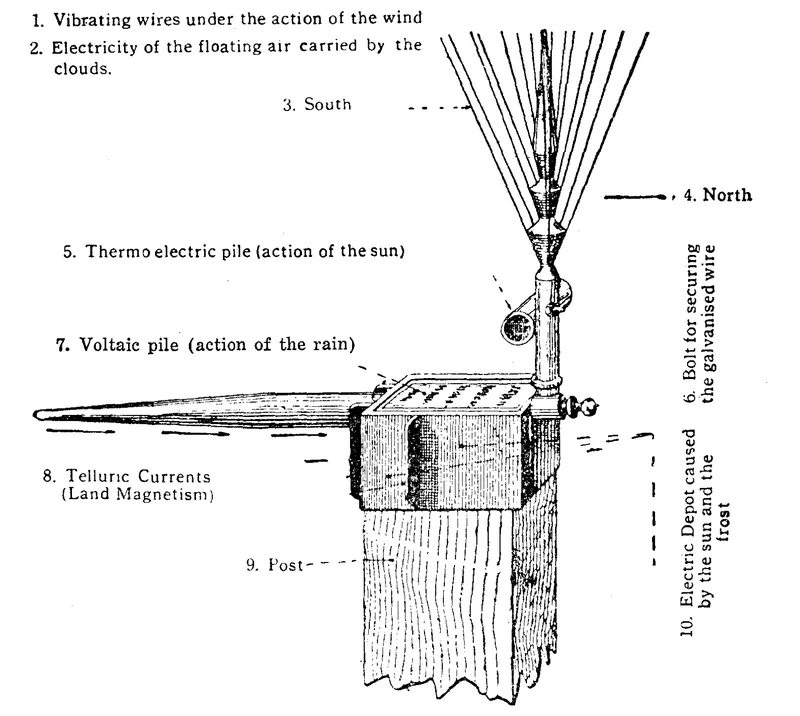
Lemström's setup was a network of insulated wires hung over the crop, fitted with downward points and charged from an influence machine (a hand- or engine-driven static generator). The positive pole went to the wires and the negative pole to the earth, so that charge leaked from the points down through the plants. In his first test, from May to 24 June 1885, he hung a net of pointed wires over pots of barley, wheat and rye in a south window, ran a Holtz machine five hours a day and kept a third compartment without wires as a control (pp. 9–10).
Field versions used the same idea at scale, with wires on poles and later a new type of influence machine built in Helsingfors. He found that treatment during hot sunshine damaged most crops and recommended interrupting it in the middle of sunny days, and he reported that some crops, such as peas, carrots and cabbage, needed watering to respond. The USDA later described its own 1908 close-wire test as "similar to that employed by Lemström".
What results did Lemström report?
Lemström reported large gains for most crops and losses for some, all from small plots compared with untreated neighbours. These are historical reports: few repeats, no statistics and controls that sat beside the treated plots, where his own text shows soil differences could swing the result.
| Place and year | Crop | Result he reported | Evidence level |
|---|---|---|---|
| Helsingfors laboratory, 1885 | Barley, wheat, rye in pots | About 40% more growth | Historical report |
| Vichtis farm, 1885 | Barley field | +35.1% | Historical report |
| Garden Society, Helsingfors, 1886 | White beets, red beets, parsnips | +107%, +65%, +54% | Historical report |
| Garden Society, Helsingfors, 1886 | Carrots, cabbage | −51%, −44% | Historical report |
| Brödtorp estate, 1886 | Wheat (first-quality grain) | +57% | Historical report |
| Durham College of Science, 1903 | Potatoes, beans (second plots) | −26.5%, −8.9% | Historical report |
The strawberries make a good example of his style. Under charged wires in a greenhouse they ripened in 28 days with a positive charge, 33 with a negative one and 54 without, he wrote (p. 11). He explained the 1886 cabbage and carrot losses as "want of water", and the 1903 Durham losses by noting that the electrified plots lay about 0.3 m lower than the controls (pp. 45–46).
From all this he drew a summary that later writers quoted for decades: "we are approaching its smallest value in fixing it at 45 per cent. for land of average fertility" (p. 41). He added that on poor soil the increase was "so small as to be scarcely perceptible". Even the 2025 Marquette study by Chier and colleagues still cites him for gains of 40–70 per cent in potatoes, celery and carrots.
Lemström's work in numbers
- 1882Year of his artificial aurora experiment on OratunturiLemström, Nature 28 (1883)
- 900 m²Area of pointed copper wire laid on the summitLemström, Nature 28 (1883)
- 40%Growth gain he estimated in his first pot trial, 1885Lemström 1904, pp. 9–10
- 45%His own figure for the smallest real yield gainLemström 1904, p. 41
- −26.5%Potato result on his second Durham plots, 1903Lemström 1904, p. 46
Did anyone repeat Lemström's experiments?
Yes, many researchers repeated Lemström's overhead-network method, and the better-controlled repeats did not confirm his gains. In Britain, Newman and Lodge electrified about 20 acres at Evesham from 1906, and the government committee under V. H. Blackman ran 33 field trials in 1915–1920; the USDA's review found the biggest of those gains traced to weak control strips, and Blackman's 47 pot trials averaged just 1 per cent.
In Germany, Gerlach and Erlwein, Höstermann, Clausen and Breslauer tested networks and saw no benefit; the USDA notes that Lemström's claim that richer soil responds more "is not substantiated" by those trials (p. 26). The USDA's own Arlington trials, with positively charged wires at 30,000–60,000 volts, held winter-wheat grain between 11 per cent below and 3 per cent above the control over 1914–18 and concluded that electroculture "is not recommended". The story continues on our 1926 USDA report and electric fields and plant growth pages.
What Lemström's work means for gardeners
Lemström's work means less for garden antennas than many websites suggest, because his method was powered. He drove a static machine to put tens of thousands of volts on wires over the crop; a passive copper stake has no power source at all, and the 2025 Marquette trial measured only about 2 millivolts from such rods in soil. Quoting his 45 per cent for a coil on a dowel compares two different things.
His lasting contribution is the question he asked, and his habit of reporting losses alongside gains. Modern research on applied electric fields and on atmospheric electricity and plants still works on it, with measured doses. If you want to try something yourself, a fair comparison of treated and untreated beds is the way: see how to test electroculture, and for the wider verdict, does electroculture work.
How we put this page together
Our main source here is Lemström's own book, Electricity in Agriculture and Horticulture (London: "The Electrician" Printing & Publishing Co.; New York: D. Van Nostrand, 1904), read in Cornell University Library's scan; his 1883 Nature article on the aurora; Hull's Electro-Horticulture (1898); USDA Bulletin 1379 (1926); and Chier et al. (2025), all checked in October 2026. Percentages are as Lemström printed them. Hull's version of the first field trial ("Niemis", one third) differs from Lemström's own (Vichtis, 35.1 per cent); this page follows Lemström. Figures from later web compilations, such as gains of 125 per cent or currents of "11 amps", were left out because they do not match the primary text.
Common questions
Were Lemström's results peer-reviewed?
Not in the modern sense. He published his early results in French as Expériences sur l'influence de l'électricité sur les végétaux (Helsingfors, 1890) and the full series in his 1904 book, both under his own name and without outside replication or statistics.
Did Lemström really create an artificial aurora?
He reported a nightly glow above his wire array on Oratunturi in December 1882 that showed the auroral spectral line. Later physicists explain such glows as corona discharge from points in strong fields, which Dufour's 2026 model of a similar collector also predicts under storm-like conditions.
Was Lemström's electroculture passive or powered?
Powered. He charged his overhead wires with a Holtz influence machine and later an improved machine built in Helsingfors. That makes his work an ancestor of modern applied-field research, not of passive copper antennas; the electroculture FAQ explains the difference.
Where did Lemström run his field trials?
In Finland at Vichtis, Helsingfors and the Brödtorp estate in the parish of Pojo; in Burgundy in 1888; and in 1902–03 at Durham College of Science in Newcastle-upon-Tyne, at Kryschanowitz near Breslau and at Atvadaberg in Sweden.
Why did some crops do worse under his wires?
He blamed dry weather for the 1886 losses in cabbage and carrots, hot sunshine during treatment for damage to most crops, and the low position of his Durham plots for the 1903 losses. None of those explanations was tested separately.
Is Lemström's 1904 book worth reading today?
Yes, as history. It is short, includes his tables and his reasoning, and shows how persuasive small-plot results can look; Cornell's free scan is on archive.org. For the evidence on yields, read it alongside the 1926 USDA bulletin.
Related history
More help: see our electroculture gardening.