
Antennas
Copper Wire for Electroculture: Gauge and Type
Copper wire for electroculture can be any bare solid copper thick enough to hold a coil, roughly 10 to 16 AWG; no study has found that gauge, type or winding changes a passive antenna's effect.
On this page
Key takeaways
- AWG numbers run backwards: 12 AWG solid wire is about 2.05 mm thick and 18 AWG about 1.02 mm, per the HyperPhysics wire table at Georgia State University.
- The copper-coiled dowels in the 2025 PLoS One trial carried only about 2 millivolts into the soil, and the paper does not even report the wire gauge.
- Christofleau's booklet (c. 1927) specified No. 12 galvanised iron wire, buried 10 inches deep: iron, not copper.
- The Iowa station trial of 1930–32 buried seven-strand No. 22 copper radio cable about 12 inches deep; yields stayed within experimental error.
- Bare copper browns and then greens outdoors; the Statue of Liberty took about thirty years to form its full patina.
- Never connect electroculture wire to mains power or batteries, and keep tall posts and long wires well clear of overhead power lines.
What copper wire is used for electroculture?
Most electroculture antennas use bare, solid copper wire wound around a wooden stake or bent into a spiral. Solid wire holds a coil shape; stranded wire tends to splay and needs a support. The modern copper coil on a stake is a recent design: it does not appear in Christofleau's 1920s booklet or in the USDA's 1926 bulletin.
The best-documented modern example is the one in Chier et al. (2025): "a 40 cm dowel rod coiled with copper wire and inserted 10 cm into the soil." The paper does not give the gauge, the number of turns or whether the wire was bare or coated, which tells you how little the authors expected those details to matter. The rods showed no consistent benefit to four vegetable crops (controlled, peer-reviewed). The full trial is covered on copper rods in the garden.
What gauge copper wire for electroculture?
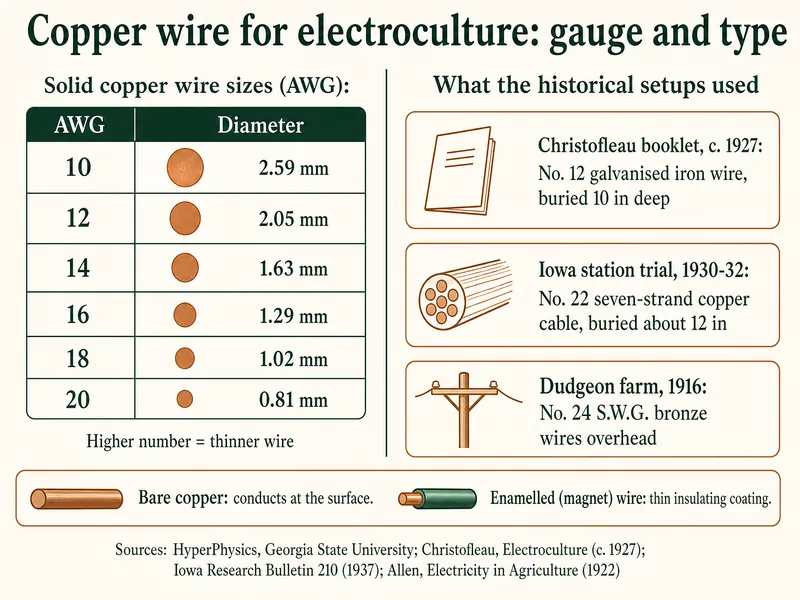
Any gauge from about 10 to 16 AWG will hold a coil on a stake, and no study has tested whether gauge changes anything. In the American Wire Gauge (AWG) system the number rises as the wire gets thinner, so 10 AWG is thick and stiff while 20 AWG bends easily in the fingers.
| AWG | Diameter (inches) | Diameter (mm) | Resistance per 1,000 ft at 20 °C |
|---|---|---|---|
| 10 | 0.1019 | 2.59 | 1.00 ohm |
| 12 | 0.0808 | 2.05 | 1.59 ohm |
| 14 | 0.0641 | 1.63 | 2.53 ohm |
| 16 | 0.0508 | 1.29 | 4.02 ohm |
| 18 | 0.0403 | 1.02 | 6.39 ohm |
| 20 | 0.0320 | 0.81 | 10.15 ohm |
Inch diameters and resistances are from the HyperPhysics table; millimetres are converted at 25.4 mm per inch. Choose by handling, not by electrics: thick wire (10–12 AWG) stands up on its own as a spiral, medium wire (14–16 AWG) winds neatly around a dowel by hand, and thin wire (18 AWG and up) needs a stake and is easily snagged by tools.
Why doesn't gauge matter electrically? A metre of 14 AWG copper has a resistance of under a hundredth of an ohm. The natural fair-weather current from the air to the ground is about 1.5 to 2.2 trillionths of an amp per square metre. Push a current that small through a wire that conductive and the voltage lost along the wire is far too small to measure; the 2 mV the 2025 trial recorded at the soil was not limited by the wire. Gauge changes how a coil looks and how long it lasts, not what it collects. The physics of that air current is on atmospheric electricity and plants.
Copper wire numbers worth knowing
- 2.05 mmDiameter of 12 AWG solid wireHyperPhysics, Georgia State University
- 2 mVSignal copper-coiled dowels carried into soilPLoS One, Chier and colleagues (2025)
- No. 22Copper cable buried in the 1930–32 Iowa collector trialIowa Research Bulletin 210 (1937)
- No. 12Galvanised iron wire Christofleau's booklet specifiedChristofleau, Electroculture (c. 1927), printed p. 10
Bare, enameled or coated wire?
Bare copper is the usual choice, because the antenna idea assumes the metal touches air and soil directly. Enameled wire, sold as magnet wire, carries a thin insulating film, and plastic-coated house wire has a thick sheath; both keep the copper itself away from the soil. If you follow the antenna claim literally, insulation defeats the purpose.
There is no evidence either way. No study has compared bare, enameled and coated wire for plants, and the 2025 trial did not say which it used. For a home test the practical rule is consistency: use the same wire for every antenna, and make the untreated stakes from the same wood with no wire at all. Enameled wire is also slippery and springy to wind; bare solid wire from a hardware store is easier to work. Step-by-step winding instructions are on how to make an electroculture antenna.
How much copper wire does an antenna need?
A typical stake coil needs about one to two metres of wire, depending on the dowel's thickness and how tightly you wind. Each turn uses roughly the dowel's circumference: on a 12 mm (half-inch) dowel that is about 4 cm per turn, so 30 turns take about 1.2 m, plus a few centimetres at each end for fixing.
That arithmetic is the only rule. The 2025 trial coiled wire along a 40 cm dowel without reporting the turn count, and no source gives a tested number of turns. Popular rules about turn counts, such as the nine-turn conical coil on Robert Nelson's Rex Research web page, come with no source at all. What does matter for a fair test is that every treated stake gets the same wire, the same length and the same number of turns, so the antennas differ from the controls in one way only.
Did the historical designs specify wire?
Yes, and most of them did not use copper for the main line. The historical setups that gave wire specifications used galvanised iron, galvanised steel, bronze and, in one American trial, copper cable.
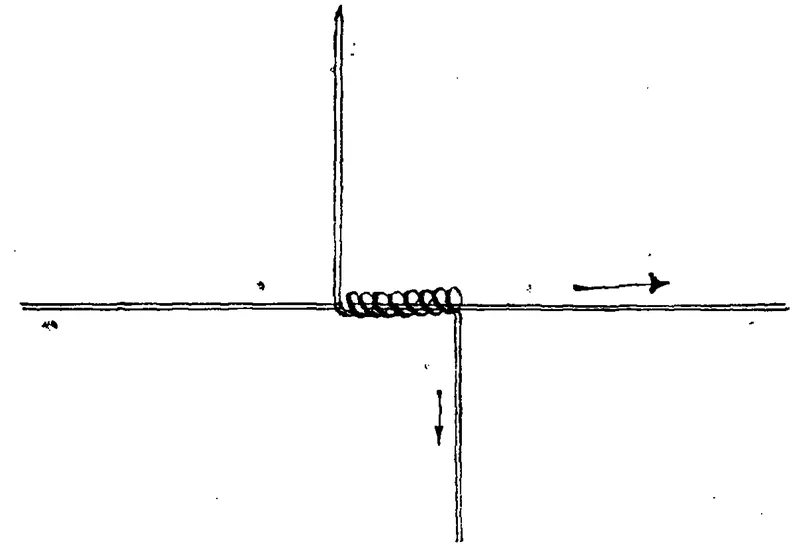
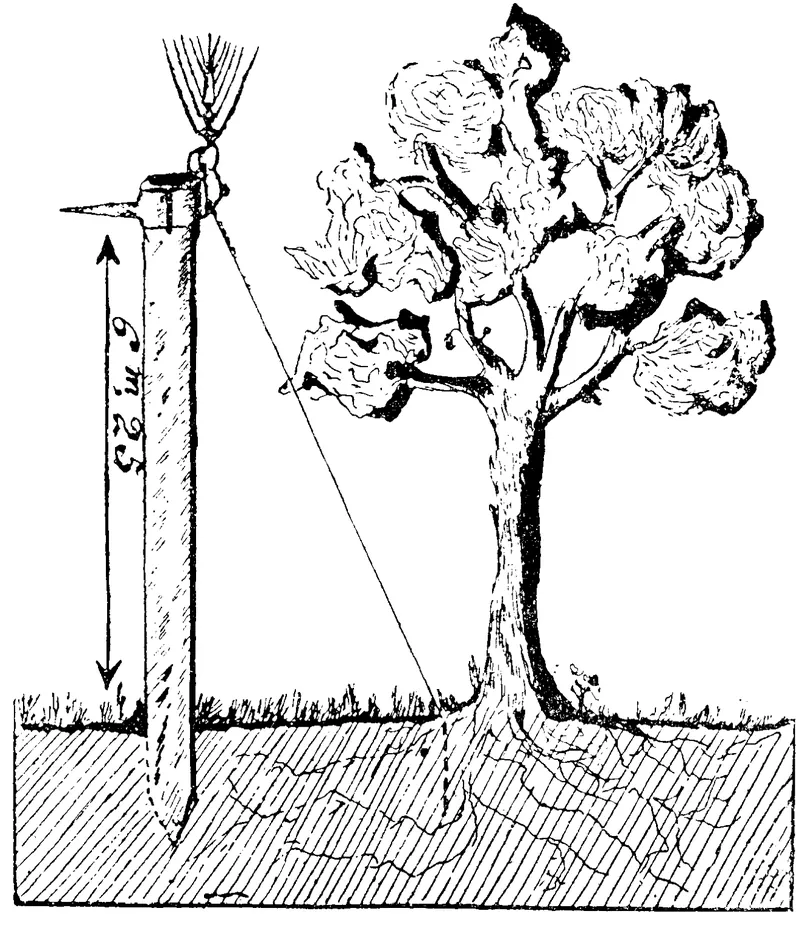
- Christofleau's apparatus (booklet, c. 1927). The installation page calls for "No. 12" gauge "soft pliable galvanised iron wire" (the digit after 12 is blacked out in the surviving scan; other pages say 12 or 12½). It ran down a 25 ft post past four porcelain insulators and was buried 10 inches deep toward magnetic north. Joins were spliced tightly for about 16 inches and soldered. Iron, not copper. More on Justin Christofleau.
- Dudgeon farm, Scotland, 1916. Allen's Electricity in Agriculture (1922, p. 100) describes overhead No. 24 S.W.G. bronze wires 4½ yards apart, about 6 to 7 ft above oats, energised by a transformer and rectifier. The USDA bulletin calls them silicon-bronze.
- Llantwit Vadre, Wales, 1917–18. Allen (pp. 100–101) describes a galvanised steel wire network over 1.2 acres of potatoes, held at 30,000 to 39,000 volts.
- USDA Arlington farm, 1907–18. The USDA's Bulletin 1379 strung open wire networks on glass insulators over wheat, rye and vegetables, charged to 30,000–60,000 volts. It concluded the method "is not recommended". Details are on the 1926 USDA report page.
- Iowa Agronomy Farm, 1930–32. Research Bulletin 210 used "Seven strand, No. 22 copper radio cable", laid north–south about 12 inches deep under each treated plot and fed from collectors 20 ft up, one an original Christofleau head. Yields of six crops stayed within experimental error.
Two cautions follow. First, the British S.W.G. and the iron-wire gauges of the 1920s are not the same scale as AWG, so "No. 12" in Christofleau is not the same as 12 AWG copper. Second, every powered system above ran on machines at tens of thousands of volts. None of them is a home project, and none showed a reliable benefit.
How long does copper wire last outdoors?
Bare copper wire lasts many years outdoors; it tarnishes rather than rusting away. The National Park Service notes that the Statue of Liberty's copper was brown when completed in 1886 and took about thirty years to oxidise into its green patina. A garden coil follows the same path on a smaller scale: dull brown within months, green-tinged after a few seasons.
The weak point is usually the support. A pine or bamboo dowel in wet soil can soften within a season or two, while a hardwood dowel lasts longer. Thin wire (18 AWG and finer) is more easily broken by hoes and trimmers than the wire itself is worn by weather. The patina is not a sign the antenna has "charged" or "failed"; it is ordinary surface chemistry.
Is copper wire for electroculture safe?
Bare copper wire on a stake is safe in a garden as long as it stays passive. The risks come from the add-ons some guides suggest.
- Never connect electroculture wire to mains power, an electric fence or a battery. The historical "active" systems used powerful machines and are not garden projects; the 2025 trial was passive, and so is every product on this site.
- Keep tall posts and long wires away from overhead lines. A Michigan State University hazard alert on overhead power lines warns not to assume overhead wires are insulated and lists metal tools and materials among things that must stay at least 10 feet from power lines. A Christofleau-style mast 20 ft tall, or a wire flung over a branch, can reach a service line.
- Mind the ends. Cut wire ends are sharp; bend them over or tuck them into the dowel, especially at child height.
Copper itself is a plant micronutrient, and the 2025 authors judged that a solid rod does not release copper fast enough to reach roots. Testing a coil fairly, rather than worrying about it, is the useful next step: see how to test electroculture.
How we put this page together
This page draws on the HyperPhysics wire-gauge table (Georgia State University), the 2025 copper rod trial in PLoS One by Chier, Oakey, Budny and Lemoine, Christofleau's booklet Electroculture (Perth edition, c. 1927, printed pp. 9–10 and 44), Allen's Electricity in Agriculture (Pitman, 1922, pp. 100–101), USDA Department Bulletin 1379 (1926), Dorchester's Iowa Research Bulletin 210 (1937, p. 11), the National Park Service Statue of Liberty FAQ and a Michigan State University hazard alert on overhead power lines, checked in October 2026. Left out: claims that a particular gauge, purity, turn count or winding direction improves results, none of which any source has tested, and high-voltage or "water-sparker" builds from 1940s books.
Common questions
Is 99.9 per cent pure copper better for electroculture than ordinary copper wire?
No study has compared copper purities for plants. Electrical-grade copper wire is already high purity, and at the tiny currents involved the difference in conductivity is irrelevant. Choose wire for stiffness and durability.
Can you use aluminium or steel wire instead of copper?
Nothing in the trial record shows copper outperforming other metals, and the most famous historical design, Christofleau's, buried galvanised iron. Aluminium is soft and steel rusts, so copper is mainly the practical, long-lasting choice.
Does stranded copper wire work for an electroculture antenna?
Stranded wire is harder to shape because it does not hold a coil, but nothing suggests it behaves differently. The Iowa trial of 1930–32 buried stranded copper radio cable; its plots showed no yield effect beyond experimental error.
What gauge is the copper in store-bought antennas?
Sellers do not always say. If a listing gives a gauge, compare it with the AWG table above: 10 AWG is about 2.6 mm, 12 AWG about 2.1 mm.
Should electroculture wire be soldered or just twisted?
For a passive coil on a stake, a tight twist or a staple is enough to hold the wire in place. Christofleau's booklet asked for soldered splices on its long buried runs, but that advice was for joining two lengths of iron wire, not for finishing a coil.
Does copper wire need to touch the soil?
The claim is that the coil gathers charge from the air and the stake carries it into the ground, so most designs push the bottom of the wire or stake into the soil. In the 2025 trial, exposed coils with 10 cm in the soil showed no effect on height or leaf greenness.
Where can you buy copper wire for a DIY antenna?
Bare solid copper wire is sold by length at hardware and electrical stores, often as ground wire. Buy enough for every treated stake in your test, from the same reel.
More on building and testing
More help: see our electroculture gardening library.