
Antennas
Copper Rods in the Garden: Do They Help?
Does putting copper rods in your garden help? The only controlled trial of copper rods in garden soil, published in 2025, found no consistent benefit to growth or yield.
Disclosure: Thrive Garden, which sells the electroculture antennas and copper stakes we link to, is a store owned by the same team as this site. Our history pages follow the original documents and our science pages follow peer-reviewed studies, checked October 2026. Store descriptions are reported as the store's own claims. Ownership disclosure
View at Thrive GardenOn this page
Key takeaways
- The 2025 PLoS One trial by Chier and colleagues used the common DIY design: a 40 cm wooden dowel wound with copper wire (controlled, peer-reviewed).
- Across 4 crops and 10 plants per treatment per crop, rods changed neither plant height nor leaf greenness over 8 weeks.
- The rods carried about 2 millivolts into the soil, and about 20 mV at most beside a fluorescent light.
- Copper is a plant micronutrient, but Mississippi State Extension notes that in excess it damages proteins and lowers yields; the 2025 authors judged a solid rod unlikely to release copper fast enough to matter.
- An original Christofleau antenna feeding buried copper cable was tried at Iowa State College in 1930–32; crop yields stayed within experimental error.
- If you want to try rods, treat them as a test: rods in some plots, plain stakes in others, chosen by coin toss.
Does putting copper rods in your garden help?
Putting copper rods in your garden has not been shown to help crops in any controlled study. The one modern trial built for this question, Chier et al. (2025) in PLoS One, concluded: "We found no consistent evidence that passive electroculture is beneficial to crop growth or yield in container gardens." That is a controlled, peer-reviewed result, though a small one, run indoors in pots.
Many gardeners still report bigger or healthier plants after adding rods, and those reports are worth taking seriously as observations. They are anecdotes, though: most compare one season with another, or a favourite bed with an ordinary one. Soil alone can swing a harvest widely: the USDA found an untreated plot beat its neighbour by 43 per cent in a year with no electricity. The wider picture is on does electroculture work.
What are electroculture rods?
Electroculture rods are passive copper stakes, usually copper wire coiled on a wooden dowel or a solid copper spiral, pushed into soil near plants. Sellers and online guides say the rod collects atmospheric electricity and passes it to the roots. Nothing powers the rod: no battery, no solar cell, no mains connection.
The idea borrows from older devices that were very different. Justin Christofleau's 1920s apparatus stood on a post about 20 ft high and fed a buried galvanised iron wire, not copper. The overhead networks tested by the USDA from 1907 to 1918 were charged by machines to 30,000–60,000 volts. A copper rod in a raised bed has neither the height nor the power source of either. For the range of shapes on sale, see electroculture antennas and antenna designs.
What did the copper rod study measure?
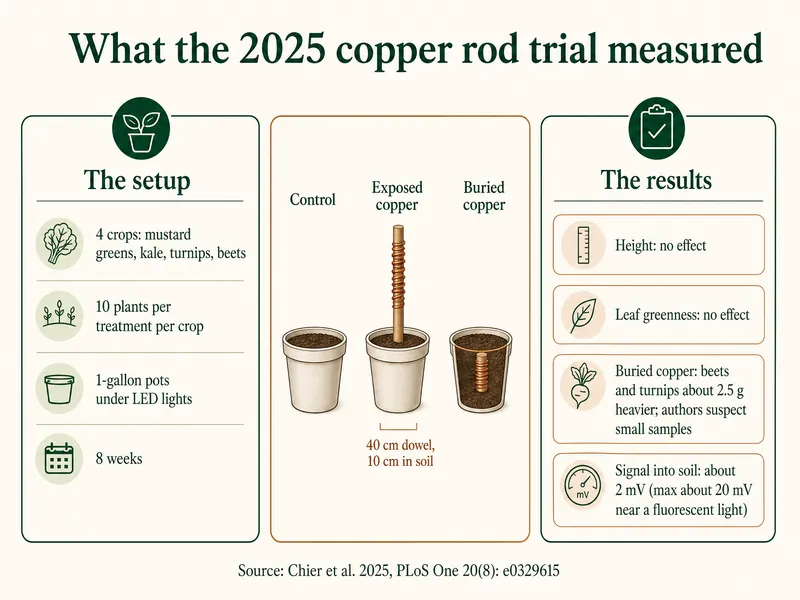
The 2025 study measured plant height, leaf greenness (SPAD), aboveground biomass and stomatal conductance, and it measured the electrical signal the rods carried into the soil. The team at Marquette University in Milwaukee grew mustard greens, kale, turnips and beets from seed, moved seedlings into one-gallon pots after four weeks, and assigned each plant at random to one of three treatments.
- Control: no rod.
- Exposed copper: a 40 cm dowel coiled with copper wire, inserted 10 cm into the soil, so most of the coil stood in the air.
- Buried copper: a 10 cm copper-coiled dowel buried completely under the soil.
Plants were rotated around the growing table every week so no treatment kept the best spot. Height and leaf greenness showed no treatment effect. Buried copper raised the aboveground biomass of beets and turnips by about 2.5 g, but exposed copper, the arrangement nearly every garden rod uses, did not. The authors wrote that the buried-copper pattern was "likely" a "result of small sample sizes". Kale stomatal conductance rose about 13 per cent under buried copper, with no matching growth gain.
What the 2025 copper rod trial found
- 2 mVTypical signal a copper rod carried into the soilPLoS One, Chier and colleagues (2025)
- 20 mVHighest reading, with a rod within 4 cm of a fluorescent lightPLoS One, Chier and colleagues (2025)
- 10Plants per treatment per cropPLoS One, Chier and colleagues (2025)
- 30 yearsTime the Statue of Liberty's copper took to form a full green patinaNational Park Service
The voltage result explains a lot. The authors measured it with an oscilloscope and found rods placed around the room passed about 2 mV into the soil. The natural electric field near the ground is around 100 volts per metre in fair weather, which in principle could give about 4 V across a 40 cm rod, yet almost none of that reached the pot. The rest of the physics is on atmospheric electricity and plants.
Can copper rods harm soil or plants?
A solid copper rod is unlikely to harm soil or plants, because it releases copper very slowly. Copper itself is an essential plant nutrient: Mississippi State University Extension lists it as needed "for photosynthesis, nitrogen and carbon metabolism, and cell wall synthesis". The same publication warns that too much copper "can become toxic in the plant", lowering chlorophyll and yields.
Where garden copper problems do arise, extension sources point to repeated copper sprays and some manures, not to metal stakes. The 2025 authors addressed the rod question directly: "Copper likely does not leach from the metal rod fast enough to infiltrate soils and plant roots." They also noted that copper moves downward in soil more than sideways, and that many bagged potting mixes already contain copper sulfate. If you already spray copper fungicides, a soil test from your extension service is a better guide than any rod.
Outdoors, copper slowly oxidises. The National Park Service says the Statue of Liberty was brown like a penny in 1886 and took about thirty years to form its full green patina. Expect a rod to darken within a season and turn greener over years; the patina is ordinary corrosion, not a sign the rod is working or failing.
A few practical cautions apply to any stake. Push rods in beside young plants at planting time rather than through an established root zone, keep them where a mower or strimmer will not hit them, and never connect a garden rod to mains power, batteries or an electric fence.
How do copper rods compare with coil antennas?
Copper rods and coil antennas work on the same claimed principle, and the evidence for both rests on the same small body of trials. A "rod" usually means copper wire wound on wood, as in the 2025 study; a "coil antenna" is often an all-copper spiral with a stake. No study has compared shapes, metals or wire thickness against each other.
| Device | Where it was tested | Result | Evidence level |
|---|---|---|---|
| Copper wire coiled on a 40 cm dowel, exposed | Marquette University pots, 2025 | No effect on height or leaf greenness | Controlled, peer-reviewed |
| Copper-coiled dowel, buried | Marquette University pots, 2025 | Beets and turnips about 2.5 g heavier; authors suspect small samples | Controlled, peer-reviewed |
| Christofleau collector on a 20 ft post feeding buried copper cable | Iowa State College field, 1930–32 | Six crops within experimental error | Controlled government or station trial |
| Overhead wires charged to 30,000–60,000 V | USDA Arlington farm, 1907–18 | "no well-defined increase in yield" | Controlled government or station trial |
| All-copper spiral stakes | Store listings only | Sellers report better growth | Promotional claim |
The Iowa test is the closest older match to a garden rod. Research Bulletin 210 (Dorchester, 1937) ran five atmospheric collectors, one an original Christofleau apparatus, into copper cable buried about 12 inches under corn, soybeans, turnips, chard, beets and string beans. Yields ranged from about 4 per cent below to 11 per cent above the controls, all within experimental error. The USDA's Bulletin 1379 used powered wires far stronger than any rod and still concluded the method "is not recommended". A 2024 Washington State University Extension article put the modern claims more bluntly, reporting horticulturist Linda Chalker-Scott's view: "none of these promises are backed with any reliable scientific evidence."
How do you try copper rods fairly?
Try copper rods fairly by giving them a matched comparison: rods in some plots, plain wooden stakes of the same size in others, and a coin toss deciding which is which. Everything else, from seed packet to watering can, stays the same for both groups.
- Choose one quick crop you can weigh, such as radishes, lettuce or bush beans, and one variety.
- Mark out at least four pairs of small plots or pots that look alike.
- In each pair, flip a coin: heads gets the copper rod, tails gets a bare stake.
- Weigh each plot's harvest on the same day and write it down.
- Compare the gap between rod and no-rod plots with the gap between pairs. If the rod plots are not ahead in most pairs, the rods probably did nothing you can measure.
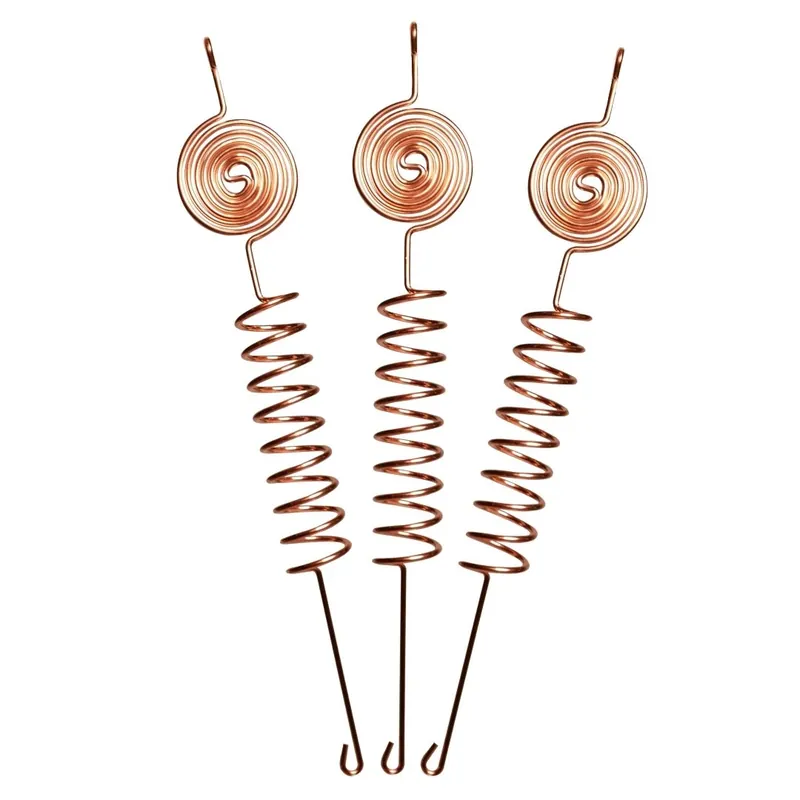
Thrive Garden, a store owned by the same team as this site, sells the Tesla Coil antenna in 3, 6, 12 and 24 packs at $39, $73, $141 and $272 (store prices, October 2026), listed as 99.9 per cent copper. Its product page suggests setting the base 3 to 4 inches into the soil; that is the store's guidance, not a tested rule. A pack makes a tidy, durable set of copper stakes for a side-by-side trial, and the step-by-step trial plan with a printable log lives on how to test electroculture. For where to put rods in the bed, see antenna placement, and for a home-built version, how to make an electroculture antenna.
How we put this page together
Sources: the copper rod trial by Chier, Oakey, Budny and Lemoine (PLoS One, 2025, e0329615), Dorchester's Iowa bulletin on electric current and crop plants (Research Bulletin 210, 1937), the USDA's 1926 Electroculture bulletin (No. 1379), Mississippi State University Extension publication P3726 on micronutrients, Washington State University Extension (Sheehan, 2024), the National Park Service Statue of Liberty FAQ and Thrive Garden's Tesla Coil product page, all checked in October 2026. Store prices and placement advice are reported as the store's own. Left out: forum and video reports of results, claims about pest or frost protection, and any lightning or grounding advice, which no source on garden stakes addressed.
Common questions
How many copper rods does a garden bed need?
No study has tested rod density, so there is no evidence-based number. For a fair test, the number per plot matters less than using the same number in every treated plot. Thrive Garden's page says one antenna covers about 9 to 16 square feet, which is the store's estimate.
Do copper rods work in containers and pots?
The 2025 trial was run entirely in one-gallon pots and found no consistent benefit. If you test rods in containers, put one rod per pot in half the pots and a plain stake in the rest, assigned by coin toss.
Is copper wire on a wooden stake the same as a solid copper rod?
Electrically, both are passive copper conductors with no power source. The tested design in 2025 was copper wire wound on a 40 cm dowel. Solid rods and spirals have not been trialled separately.
Will copper rods add copper to the soil as a fertilizer?
Very little, if any. The 2025 authors judged that copper does not leach from a rod fast enough to reach roots. If a soil test shows copper deficiency, your extension service will recommend a measured copper fertilizer rather than metal stakes.
Should copper rods be buried or left standing above the soil?
Most garden rods stand mostly above the soil, and that exposed arrangement showed no effect in the 2025 trial. Fully buried copper gave a small biomass gain in beets and turnips that the authors attributed to small samples.
How long does a copper rod last outdoors?
Copper resists corrosion well: it browns and then slowly greens as a patina forms, which took about thirty years on the Statue of Liberty. A wooden core will rot long before the copper does, so dowel-based rods need replacing sooner.
Can copper rods stand in for fertilizer or sprays?
Nothing in the controlled record shows rods doing the job of fertilizer, sprays or watering. Keep feeding and protecting rod plots exactly like the comparison plots, or the test cannot tell you anything.
More on copper and antennas
 AntennasCopper wire for electroculture
 AntennasElectroculture antennas
 Try itHow to test electroculture
- LearnDoes electroculture work?
Try it in your own beds
Tesla Coil Electroculture Antenna Starter Pack
Check current pack sizes and prices at Thrive Garden, then set up a fair side-by-side test.
View at Thrive GardenThrive Garden, which sells the electroculture antennas and copper stakes we link to, is a store owned by the same team as this site. Ownership disclosure
More help: see our honest guide to electroculture.