
Antennas
Tesla Coil Electroculture Antenna: What It Is
A Tesla coil electroculture antenna is a passive 29 cm copper spiral stake, not a Tesla coil; it has no power source, and no controlled study has tested this shape.
Disclosure: Thrive Garden, which sells the electroculture antennas and copper stakes we link to, is a store owned by the same team as this site. Our history pages follow the original documents and our science pages follow peer-reviewed studies, checked October 2026. Store descriptions are reported as the store's own claims. Ownership disclosure
View at Thrive Garden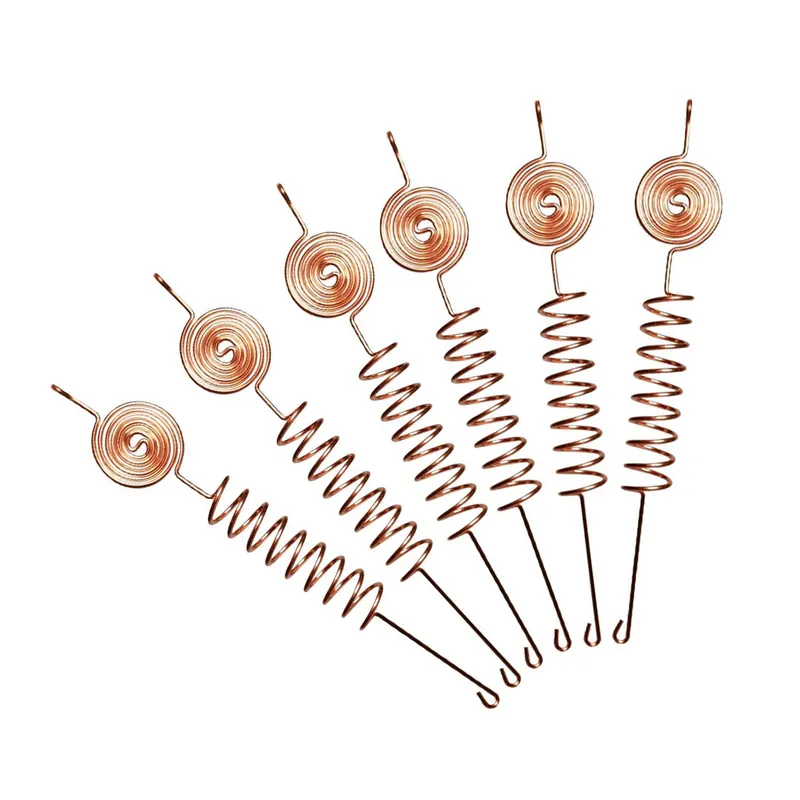
On this page
Key takeaways
- Thrive Garden lists its Tesla Coil antenna as 99.9% copper, about 11.5 in (29 cm) long, with a clockwise coil (store listing (a store we own), October 2026).
- The store charges $39 for a 3-pack and $272 for 24 (October 2026), which works out at $11.33 to $13 a stake.
- A real Tesla coil, patented by Nikola Tesla in 1891 as US 454,622, is a powered resonant transformer; a university demonstration coil turns 5,000 V into about 200,000 V.
- The garden stake shares the copper and the coil shape, but has no power supply, capacitor or spark gap.
- The closest controlled test, of copper-coiled dowels in 2025, found no consistent benefit to four vegetables (Chier et al. 2025).
- The store's placement advice (south side, every 2.5–3 ft, 3–4 in deep) is its own observation, not a trial result.
What is a Tesla coil electroculture antenna?
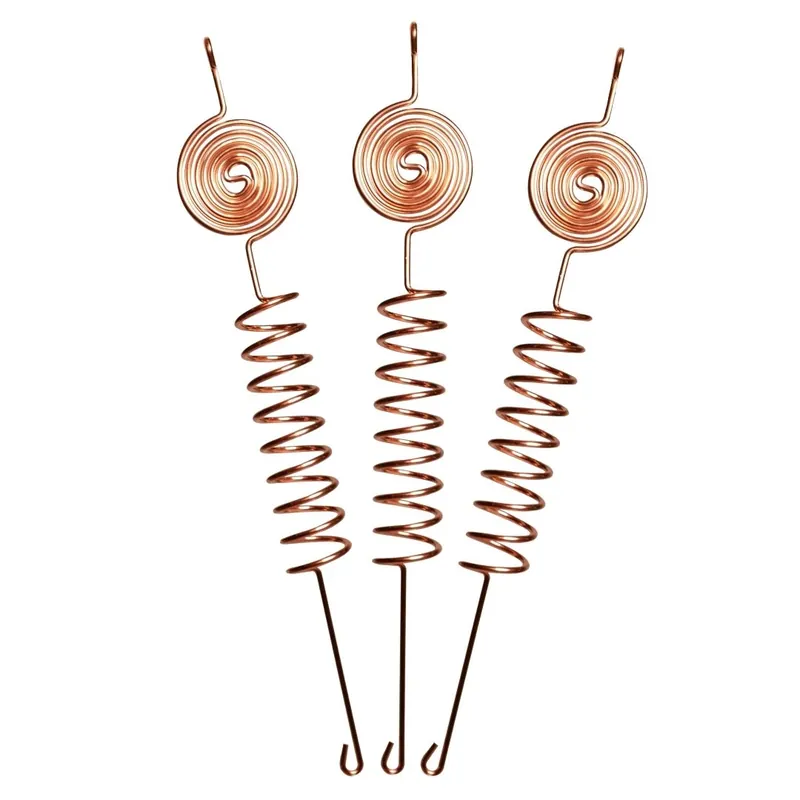
A Tesla coil electroculture antenna is a single piece of bare copper wire bent into a flat spiral at the top, a sprung coil in the middle and a straight stake below, pushed into garden soil. Thrive Garden, which shares its owners with this site, sells it as the Tesla Coil Electroculture Gardening Antenna Starter Pack.
The store's listing gives three physical facts: 99.9% copper, approximately 11.5 in (29 cm) long, and coils "turned clockwise". The product photos show the lower end bent into a small hook. It is one of the five common designs compared on electroculture antennas, and a ready-made version of the copper coil described in electroculture antenna designs.
Is it actually a Tesla coil?
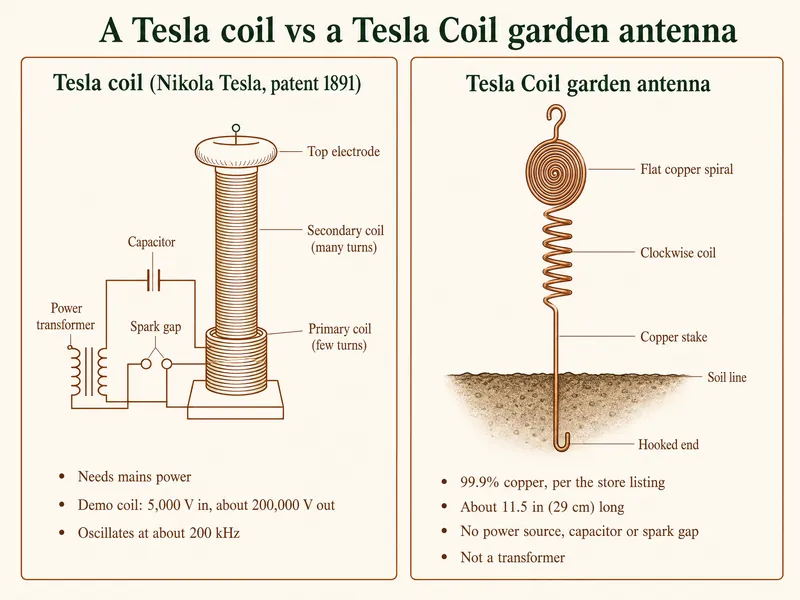
No, the Tesla Coil antenna is not a Tesla coil in the engineering sense. A Tesla coil is a resonant transformer that needs electrical power, and the garden stake is an unpowered piece of copper.
Nikola Tesla's patent US 454,622, "System of Electric Lighting", granted on 23 June 1891, describes the circuit. A supply transformer charges a capacitor; when the voltage is high enough a spark gap fires; the gap and a primary coil of a few turns then ring at high frequency and drive a loosely coupled secondary of many turns. The University of New Mexico physics demonstration notes describe a lecture coil fed by a 5,000 volt transformer that "resonates at a frequency of about 200 kilohertz" and produces about 200,000 volts. Western Washington University's demonstration page describes the same layout: a primary of "a few turns of copper bar" and a secondary of "many turns of fine copper wire".
| Feature | Tesla coil (1891 design) | Tesla Coil garden antenna | Source |
|---|---|---|---|
| Power | Mains supply and transformer | None | US 454,622; store listing |
| Parts | Capacitor, spark gap, primary and secondary coils | One bent copper wire | UNM demonstration notes; store photos |
| Output | About 200,000 V at about 200 kHz (demo coil) | About 2 mV reached soil from comparable copper rods | UNM; Chier et al. 2025 |
| Size | Demo unit 3 ft wide, 6 ft high | About 11.5 in (29 cm) | UNM; store listing |
| Evidence for crop benefit | Not a garden device | No controlled study of this shape | Literature checked October 2026 |
So where does the name come from? The store's listing leans on Tesla as an inspiration, quoting a line it attributes to him about "energy, frequency and vibration" and linking his ideas about wireless energy to electroculture. That is a marketing association, not a description of how the stake works. The coil shape is the only thing the two objects share.
What is in a Thrive Garden Tesla Coil antenna pack?
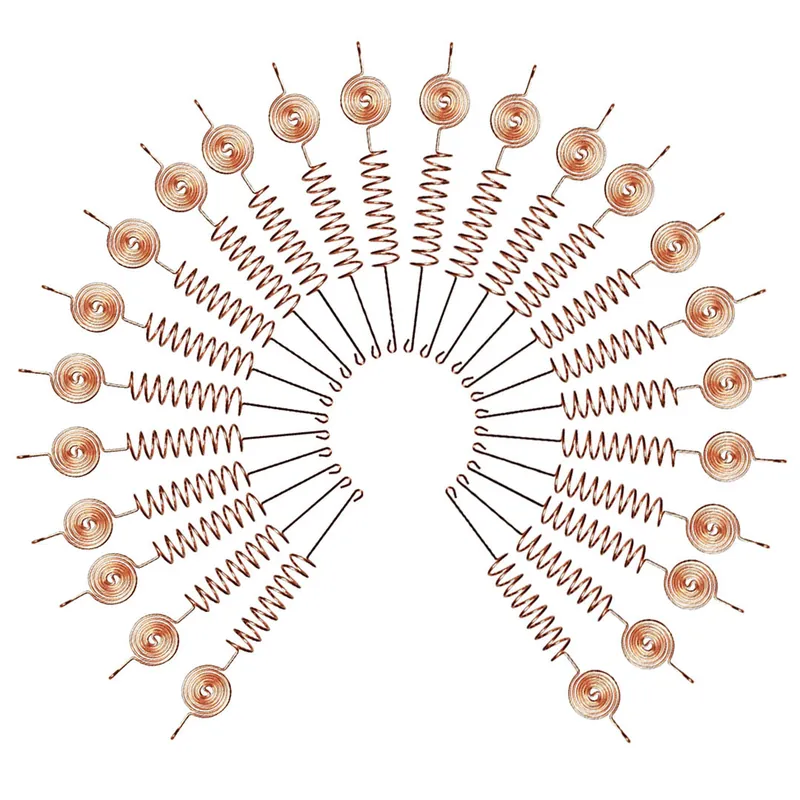
A Thrive Garden Tesla Coil pack contains one 29 cm stake design, sold in packs of 3, 6, 12 or 24. These are the store's prices on its product page (a store we own) as of October 2026:
- 3-pack: $39
- 6-pack: $73
- 12-pack: $141
- 24-pack: $272
The numbers behind the name
- 1891Year Nikola Tesla's coil patent was grantedUS Patent 454,622
- 200,000 VOutput of a university demonstration Tesla coil fed with 5,000 VUniversity of New Mexico physics demonstrations
- 29 cmLength of the Tesla Coil garden antenna, per the storeThrive Garden product page (a store we own)
- 2 mVSignal comparable copper rods passed into soilChier et al. 2025, PLoS One
Worked out per stake, that is $13.00 in the 3-pack, about $12.17 in the 6-pack, $11.75 in the 12-pack and about $11.33 in the 24-pack. For a fair trial you need at least four treated plots, so a 6-pack or 12-pack is the practical size: enough stakes for several plots with spares, and the untreated plots cost nothing.
What does the store say the antenna does?
The store says the antenna improves plant health and vitality, and gives placement advice drawn from its own observation; none of it comes with published measurements. Thrive Garden says it has observed that antennas on the south side of a plant do better, and that plants within a 2.5–3 ft (76–92 cm) radius look improved. It suggests one antenna every 2.5–3 ft in beds, the base pushed 3–4 in (8–10 cm) into the soil, and one per pot or grow bag.
Elsewhere the listing says electroculture conserves water and reduces the need for chemical fertilisers and pesticides. Treat these as promotional claims. The one water measurement in the historical record points the other way: in the USDA's 1926 bulletin, cowpeas under a charged network used about 4% more water per unit of growth (449 ± 4 against 429 ± 5), and that network carried tens of thousands of volts. No controlled study has shown that a passive copper stake replaces feeding, spraying or watering.
What does research say about copper coil stakes?
Research on copper coil stakes amounts to one small controlled study, and it found no consistent benefit. Nothing published tests the Tesla Coil spiral shape itself.
In Chier et al. (2025), researchers in Milwaukee grew mustard greens, kale, turnips and beets, 10 plants per treatment per crop, in 1-gallon pots for 8 weeks. Each treated plant got either a 40 cm copper-coiled dowel pushed 10 cm into the soil or a 10 cm coiled dowel buried completely. Exposed copper, the arrangement closest to a Tesla Coil stake, changed nothing measurable; buried copper raised beet and turnip leaf mass by about 2.5 g (p < 0.01), which the authors put down to small samples. The rods passed about 2 mV into the soil. The study's limits are small samples and indoor containers, so it is a first test, not the last word.
Physics sets the ceiling. A peer-reviewed model by Dufour (2026) found that a pointed collector concentrates the natural field only within millimetres to centimetres of its tips, with currents in the trillionths-to-billionths of an amp per square metre range. A 2024 WSU Extension article reported the view of Washington State University horticulturist Linda Chalker-Scott: "none of these promises are backed with any reliable scientific evidence". The full record is on does electroculture work, and copper rods specifically on copper rods in the garden.
How do you install and test the antennas?
Install the antennas in some plots and not others, and compare harvests by weight; that is the only way to tell whether they do anything in your garden. Copper stakes are cheap enough to make this a proper experiment rather than a leap of faith.
- Choose one quick crop, such as radishes, lettuce or bush beans, and one bed with even sun.
- Mark out 8 equal plots and use a coin toss to decide which 4 get antennas.
- In each antenna plot, push the stakes in the same way. If you follow the store's suggestion, that is 3–4 in deep on the south side of the plants; write down what you did.
- Water, feed and weed every plot identically, and keep the same people tending all of them.
- Weigh each plot's harvest on the same day, then compare the averages and how much plots vary within each group.
If the antenna plots beat the plain ones by less than the plain plots differ from each other, there is no result to report. The full protocol, with a record sheet, is on how to test electroculture, and placement options are on antenna placement.
How we put this page together
This page is based on Thrive Garden's Tesla Coil product page and its product data, checked on 23 October 2026 (prices, sizes and the store's placement advice, reported as the store's claims); Nikola Tesla's US patent 454,622 (1891); physics demonstration notes from the University of New Mexico and Western Washington University; the 2025 copper rod trial by Chier and colleagues; the 2026 Dufour model (crmeca.346); USDA Department Bulletin 1379 (1926); and WSU Extension (2024). The page uses the store's plain product shots. Left out: customer reviews, before-and-after photos and unreferenced claims that Tesla coils protect plants from frost.
Common questions
Why is it called a Tesla coil if it is not one?
The name is a marketing nod to Nikola Tesla, whose ideas about energy the store's listing quotes. A real Tesla coil is a powered resonant transformer; the garden stake is a bent copper wire with no circuit.
Does the Tesla Coil antenna need electricity or batteries?
No. It is fully passive and has no terminals to connect anything to. Never wire a garden stake to mains power or a high-voltage device.
Does it matter that the coil is clockwise?
No controlled study has compared clockwise and counterclockwise coils. Thrive Garden lists its coils as clockwise; some hobby guides recommend the opposite for the northern hemisphere, without trial data either way.
How many Tesla Coil antennas does a raised bed need?
For a home test, enough for half the plots: a 4 by 8 ft bed split into 8 plots needs 4 to 8 stakes depending on spacing. The store suggests one every 2.5–3 ft, which is its own guidance, not a tested coverage figure.
Will the copper turn green?
Yes, slowly. Bare copper tarnishes brown within months and builds a green patina over years; the National Park Service says the Statue of Liberty's copper took about thirty years to reach a full patina.
Do Tesla Coil antennas work in pots and grow bags?
Yes, the store suggests one per container. Pots also make a cleaner test than beds: give half your pots an antenna, assign them at random and keep the rest identical.
Is the Tesla Coil antenna safe around vegetables and pets?
It is a solid piece of copper with no power, so the main risk is physical: the pointed stake and spiral top can catch hands or paws. Ordinary soil holds roughly 2–100 ppm of copper to begin with; no study has measured how much a solid stake sheds into soil.
Related guides
 AntennasElectroculture antennas
- Copper rods in the garden
 AntennasAntenna placement
 Try itHow to test electroculture
Try it in your own beds
Tesla Coil Electroculture Antenna Starter Pack
Check current pack sizes and prices at Thrive Garden, then set up a fair side-by-side test.
View at Thrive GardenThrive Garden, which sells the electroculture antennas and copper stakes we link to, is a store owned by the same team as this site. Ownership disclosure
More help: see our guide to electroculture gardening.